Results by title

16 books match the query 'Quality of life'

cover of After the End of History: The Curious Fate of American Materialism

After the End of History

The Curious Fate of American Materialism

Robert E. Lane

University of Michigan Press, 2005

"Robert E. Lane is one of the most prominent and distinguished critics of both the human impact of market economies and economic theory, arguing from much research that happiness is more likely to flow from companionship, enjoyment of work, contribution to society, and the opportunity to develop as a person, than from the pursuit of wealth and the accumulation of material goods in market economies. This latest work playfully personalizes the contrast through a dialogue between a humanistic social scientist, Dessi, and a market economist, Adam. It is all too rare to have the two sides talking to each other. Moreover, in Lane's witty and literate hands, it is an open-minded and balanced conversation, in which neither side has all the answers. His unparalleled grasp of interdisciplinary social scientific knowledge is brought to bear on the largest questions of human life: What genuinely makes people happy? How should human society be organized to maximize the quality of human lives?"
--David O. Sears, Professor of Psychology and Political Science, UCLA

"Lane's deep knowledge of the sources of human happiness enables him to develop a powerful critique of economic theory."
---Robert A. Dahl, Sterling Professor Emeritus of Political Science, Yale University

Robert E. Lane is the Eugene Meyer Professor Emeritus of Political Science at Yale University. His previous publications include The Loss of Happiness in Market Democracies (2000) and The Market Experience (1991).

[more]
cover of All That Was Not Her

All That Was Not Her

Todd Meyers

Duke University Press, 2022
While studying caregiving and chronic illness in families living in situations of economic and social insecurity in Baltimore, anthropologist Todd Meyers met a woman named Beverly. In All That Was Not Her Meyers presents an intimate ethnographic portrait of Beverly, stitching together small moments they shared scattered over months and years and, following her death, into the present. He meditates on the possibilities of writing about someone who is gone—what should be represented, what experiences resist rendering, what ethical challenges exist when studying the lives of others. Meyers considers how chronic illness is bound up in the racialized and socioeconomic conditions of Beverly’s life and explores the stakes of the anthropologist’s engagement with one subject. Even as Meyers struggles to give Beverly the final word, he finds himself unmade alongside her. All That Was Not Her captures the complexity of personal relationships in the field and the difficulty of their ending.
[more]
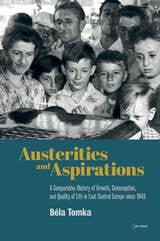
cover of Austerities and Aspirations: A Comparative History of Growth, Consumption, and Quality of Life in East Central Europe since 1945

Austerities and Aspirations

A Comparative History of Growth, Consumption, and Quality of Life in East Central Europe since 1945

Béla Tomka

Central European University Press, 2020

This monograph provides an analysis of the economic performance and living standard in Czechoslovakia and its successor states, Hungary, and Poland since 1945. The novelty of the book lies in its broad comparative perspective: it places East Central Europe in a wider European framework that underlines the themes of regional disparities and European commonalities. Going beyond the traditional growth paradigm, the author systematically studies the historical patterns of consumption, leisure, and quality of life—aspects that Tomka argues can best be considered in relation to one other. By adopting this “triple approach,” he undertakes a truly interdisciplinary research drawing from history, economics, sociology, and demography.

As a result of Tomka’s three-pillar comparative analysis, the book makes a major contribution to the debates on the dynamics of economic growth in communist and postcommunist East Central Europe, on the socialist consumer culture along with its transformation after 1990, and on how the accounts on East Central Europe can be integrated into the emerging field of historical quality of life research.

[more]
cover of Creating a Human World: A New Psychological and Religious Anthropology In Dialogue with Freud, Heidegger, and Kierkegaard

Creating a Human World

A New Psychological and Religious Anthropology In Dialogue with Freud, Heidegger, and Kierkegaard

Ernest Daniel Carrere

University of Scranton Press, 2006

In Creating a Human World, Trappist monk and scholar Ernest Daniel Carrere explores what it means to be fully human, to live in a shared world, and to resist the easy tendency to flee reality and seek pleasure in material pursuits. To do so he examines the writings of three great modern thinkers—Sigmund Freud, Martin Heidegger, and Søren Kierkegaard—and proposes a new reading of their work in light of his own understanding of New Testament teachings.

Carrere elucidates the paradoxical spiritual truth that salvation lies not in an escape from humanity, but in embracing it.  An interdisciplinary tour de force, this book will appeal to anyone interested in philosophy, psychology, religion, or cultural anthropology.
[more]
cover of Detroit Lives

Detroit Lives

Robert Mast

Temple University Press, 1994

[more]
cover of Environmentally Devastated Neighborhoods: Perceptions, Policies, and Realities

Environmentally Devastated Neighborhoods

Perceptions, Policies, and Realities

Greenberg, Michael

Rutgers University Press, 1996

Only 3% of all Americans believe they live in bad neighborhoods. But 30% to 45% of those who live in places with crime and illegal drug sales, rats and stray dogs, hazardous waste sites, factory pollution, and abandoned and blighted buildings rate their neighborhood as poor quality. Even when these neighborhoods have good schools, parks, and other amenities, their resident's ratings do not go up. This holds true no matter who is asked - young, old, men or women, middle class, working class, or on welfare. Local health and planning officials corroborate resident perceptions. It is particularly noticeable that stress from living near a toxic waste site - the hazard that gets the biggest attention in terms of dollars spent - is low on the resident's list of fears about their neighborhoods. They'd much prefer to see the money put to fixing the immediate dangers on their block. But because federal and state government policies for protecting public health, lowering crime, and saving the environment are divided into separate bureaucratic cubby-holes, effective planning to improve these stressed neighborhoods is difficult. Beginning with the call for a definition of "environment" that fits the realities of these places, the authors argue for and propose policy initiatives that address all the desperate needs of these beleaguered neighborhoods. This book is essential reading for students, academics, and professionals in environmental studies, public health, urban studies and planning, as well as grassroots community organizers.
[more]
cover of First, Do No Harm: Power, Oppression, and Violence in Healthcare

First, Do No Harm

Power, Oppression, and Violence in Healthcare

Edited by Nancy L. Diekelmann

University of Wisconsin Press, 2002

    First, Do No Harm shows how health care professionals, with the best intentions of providing excellent, holistic health care, can nonetheless perpetuate violence against vulnerable patients. The essays investigate the need to rethink contemporary healthcare practices in ways that can bring the art and science of medicine back into sorely needed balance.
    These ground-breaking studies by noted scholars question commonly held assumptions in contemporary healthcare that underlie oppressive power dynamics and even violence for patients and their families. The contributors discuss such topics as women and violence, life-support technologies, and healthcare professionals’ own experiences as patients. First, Do No Harm opens the discourse for reaching new understandings, from reassessing the meaning of "quality of life" to questioning the appropriateness of the very language used by healthcare professionals. It will be welcomed by healthcare workers and by scholars in nursing, medicine, and the allied health sciences.

[more]
cover of Health and Welfare during Industrialization

Health and Welfare during Industrialization

Edited by Richard H. Steckel and Roderick Floud

University of Chicago Press, 1997

In this unique anthology, Steckel and Floud coordinate ten essays that bring a new perspective to inquiry about standard of living in modern times. These papers are arranged for international comparison, and they individually examine evidence of health and welfare during and after industrialization in eight countries: the United States, Britain, Sweden, the Netherlands, France, Germany, Japan, and Australia.
The essays incorporate several indicators of quality of life, especially real per capita income and health, but also real wages, education, and inequality. And while the authors use traditional measures of health such as life expectancy and mortality rates, this volume stands alone in its extensive use of new "anthropometric" data—information about height, weight and body mass index that indicates changes in nations' well-being. Consequently, Health and Welfare during Industrialization signals a new direction in economic history, a broader and more thorough understanding of what constitutes standard of living.
[more]
cover of Horizontal Equity, Uncertainty, and Economic Well-being

Horizontal Equity, Uncertainty, and Economic Well-being

Edited by Martin David and Timothy Smeeding

University of Chicago Press, 1985

The result of a National Bureau of Economic Research Income and Wealth conference held in December 1983, this volume looks at the concept of "economic well-being" and the ways that analysts have tried to measure it. In addition to income, economists have begun to consider such factors as pensions, wealth, health, and environment when measuring the well-being of a particular group. They have also begun to measure how consumers respond, successfully or unsuccessfully, to such economic uncertainties as inflation, divorce, and retirement. Using new data and techniques, the contributors to this book concentrate on issues of uncertainty and horizontal equity (the equal treatment of individuals within a defined group). Their work points to better ways of determining how various groups in a society are faring relative to other groups. Economists and policy analysts, therefore, will be in a better position to determine how government programs should be applied when well-being is used as a test.
[more]
cover of Pedaling Resistance: Sympathy, Subversion, and Vegan Cycling

Pedaling Resistance

Sympathy, Subversion, and Vegan Cycling

Carol J. Adams

University of Arkansas Press, 2024

Vegans and cyclists are often outsiders, negotiating food systems and built environments that tend to prioritize omnivores and motor vehicles by default. Pedaling Resistance: Sympathy, Subversion, and Vegan Cycling examines the relationship between veganism and cycling through the journeys, experiences, and reflections of a dozen vegan cyclists from the United States and beyond.
 
The essays in this collection explore the unity between cycling for health, work, competition, transport, and joy, and the issues of animal suffering, environmentalism, and speciesism inherent in veganism—all through lenses of class, race, gender, and disability. Pedaling Resistance illuminates themes of everyday resistance and boundary crossing to uncover the greater social and political issues that underlie the decisions to give up animal products and choose cycling over driving.

 
[more]
cover of The Color Line and the Quality of Life in America

The Color Line and the Quality of Life in America

Reynolds Farley

Russell Sage Foundation, 1987
Is the United States a nation divided by the "color line," as W.E.B. Dubois declared? What is the impact of race on the lives of Americans today? In this powerful new assessment of the social reality of race, Reynolds Farley and Walter Allen compare demographic, social, and economic characteristics of blacks and whites to discover how and to what extent racial identity influences opportunities and outcomes in our society. They conclude that despite areas of considerable gain, black Americans continue to be substantially disadvantaged relative to whites. A Volume in the Russell Sage Foundation Census Series
[more]
cover of The Quality of Government: Corruption, Social Trust, and Inequality in International Perspective

The Quality of Government

Corruption, Social Trust, and Inequality in International Perspective

Bo Rothstein

University of Chicago Press, 2011
The relationship between government, virtue, and wealth has held a special fascination since Aristotle, and the importance of each frames policy debates today in both developed and developing countries. While it’s clear that low-quality government institutions have tremendous negative effects on the health and wealth of societies, the criteria for good governance remain far from clear.
 
In this pathbreaking book, leading political scientist Bo Rothstein provides a theoretical foundation for empirical analysis on the connection between the quality of government and important economic, political, and social outcomes. Focusing on the effects of government policies, he argues that unpredictable actions constitute a severe impediment to economic growth and development—and that a basic characteristic of quality government is impartiality in the exercise of power. This is borne out by cross-sectional analyses, experimental studies, and in-depth historical investigations. Timely and topical, The Quality of Government tackles such issues as political legitimacy, social capital, and corruption.
[more]
cover of The Well-Being of the Elderly in Asia: A Four-Country Comparative Study

The Well-Being of the Elderly in Asia

A Four-Country Comparative Study

Albert I. Hermalin, Editor

University of Michigan Press, 2010
In the broadest sense, The Well-Being of the Elderly in Asia is a study of social change and of anticipating future social change. It examines the effects on the current and future elderly of the rapid demographic transition that has occurred over much of Asia, accompanied in many countries by equally dramatic social and economic transformations. Policymakers in Asia have been aware of these trends and their potentially deleterious consequences for a decade or more, and have sought to fashion appropriate policies and programs that anticipate and mitigate their effects. Accordingly, any study of the sociodemographic trends and their impact must be examined in the light of policies put in place and under development.
[more]
cover of To Dwell among Friends: Personal Networks in Town and City

To Dwell among Friends

Personal Networks in Town and City

Claude S. Fischer

University of Chicago Press, 1982

[more]
cover of Urban Life in Contemporary China

Urban Life in Contemporary China

Martin King Whyte and William L. Parish

University of Chicago Press, 1984
Through interviews with city residents, Martin King Whyte and William L. Parish provide a unique survey of urban life in the last decade of Mao Zedong's rule. They conclude that changes in society produced under communism were truly revolutionary and that, in the decade under scrutiny, the Chinese avoided ostensibly universal evils of urbanism with considerable success. At the same time, however, they find that this successful effort spawned new and equally serious urban problems—bureaucratic rigidity, low production, and more.
[more]
cover of Well-Being: Foundations of Hedonic Psychology

Well-Being

Foundations of Hedonic Psychology

Daniel Kahneman

Russell Sage Foundation, 1999

The nature of well-being is one of the most enduring and elusive subjects of human inquiry. Well-Being draws upon the latest scientific research to transform our understanding of this ancient question. With contributions from leading authorities in psychology, social psychology, and neuroscience, this volume presents the definitive account of current scientific efforts to understand human pleasure and pain, contentment and despair. The distinguished contributors to this volume combine a rigorous analysis of human sensations, emotions, and moods with a broad assessment of the many factors, from heredity to nationality, that bear on our well-being. Using the tools of experimental science, the contributors confront the puzzles of human likes and dislikes. Why do we grow accustomed and desensitized to changes in our lives, both good and bad? Does our happiness reflect the circumstances of our lives or is it determined by our temperament and personality? Why do humans acquire tastes for sensations that are initially painful or unpleasant? By examining the roots of our everyday likes and dislikes, the book also sheds light on some of the more extreme examples of attraction and aversion, such as addiction and depression. Among its wide ranging inquiries, Well-Being examines systematic differences in moods and behaviors between genders, explaining why women suffer higher rates of depression and anxiety than men, but are also more inclined to express positive emotions. The book also makes international comparisons, finding that some countries' populations report higher levels of happiness than others. The contributors deploy an array of methods, from the surveys and questionnaires of social science to psychological and physiological experiments, to develop a comprehensive new approach to the study of well-being. They show how the sensory pleasures of the body can tells us something about the higher pleasures of the mind and even how the effectiveness of our immune system can depend upon the health of our social relationships.
[more]