Results by title
10 books match the query 'Quechua language'
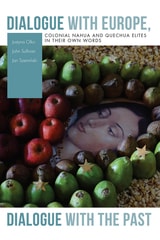
Dialogue with Europe, Dialogue with the Past
Colonial Nahua and Quechua Elites in Their Own WordsJustyna Olko
University Press of Colorado, 2018
In each chapter a particular document is transcribed exactly as it appears in the original manuscript or colonial printed document, with the editor placing it in historical context and considering the degree of European influence. These texts show the nobility through documents they themselves produced or caused to be produced—such as wills, land deeds, and petitions—and prioritize indigenous ways of expression, perspectives, and concepts. Together, the chapters demonstrate that native elites were independent actors as well as agents of social change and indigenous sustainability in colonial society. Additionally, the volume diversifies the commonly homogenous term “cacique” and recognizes the differences in elites throughout Mesoamerica and the Andes.
Showcasing important and varied colonial genres of indigenous writing, Dialogue with Europe, Dialogue with the Past reveals some of the realities, needs, strategies, behaviors, and attitudes associated with the lives of the elites. Each document and its accompanying commentary provide additional insight into how the nobility negotiated everyday life. The book will be of great interest to students and researchers of Mesoamerican and Andean history, as well as those interested in indigenous colonial societies in the Spanish Empire.
Contributors: Agnieszka Brylak, Maria Castañeda de la Paz, Katarzyna Granicka, Gregory Haimovich, Anastasia Kalyuta, Julia Madajczak, Patrycja Prządka-Giersz
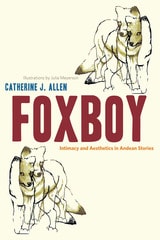
Foxboy
Intimacy and Aesthetics in Andean StoriesBy Catherine J. Allen
University of Texas Press, 2011
Once there was a Quechua folktale. It begins with a trickster fox's penis with a will of its own and ends with a daughter returning to parents who cannot recognize her until she recounts the uncanny adventures that have befallen her since she ran away from home. Following the strange twists and turnings of this tale, Catherine J. Allen weaves a narrative of Quechua storytelling and story listening that links these arts to others—fabric weaving, in particular—and thereby illuminates enduring Andean strategies for communicating deeply felt cultural values.
In this masterful work of literary nonfiction, Allen draws out the connections between two prominent markers of ethnic identity in Andean nations—indigenous language and woven cloth—and makes a convincing case that the connection between language and cloth affects virtually all aspects of expressive culture, including the performing arts. As she explores how a skilled storyteller interweaves traditional tales and stock characters into new stories, just as a skilled weaver combines traditional motifs and colors into new patterns, she demonstrates how Andean storytelling and weaving both embody the same kinds of relationships, the same ideas about how opposites should meet up with each other. By identifying these pervasive patterns, Allen opens up the Quechua cultural world that unites story tellers and listeners, as listeners hear echoes and traces of other stories, layering over each other in a kind of aural palimpsest.
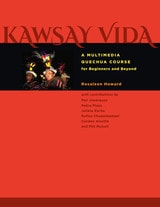
Kawsay Vida
A Multimedia Quechua Course for Beginners and BeyondBy Rosaleen Howard
University of Texas Press, 2014
Kawsay Vida is a course book and interactive multimedia program for the teaching and learning of the Quechua language from beginner to advanced levels. The course book is based on contemporary Bolivian Quechua, while the multimedia program contains a section on Bolivian Quechua (beginner to intermediate levels) and a section on southern Peruvian Quechua (advanced level). The book provides a practical introduction to spoken Quechua through the medium of English, while the multimedia program offers a choice of English or Spanish as the medium of instruction. The video clips introduce us to Quechua speakers in the valleys of Northern Potosí (Bolivia) and Cuzco (Peru), giving a sense of immediacy that the printed page cannot achieve, and highlighting the social and cultural settings in which the language is spoken. The multimedia program is available for both PC and Macintosh platforms.
The book contains twenty-two units of study. As students work through these, cross-references take them to relevant sections of the multimedia program. The Bolivian and Peruvian Quechua sections of the multimedia program are divided into thematically and grammatically ordered modules, which introduce users to different aspects of Andean life, while progressing language learning in a structured way. Users engage with the audio, video, and visual material contained in the program through a range of interactive exercises, which reinforce listening and comprehension skills. Once familiarity with the language is acquired, the multimedia program may be used independently from the book.
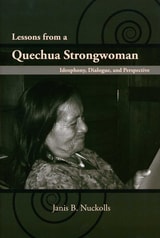
Lessons from a Quechua Strongwoman
Ideophony, Dialogue, and PerspectiveJanis B. Nuckolls
University of Arizona Press, 2010
This book is a fascinating look at ideophones—words that communicate succinctly through imitative sound qualities. They are at the core of Quechua speakers’ discourse—both linguistic and cultural—because they allow agency and reaction to substances and entities as well as beings. Nuckolls shows that Luisa Cadena’s utterances give every individual, major or minor, a voice in her narrative. Sometimes as subtle as a barely felt movement or unintelligible sound, the language supports an amazingly wide variety of voices.
Cadena’s narratives and commentaries on everyday events reveal that sound imitation through ideophones, representations of dialogues between humans and nonhumans, and grammatical distinctions between a speaking self and an other are all part of a language system that allows for the possibility of shared affects, intentions, moral values, and meaningful, communicative interactions between humans and nonhumans.
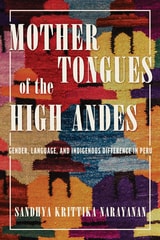
Mother Tongues of the High Andes
Gender, Language, and Indigenous Difference in PeruSandhya Krittika Narayanan
University of Arizona Press, 2025
Anthropologist Sandhya Krittika Narayanan begins with these challenges, and asks: What does it mean to be a Quechua or Aymara speaker in Puno today? What does it mean to be an Indigenous ethnic Quechua or Aymara individual?
Mother Tongues of the High Andes opens with these questions, exploring what Quechua and Aymara languages and identities mean for Indigenous puneños as they navigate their past and present. Narayanan argues that understanding inter-Indigenous linguistic and social differences involves examining Indigenous gender roles, responsibilities, and linguistic practices, particularly those of Indigenous puneña women. She shows how these practices have contributed to the maintenance of Indigenous multilingualism and continuity in local modes of understanding Indigenous identity and difference.
Even as ideologies around Indigenous identity and linguistic practices shift due to global discourses on Indigenous ethnic identity and nationalism, Indigenous women continue to play a crucial role, promoting new ways to speak and think about Quechua and Aymara linguistic differences, making the Indigenous roots and histories of Puno recognizable to a global audience. Through a comprehensive ethnographic exploration of gender, language, and Indigenous difference, Narayanan shows how the linguistic and social practices of Indigenous puneña women both contest and reaffirm competing visions of Quechua and Aymara linguistic identity and authority.
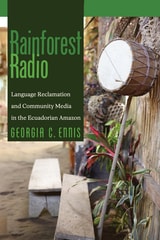
Rainforest Radio
Language Reclamation and Community Media in the Ecuadorian AmazonGeorgia C. Ennis
University of Arizona Press, 2025
Napo Kichwa communities in the Upper Ecuadorian Amazon find themselves doubly marginalized by settler colonialism and well-intentioned language revitalization projects.
In Rainforest Radio Georgia C. Ennis provides a comprehensive ethnographic exploration of Amazonian Kichwa community media, offering a unique look at how Indigenous broadcast and performance media facilitate linguistic and cultural reclamation in the Ecuadorian Amazon.
This work offers a critical analysis of how standardized language revitalization efforts, like the imposition of Unified Kichwa, can inadvertently perpetuate linguistic oppression. Ennis follows producers, performers, and consumers to understand the role of media in language reclamation. Through extensive fieldwork, she provides vivid portrayals of community efforts to sustain the language and cultural practices of their elders amid environmental and social upheaval.
Meticulously researched and beautifully written, Rainforest Radio is an essential work for anthropologists, linguists, and social scientists interested in language revitalization, Indigenous media, and environmental justice. This book showcases the transformative potential of community-driven media initiatives, highlighting the innovative responses of Napo Kichwa activists to the unique challenges they face. It serves as a powerful model for those working on similar issues worldwide, demonstrating the critical role of community media in language reclamation and cultural sustainability.
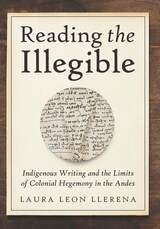
Reading the Illegible
Indigenous Writing and the Limits of Colonial Hegemony in the AndesLaura Leon Llerena
University of Arizona Press, 2023
The concept of legibility allows us to reconsider this unique manuscript within the intertwined histories of literacy, knowledge, and colonialism. Reading the Illegible shows that the anonymous author(s) of the Huarochirí Manuscript, along with two contemporaneous Andean-authored texts by Joan de Santa Cruz Pachacuti and Felipe Guaman Poma de Ayala, rewrote the history of writing and the notion of Christianity by deploying the colonizers’ technology of alphabetic writing.
Reading the Illegible weaves together the story of the peoples, places, objects, and media that surrounded the creation of the anonymous Huarochirí Manuscript to demonstrate how Andean people endowed the European technology of writing with a new social role in the context of a multimedia society.
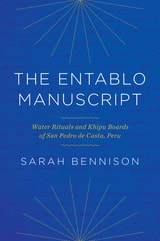
The Entablo Manuscript
Water Rituals and Khipu Boards of San Pedro de Casta, PeruSarah Bennison
University of Texas Press, 2022
A unique study of an Andean community’s water rituals and the extraordinary document describing how they should be performed
In the dry season in the Andes, water from springs, lakes, reservoirs, and melting glaciers feeds irrigation canals that have sustained communities for thousands of years. Managing and maintaining these water infrastructures is essential, and in 1921, in the village of San Pedro de Casta, Peru, local authorities recorded their ritual canal-cleaning duties in a Spanish-language document called the Entablo. It is only the second book (along with the Huarochirí Manuscript) ever seen by scholars in which an Andean community explains its customs and ritual laws in its own words.
Sarah Bennison offers a critical introduction to the Entablo, a Spanish transcription of the document, and an English translation. Among its other revelations, the Entablo delves into the use of khipu boards, devices that meld the traditional knotted strings known as khipus with a written alphabet. Only in the Entablo do we learn that there were multiple khipu boards associated with a single canal-cleaning ritual, or that there were separate khipu records for men and women. The Entablo manuscript furnishes unparalleled insights into Andean rituals, religion, and community history at a historical moment when rural highland communities were changing rapidly.
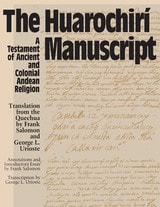
The Huarochiri Manuscript
A Testament of Ancient and Colonial Andean ReligionTranslation from the Quechua by Frank Salomon and George L. Urioste
University of Texas Press, 1991
One of the great repositories of a people's world view and religious beliefs, the Huarochirí Manuscript may bear comparison with such civilization-defining works as Gilgamesh, the Popul Vuh, and the Sagas. This translation by Frank Salomon and George L. Urioste marks the first time the Huarochirí Manuscript has been translated into English, making it available to English-speaking students of Andean culture and world mythology and religions.
The Huarochirí Manuscript holds a summation of native Andean religious tradition and an image of the superhuman and human world as imagined around A.D. 1600. The tellers were provincial Indians dwelling on the west Andean slopes near Lima, Peru, aware of the Incas but rooted in peasant, rather than imperial, culture. The manuscript is thought to have been compiled at the behest of Father Francisco de Avila, the notorious "extirpator of idolatries." Yet it expresses Andean religious ideas largely from within Andean categories of thought, making it an unparalleled source for the prehispanic and early colonial myths, ritual practices, and historic self-image of the native Andeans.
Prepared especially for the general reader, this edition of the Huarochirí Manuscript contains an introduction, index, and notes designed to help the novice understand the culture and history of the Huarochirí-area society. For the benefit of specialist readers, the Quechua text is also supplied.

The Language of the Inka since the European Invasion
By Bruce Mannheim
University of Texas Press, 1991
The Inka empire, Tawantinsuyu, fell to Spanish invaders within a year's time (1532-1533), but Quechua, the language of the Inka, is still the primary or only language of millions of Inka descendants throughout the southern Andes. In this innovative study, Bruce Mannheim synthesizes all that is currently known about the history of Southern Peruvian Quechua since the Spanish invasion, providing new insights into the nature of language change in general, into the social and historical contexts of language change, and into the cultural conditioning of linguistic change.
Mannheim first discusses changes in the social setting of language use in the Andes from the time of the first European contact in the sixteenth century until today. He reveals that the modern linguistic homogeneity of Spanish and Quechua is a product of the Spanish conquest, since multilingualism was the rule in the Inka empire. He identifies the social and political forces that have influenced the kinds of changes the language has undergone. And he provides the first synthetic history of Southern Peruvian Quechua, making it possible at last to place any literary document or written text in a chronological and social context.
Mannheim also studies changes in the formal structure of Quechua. He finds that changes in the sound system were motivated primarily by phonological factors and also that the changes were constrained by a set of morphological and syntactic conditions. This last conclusion is surprising, since most historical linguists assume that sound change is completely independent of other aspects of language. Thus, The Language of the Inka since the European Invasion makes an empirical contribution to a general theory of linguistic change.
Written in an engaging style that is accessible to the nonlinguist, this book will have a special appeal to readers interested in the history and anthropology of native South America.