Results by title
4 books match the query 'Queer Cinema'

Queer Cinema in Europe
Edited by Robin Griffiths
Intellect Books, 2008
Queer cinema has gained scholarly attention in recent years as a manifestation of the conflicts, anxieties, and liberation of European sexuality. Robin Griffiths’ Queer Cinema in Europe, the first anthology of its kind, probes the questions and implications of sex, gender, and identity in contemporary European filmmaking. An esteemed group of contributors discuss the varieties of lesbian and gay representation to deconstruct and redefine notions of national identity and culture in a diverse European context. This volume explores a wide scope of films, directors, and genres to forge a new understanding of what it means to be queer in the twenty-first century.
[more]
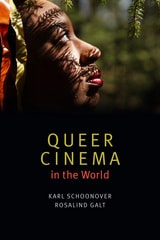
Queer Cinema in the World
Karl Schoonover and Rosalind Galt
Duke University Press, 2016
Proposing a radical vision of cinema's queer globalism, Karl Schoonover and Rosalind Galt explore how queer filmmaking intersects with international sexual cultures, geopolitics, and aesthetics to disrupt dominant modes of world making. Whether in its exploration of queer cinematic temporality, the paradox of the queer popular, or the deviant ecologies of the queer pastoral, Schoonover and Galt reimagine the scope of queer film studies. The authors move beyond the gay art cinema canon to consider a broad range of films from Chinese lesbian drama and Swedish genderqueer documentary to Bangladeshi melodrama and Bolivian activist video. Schoonover and Galt make a case for the centrality of queerness in cinema and trace how queer cinema circulates around the globe–institutionally via film festivals, online consumption, and human rights campaigns, but also affectively in the production of a queer sensorium. In this account, cinema creates a uniquely potent mode of queer worldliness, one that disrupts normative ways of being in the world and forges revised modes of belonging.
[more]
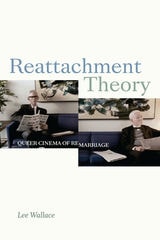
Reattachment Theory
Queer Cinema of RemarriageLee Wallace
Duke University Press, 2020
In Reattachment Theory Lee Wallace argues that homosexuality—far from being the threat to “traditional” marriage that same-sex marriage opponents have asserted—is so integral to its reimagining that all marriage is gay marriage. Drawing on the history of marriage, Stanley Cavell's analysis of Hollywood comedies of remarriage, and readings of recent gay and lesbian films, Wallace shows that queer experiments in domesticity have reshaped the affective and erotic horizons of heterosexual marriage and its defining principles: fidelity, exclusivity, and endurance. Wallace analyzes a series of films—Dorothy Arzner's Craig's Wife (1936); Tom Ford's A Single Man (2009); Lisa Cholodenko's High Art (1998), Laurel Canyon (2002), and The Kids Are All Right (2010); and Andrew Haigh's Weekend (2011) and 45 Years (2015)—that, she contends, do not simply reflect social and legal changes; they fundamentally alter our sense of what sexual attachment involves as both a social and a romantic form.
[more]
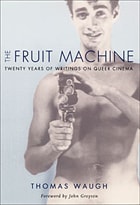
The Fruit Machine
Twenty Years of Writings on Queer CinemaThomas Waugh
Duke University Press, 2000
For more than twenty years, film critic, teacher, activist, and fan Thomas Waugh has been writing about queer movies. As a member of the Jump Cut collective and contributor to the Toronto-based gay newspaper the Body Politic, he emerged in the late 1970s as a pioneer in gay film theory and criticism, and over the next two decades solidified his reputation as one of the most important and influential gay film critics. The Fruit Machine—a collection of Waugh’s reviews and articles originally published in gay community tabloids, academic journals, and anthologies—charts the emergence and maturation of Waugh’s critical sensibilities while lending an important historical perspective to the growth of film theory and criticism as well as queer moviemaking.
In this wide-ranging anthology Waugh touches on some of the great films of the gay canon, from Taxi zum Klo to Kiss of the Spider Woman. He also discusses obscure guilty pleasures like Born a Man . . . Let Me Die a Woman, unexpectedly rich movies like Porky’s and Caligula, filmmakers such as Fassbinder and Eisenstein, and film personalities from Montgomery Clift to Patty Duke. Emerging from the gay liberation movement of the 1970s, Waugh traverses crises from censorship to AIDS, tackling mainstream potboilers along with art movies, documentaries, and avant-garde erotic videos. In these personal perspectives on the evolving cinematic landscape, his words oscillate from anger and passion to wry wit and irony. With fifty-nine rare film stills and personal photographs and an introduction by celebrated gay filmmaker John Greyson, this volume demonstrates that the movie camera has been the fruit machine par excellence.
In this wide-ranging anthology Waugh touches on some of the great films of the gay canon, from Taxi zum Klo to Kiss of the Spider Woman. He also discusses obscure guilty pleasures like Born a Man . . . Let Me Die a Woman, unexpectedly rich movies like Porky’s and Caligula, filmmakers such as Fassbinder and Eisenstein, and film personalities from Montgomery Clift to Patty Duke. Emerging from the gay liberation movement of the 1970s, Waugh traverses crises from censorship to AIDS, tackling mainstream potboilers along with art movies, documentaries, and avant-garde erotic videos. In these personal perspectives on the evolving cinematic landscape, his words oscillate from anger and passion to wry wit and irony. With fifty-nine rare film stills and personal photographs and an introduction by celebrated gay filmmaker John Greyson, this volume demonstrates that the movie camera has been the fruit machine par excellence.
[more]