Results by title
6 books match the query 'Quiché language'
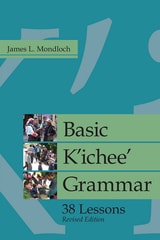
Basic K'ichee' Grammar
38 Lessons, Revised EditionJames L. Mondloch
University Press of Colorado, 2016
A pedagogical rather than a reference grammar, the book is a thorough presentation of the basics of the K’ichee’ Maya language organized around graded grammatical lessons accompanied by drills and exercises. Author James L. Mondloch spent ten years in K’ichee’-speaking communities and provides a complete analysis of the K’ichee’ verb system based on the everyday speech of the people and using a wealth of examples and detailed commentaries on actual usage.
A guide for learning the K’ichee’ language, Basic K'ichee' Grammar is a valuable resource for anyone seeking a speaking and reading knowledge of modern K’ichee’, including linguists, anthropologists, and art historians, as well as nonacademics working in K’ichee’ communities, such as physicians, dentists, community development workers, and educators.
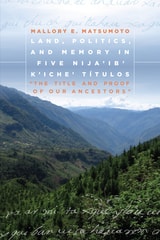
Land, Politics, and Memory in Five Nija'ib' K'iche' Títulos
"The Title and Proof of Our Ancestors"Mallory Matsumoto
University Press of Colorado, 2017
Land, Politics, and Memory in Five Nija’ib’ K’iche’ Títulos is a careful analysis and translation of five Highland Maya títulos composed in the sixteenth century by the Nija’ib’ K’iche’ of Guatemala. The Spanish conquest of Highland Guatemala entailed a series of sweeping changes to indigenous society, not the least of which were the introduction of the Roman alphabet and the imposition of a European system of colonial government. Introducing the history of these documents and placing them within the context of colonial-era Guatemala, this volume provides valuable information concerning colonial period orthographic practice, the K’iche’ language, and language contact in Highland Guatemala.
For each text, author Mallory E. Matsumoto provides a photographic copy of the original document, a transliteration of its sixteenth-century modified Latin script, a transcription into modern orthography, an extensive morphologic analysis, and a line-by-line translation into English, as well as separate prose versions of the transcription and translation. No complete English translation of this set of manuscripts has been available before, nor has any Highland Maya título previously received such extensive analytical treatment.
Offering insight into the reality of indigenous Highland communities during this period, Land, Politics, and Memory in Five Nija’ib’ K’iche’ Títulos is an important primary source for linguists, historians, and experts in comparative literature. It will also be of significant interest to students and scholars of ethnohistory, linguistics, Latin American studies, anthropology, and archaeology.
Language and Ethnicity among the K'ichee' Maya
Sergio Romero
University of Utah Press, 2015
This book explores the articulation between “accent” and ethnic identification in K’ichee’, a Mayan language spoken by more than one million people in the western highlands of Guatemala. Based on years of ethnographic work, it is the first anthropological examination of the social meaning of dialectal difference in any Mayan language. Romero deconstructs essentialist perspectives on ethnicity in Mesoamerica and argues that ethnic identification among the highland Maya is multiple and layered, the result of a diverse linguistic precipitate created by centuries of colonial resistance.
In K’ichee’, dialect stereotypes—accents—act as linguistic markers embodying particular ethnic registers. K’ichee’ speakers use and recombine their linguistic repertoire—colloquial K’ichee’, traditional K’ichee’ discourse, colloquial Spanish, Standard Spanish, and language mixing—in strategic ways to mark status and authority and to revitalize their traditional culture. The book surveys literary genres such as lyric poetry, political graffiti, and radio broadcasts, which express new experiences of Mayan-ness and anticolonial resistance. It also takes a historical perspective in examining oral and written K’ichee’ discourses from the sixteenth to the twenty-first centuries, including the famous chronicle known as the Popol Vuh, and explores the unbreakable link between language, history, and culture in the Maya highlands.
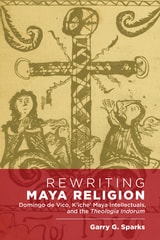
Rewriting Maya Religion
Domingo de Vico, K’iche’ Maya Intellectuals, and the Theologia IndorumGarry G. Sparks
University Press of Colorado, 2019
Centered on the specific work of Dominicans among the Highland Maya of Guatemala in the decades prior to the arrival of the Catholic Reformation in the late sixteenth century, the book focuses on the various understandings of religious analyses—Hispano-Catholic and Maya—and their strategic exchanges, reconfigurations, and resistance through competing efforts of religious translation. Sparks historically contextualizes Vico’s theological treatise within both the wider set of early literature in K’iche’an languages and the intellectual shifts between late medieval thought and early modernity, especially the competing theories of language, ethnography, and semiotics in the humanism of Spain and Mesoamerica at the time.
Thorough and original, Rewriting Maya Religion serves as an ethnohistorical frame for continued studies on Highland Maya religious symbols, discourse, practices, and logic dating back to the earliest documented evidence. It will be of great significance to scholars of religion, ethnohistory, linguistics, anthropology, and Latin American history.
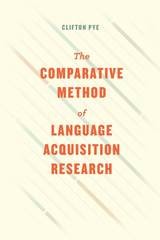
The Comparative Method of Language Acquisition Research
Clifton Pye
University of Chicago Press, 2017
Pye here applies the comparative method to three Mayan languages—K’iche’, Mam, and Ch’ol—showing how differences in the use of verbs are connected to differences in the subject markers and pronouns used by children and adults. His holistic approach allows him to observe how small differences between the languages lead to significant differences in the structure of the children’s lexicon and grammar, and to learn why that is so. More than this, he expects that such careful scrutiny of related languages’ variable solutions to specific problems will yield new insights into how children acquire complex grammars. Studying such an array of related languages, he argues, is a necessary condition for understanding how any particular language is used; studying languages in isolation, comparing them only to one’s native tongue, is merely collecting linguistic curiosities.
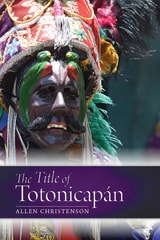
Title of Totonicapán
transcription, translation, and commentary by Allen J. Christenson
University Press of Colorado, 2022
The Title of Totonicapán is a land title written by surviving members of the K’iche’ Maya nobility, a branch of the Maya that dominated the highlands of western Guatemala prior to the Spanish invasion in 1524, and it was duly signed by the ruling lords of all three major K’iche’ lineages—the Kaweqib’, the Nijayib’, and the Ajaw K’iche’s. Titles of this kind were relatively common for Maya communities in the Guatemalan highlands in the first century after the Spanish Conquest as a means of asserting land rights and privileges for its leaders. Like the Popol Vuh, the Title of Totonicapán is written in the elevated court language of the early Colonial period and eloquently describes the mythic origins and history of the K’iche’ people. For the most part, the Title of Totonicapán agrees with the Popol Vuh’s version of K’iche’ history and cosmology, providing a complementary account that attests traditions that must have been widely known and understood. But in many instances the Totonicapán document is richer in detail and departs from the Popol Vuh’s more cursory description of history, genealogy, and political organization. In other instances, it contradicts assertions made by the authors of the Popol Vuh, perhaps a reflection of internal dissent and jealousy between rival lineages within the K’iche’ hierarchy. It also contains significant passages of cosmology and history that do not appear in any other highland Maya text.
This volume makes a comprehensive and updated edition of the Title of Totonicapán accessible to scholars and students in history, anthropology, archaeology, and religious studies in Latin America, as well as those interested in Indigenous literature and Native American/Indigenous studies more broadly. It is also a stand-alone work of Indigenous literature that provides additional K’iche’ perspectives, enhancing the reading of other colonial Maya sources.