Results by title
3 books match the query 'Quiet'
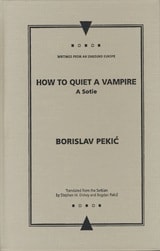
How to Quiet a Vampire
A SotieBorislav Pekic
Northwestern University Press, 2005
The disquieting novel How to Quiet a Vampire is a rumination on terror and intellect in the tradition of Joseph Heller and George Steiner. Published to acclaim in 1977, Pekic's novel of ideas follows Konrad Rutkowski, professor of medieval history and former Gestapo officer, as he returns to the scene of his war crimes determined to renounce, or perhaps justify, his Nazi past. In a series of letters, Rutkowski lays out his ambivalent reactions to war and violence, connecting his own swirling ideas to those of the major figures of European thought: Plato, St. Augustine, Descartes, Nietzsche, Freud, and others.
Delving far deeper than mere intellect, however, Borislav Pekic was himself a frequent political agitator and occasional prisoner, and he drew on his first hand knowledge of police methods and life under totalitarianism to paint a chilling portrait of a supposedly free-thinking intellectual acting in the service of repression. At the same time he questions whether Rutkowski's ideology puts him outside the philosophical tradition he so admires—or if the line separating European thought from totalitarianism is not as clear as we like to think.
Delving far deeper than mere intellect, however, Borislav Pekic was himself a frequent political agitator and occasional prisoner, and he drew on his first hand knowledge of police methods and life under totalitarianism to paint a chilling portrait of a supposedly free-thinking intellectual acting in the service of repression. At the same time he questions whether Rutkowski's ideology puts him outside the philosophical tradition he so admires—or if the line separating European thought from totalitarianism is not as clear as we like to think.
[more]
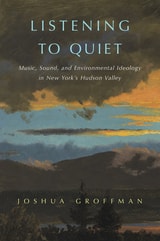
Listening to Quiet
Music, Sound, and Environmental Ideology in New York’s Hudson ValleyJoshua Groffman
University of Illinois Press, 2027
The Hudson River Valley has long attracted people with its peaceful atmosphere and natural beauty. Joshua Groffman focuses on music and sound to examine the Valley as an idea built over time through stories, music, traditions, and everyday listening.
Groffman’s investigation reveals that the relationships created by sounds form distinct acoustic communities. Listening closely—whether to gravel roads, gunshots, or the protest music of Pete Seeger—offers insight into competing views of who belongs, whose voices are heard, and the environmental impact of human action. Shifting acoustic communities reflect larger debates about race, class, and politics, inviting people to listen across their differences to build stronger connections and develop new ways of caring for both human and nonhuman communities.
An innovative inquiry into what people hear and don’t hear, Listening to Quiet considers how human and nonhuman voices can help us imagine more just and sustainable relationships with each other and the natural world.
[more]
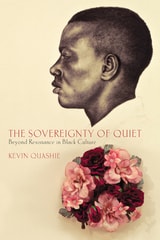
The Sovereignty of Quiet
Beyond Resistance in Black CultureQuashie, Kevin
Rutgers University Press, 2012
African American culture is often considered expressive, dramatic, and even defiant. In The Sovereignty of Quiet, Kevin Quashie explores quiet as a different kind of expressiveness, one which characterizes a person’s desires, ambitions, hungers, vulnerabilities, and fears. Quiet is a metaphor for the inner life, and as such, enables a more nuanced understanding of black culture.
The book revisits such iconic moments as Tommie Smith and John Carlos’s protest at the 1968 Mexico City Olympics and Elizabeth Alexander’s reading at the 2009 inauguration of Barack Obama. Quashie also examines such landmark texts as Gwendolyn Brooks’s Maud Martha, James Baldwin’s The Fire Next Time, and Toni Morrison’s Sula to move beyond the emphasis on resistance, and to suggest that concepts like surrender, dreaming, and waiting can remind us of the wealth of black humanity.
[more]