Results by title
5 books match the query 'Quilter, Jeffrey'
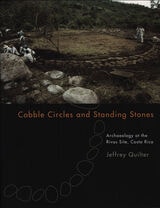
Cobble Circles and Standing Stones
Archaeology at the Rivas Site, Costa RicaJeffrey Quilter
University of Iowa Press, 2004
Writing in the first person with a balance between informal language and academic theory, Quilter concludes that Rivas was a ceremonial center for mortuary rituals to bury chiefly elite on the Panteón. Through use of his narrative technique, he provides the reader with accounts of discoveries as they occurred in fieldwork and the development of interpretations to explain the ancient refuse and cobble architecture his team uncovered. As his story progresses amid the enchantment of the Costa Rican landscape, research plans are adjusted and sometimes completely overturned as new discoveries, often serendipitous ones, are made. Such changing circumstances lead to new insights into the rise and fall of the people who built the cobble circles and raised the standing stones at Rivas, a thousand years ago.
The only book in English that focuses on a single archaeological site in Costa Rica, which continues to develop as a destination for archaeological tourism, Cobble Stones and Standing Circles will appeal to laypeople and professionals alike.
Enduring Motives
The Archaeology of Tradition and Religion in Native AmericaLinea Sundstrom
University of Alabama Press, 2012
Wesley Bernardini / James S. Brown Jr. / Cheryl Claassen / John E. Clark / ArleneColman / Warren DeBoer /
Life And Death At Paloma
Practices In Peruvian VillageJeffrey Quilter
University of Iowa Press, 1989
Narrative Threads
Accounting and Recounting in Andean KhipuEdited by Jeffrey Quilter and Gary Urton
University of Texas Press, 2002
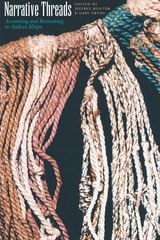
The Inka Empire stretched over much of the length and breadth of the South American Andes, encompassed elaborately planned cities linked by a complex network of roads and messengers, and created astonishing works of architecture and artistry and a compelling mythology—all without the aid of a graphic writing system. Instead, the Inkas' records consisted of devices made of knotted and dyed strings—called khipu—on which they recorded information pertaining to the organization and history of their empire. Despite more than a century of research on these remarkable devices, the khipu remain largely undeciphered.
In this benchmark book, twelve international scholars tackle the most vexed question in khipu studies: how did the Inkas record and transmit narrative records by means of knotted strings? The authors approach the problem from a variety of angles. Several essays mine Spanish colonial sources for details about the kinds of narrative encoded in the khipu. Others look at the uses to which khipu were put before and after the Conquest, as well as their current use in some contemporary Andean communities. Still others analyze the formal characteristics of khipu and seek to explain how they encode various kinds of numerical and narrative data.
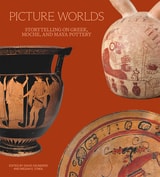
Picture Worlds
Storytelling on Greek, Moche, and Maya PotteryDavid Saunders
J. Paul Getty Trust, The, 2024
Satyrs and sphinxes, violent legumes, and a dancing maize deity figure in the stories painted on the pottery produced by the ancient Greek, Moche, and Maya cultures, respectively. Picture Worlds is the first book to examine the elaborately decorated terracotta vessels of these three distinct civilizations. Although the cultures were separated by space and time, they all employed pottery as a way to tell stories, explain the world, and illustrate core myths and beliefs. Each of these painted pots is a picture world. But why did these communities reach for pottery as a primary method of visual communication? How were the vessels produced and used? In this book, experts offer introductions to the civilizations, exploring these foundational questions and examining the painted imagery. Readers will be rewarded with a better understanding of each of these ancient societies, fascinating insights into their cultural commonalities and differences, and fresh perspectives on image making and storytelling, practices that remain vibrant to this day.
This volume is published to accompany an exhibition on view at the J. Paul Getty Museum at the Getty Villa from April 10 to July 29, 2024, and at the Michael C. Carlos Museum at Emory University from September 14 to December 15, 2024.