Results by title
9 books match the query 'Quilts'
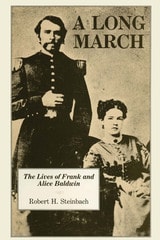
A Long March
The Lives of Frank and Alice BaldwinBy Robert H. Steinbach
University of Texas Press, 1990
During a distinguished military career, in which he rose to the rank of brigadier general and twice won the Medal of Honor, Frank Baldwin saw service in the Civil War, the Indian wars on the Great Plains, and the Spanish-American War. His wife, Alice Blackwood Baldwin, shared the "long march" with him, from his Plains service onward. In this first biography of the Baldwins, Robert Steinbach combines military and personal history to vividly portray a marriage that survived both the harshness of frontier army life and the restrictive Victorian concept of "separate spheres" for husband and wife.
Drawing on a wealth of diaries, letters, and other family papers, Steinbach re-creates the Baldwins' life on the Plains. Moving from post to post in Kansas, New Mexico, Montana, North Dakota, and Texas, they faced danger, excitement, separations, poverty, and many other hardships. Frequently they clashed over Alice's desire to be something more than "an ornament to society"—a wish eventually granted as Frank's long absences and chronic ill health required Allie to take responsibility for herself and their daughter.
With insights into military campaigns on the Great Plains in the years 1865–1890 and a revealing look at the human side of those campaigns, A Long March will appeal to a wide audience.
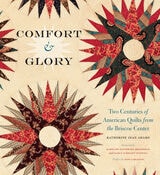
Comfort and Glory
Two Centuries of American Quilts from the Briscoe CenterBy Katherine Jean Adams
University of Texas Press, 2016
Quilts bear witness to the American experience. With a history that spans the early republic to the present day, this form of textile art can illuminate many areas of American life, such as immigration and settlement, the development of our nation’s textile industry, and the growth of mass media and marketing. In short, each quilt tells a story that is integral to America’s history.
Comfort and Glory introduces an outstanding collection of American quilts and quilt history documentation, the Winedale Quilt Collection at the Briscoe Center for American History at the University of Texas at Austin. This volume showcases 115 quilts—nearly one-quarter of the Winedale Collection—through stunning color photographs (including details) and essays about each quilt’s history and construction. The selections span more than two hundred years of American quiltmaking and represent a broad range of traditional styles and functions. Utility quilts, some worn or faded, join show quilts, needlework masterpieces, and “best” quilts saved for special occasions. Texas quilts, including those made in or brought to Texas during the nineteenth century, constitute a significant number of the selections. Color photographs of related documents and material culture objects from the Briscoe Center’s collections—quilting templates, a painted bride’s box, sheet music, a homespun dress, a brass sewing bird, and political ephemera, among them—enrich the stories of many of the quilts.

Everyday Use
Alice WalkerChristian, Barbara T
Rutgers University Press, 1994
This casebook includes an introduction by the editor, a chronology of Walker's life, an authoritative text of "Everyday Use" and of "In Search of Our Mothers' Gardens," an interview with Walker, six critical essays, and a bibliography. The contributors are Charlotte Pierce-Baker, Houston A. Baker, Jr., Thadious M. Davis, Margot Anne Kelley, John O'Brien, Elaine Showalter, and Mary Helen Washington.
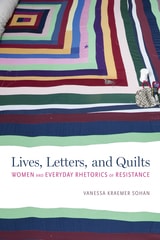
Lives, Letters, and Quilts
Women and Everyday Rhetorics of ResistanceVanessa Kraemer Sohan
University of Alabama Press, 2020
In Lives, Letters, and Quilts: Women and Everyday Rhetorics of Resistance, Vanessa Kraemer Sohan applies a translingual and transmodal framework informed by feminist rhetorical practice to three distinct case studies that demonstrate women using unique and effective rhetorical strategies in political, religious, and artistic contexts. These case studies highlight a diverse set of actors uniquely situated by their race, gender, class, or religion, but who are nevertheless connected by their capacity to envision and recontextualize the seemingly ordinary means and materials available to them in order to effectively persuade others.
The Great Depression provides the backdrop for the first case study, a movement whereby thousands of elderly citizens proselytized and fundraised for a monthly pension plan dreamt up by a California doctor in the hopes of lifting themselves out of poverty. Sohan investigates how the Townsend Plan’s elderly supporters—the Townsendites—worked within and across language, genre, mode, and media to enable them for the first time to be recognized by others, and themselves, as a viable political constituency.
Next, Sohan recounts the story of Quaker minister Eliza P. Kirkbride Gurney who met President Abraham Lincoln in 1862. Their subsequent epistolary exchanges concerning conscientious objectors made such an impression on him that one of her letters was rumored to be in his pocket the night of his assassination. Their exchanges and Gurney’s own accounts of her transnational ministry in her memoir provide useful examples of how, throughout history, women rhetors have adopted and transformed typically underappreciated forms of rhetoric—such as the epideictic—for their particular purposes.
The final example focuses on the Gee’s Bend quiltmakers—a group of African American women living in rural Alabama who repurpose discarded work clothes and other cast-off fabrics into the extraordinary quilts for which they are known. By drawing on the means and materials at hand to create celebrated works of art in conditions of extreme poverty, these women show how marginalized artisans can operate both within and outside the bounds of established aesthetic traditions and communicate the particulars of their experience across cultural and economic divides.
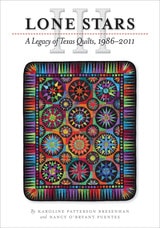
Lone Stars III
A Legacy of Texas Quilts, 1986-2011By Karoline Patterson Bresenhan and Nancy O'Bryant Puentes
University of Texas Press, 2011
From frontier times in the Republic of Texas until today, Texans have been making gorgeous quilts. Karoline Patterson Bresenhan and Nancy O'Bryant Puentes documented the first 150 years of the state's rich heritage of quilt art in Lone Stars: A Legacy of Texas Quilts, 1836–1936 and Lone Stars II: A Legacy of Texas Quilts, 1936–1986. Now in Lone Stars III, they bring the Texas quilt story into the twenty-first century, presenting two hundred traditional and art quilts that represent "the best of the best" quilts created since 1986.
The quilts in Lone Stars III display the explosion of creativity that has transformed quilting over the last quarter century. Some of the quilts tell stories, create landscapes, record events, and memorialize people. Others present abstract designs that celebrate form and color. Their makers have embraced machine quilting, as well as hand sewing, and they often embellish their quilts with buttons, beads, lace, ribbon, and even more exotic items. Each quilt is pictured in its entirely, and some entries also include photographs of quilt details. The accompanying text describes the quilt's creation, its maker, and its physical details.
With 16.3 million American quilters who spend $3.6 billion annually on their pastime, the quilting community has truly become a force to reckon with both artistically and socially. Lone Stars III is the perfect introduction to this world of creativity.

Patchwork
Iowa Quilts and QuiltersJacqueline Andre Schmeal
University of Iowa Press, 2003
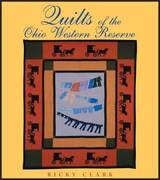
Quilts of the Ohio Western Reserve
Ricky Clark
Ohio University Press, 2005
Quilts of the Ohio Western Reserve includes early quilts brought from Connecticut to the Western Reserve in northeastern Ohio and contemporary quilts, including one by a conservative Amish woman and another inspired by Cleveland’s Rock and Roll Hall of Fame.
Ricky Clark, one of Ohio’s foremost quilt historians, has assembled exquisite examples of calamanco, “T” quilts, and borderless pieced quilts to show the influence of Connecticut aesthetics and history on the making of early quilts in this region. Rich in color, detail, and inventiveness, and often beautifully designed, the quilts of this region commemorate community history, from town fundraisers of the 1890s to a quilt designed by a Lake Erie shipbuilder. Sections of the book include quilts made during the Civil War and for postwar veterans’ organizations as well as military and presidential quilts that relate to the history of the Western Reserve.
Quilt design in Ohio has been celebrated in biennial exhibits, round-robin quilts, and most recently proudly painted on barns in rural Ohio. Quilts of the Ohio Western Reserve, lavishly illustrated with forty color photos of quilts, launches the Ohio Quilt Series. A welcome addition to Ohio’s cultural legacy, this book will interest the wider world of quilt and textile enthusiasts and historians.
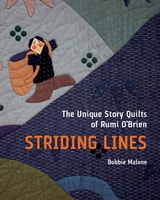
Striding Lines
The Unique Story Quilts of Rumi O'BrienBobbie Malone
University of Wisconsin Press, 2019
Bobbie Malone reaches beyond the quilts to tell O'Brien's own story, from her initial foray into the quilting world to her developed dedication to the craft. Contributions from leaders in the art, textile and quilting community, including Melanie Herzog and Marin Hanson, contextualize O'Brien's work in the greater community of quiltmakers and artists. This book celebrates the life and ingenuity of a Japanese-born American immigrant whose oeuvre is equally Japanese and Wisconsinite—and entirely distinctive.
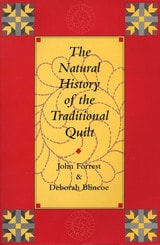
The Natural History of the Traditional Quilt
By John Forrest and Deborah Blincoe
University of Texas Press, 1995
Traditional quilts serve many purposes over the course of a useful life. Beginning as a beautiful bed covering, a quilt may later function as a ground cover at picnics until years of wear relegate it to someone's ragbag for scrap uses.
Observing this life cycle led authors John Forrest and Deborah Blincoe to the idea that quilts, like living things, have a natural history that can be studied scientifically. They explore that natural history through an examination of the taxonomy, morphology, behavior, and ecology of quilts in their native environment—the homes of humans who make, use, keep, and bestow them.
The taxonomy proposed by Forrest and Blincoe is rooted in the mechanics of replicating quilts so that it can be used to understand evolutionary and genetic relationships between quilt types. The morphology section anatomizes normal and abnormal physical features of quilts, while the section on conception and birth in the life cycle discusses how the underlying processes of replication intersect with environmental factors to produce tangible objects.
This methodology is applicable to many kinds of crafts and will be of wide interest to students of folklore, anthropology, and art history. Case studies of traditional quilts and their makers in the Catskills and Appalachia add a warm, human dimension to the book.