Results by title
3 books match the query 'Quine'

A Nice Derangement of Epistemes
Post-positivism in the Study of Science from Quine to LatourJohn H. Zammito
University of Chicago Press, 2004
Zammito shows how problems that Quine and Kuhn saw in the philosophy of the natural sciences inspired a turn to the philosophy of language for resolution. This linguistic turn led to claims that science needs to be situated in both historical and social contexts, but the claims of recent "science studies" only deepened the philosophical quandary. In essence, Zammito argues that none of the problems with positivism provides the slightest justification for denigrating empirical inquiry and scientific practice, delivering quite a blow to the "discipline" postmodern science studies.
Filling a gap in scholarship to date, A Nice Derangement of Epistemes will appeal to historians, philosophers, philosophers of science, and the broader scientific community.
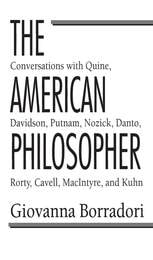
The American Philosopher
Conversations with Quine, Davidson, Putnam, Nozick, Danto, Rorty, Cavell, MacIntyre, KuhnGiovanna Borradori
University of Chicago Press, 1993
Giovanna Borradori, in her substantial introduction, explains the history of the analytic movement in America and the home-grown reaction against it. In the late nineteenth and early twentieth centuries, American philosophy was a socially engaged interdisciplinary enterprise. In transcendentalism and pragmatism, then the dominant currents in American thought, philosophy was connected to history, psychology, and public issues. But in the 1930s, the imported European movement of logical positivism redefined philosophical discourse in terms of mathematical logic and theory of language. Under the influence of this analytic view, American philosophy became a professionalized discipline, divorced from public debate and intellectual history and antagonistic to the other, more humanistic tradition of continental thought.
The American Philosopher explores the opposition between analytic and continental thought and shows how recent American work has begun to bridge the gap between the two traditions. Through a reexamination of pragmatism, and through an attempt to understand philosophy in a more hermeneutical way, the participants narrow the distance between America's distinctly scientific philosophy and Europe's more literary approach.
Moving beyond classical analytic philosophy, the participants confront each other on a number of topics. The logico-linguistic orientations of Quine and Davidson come up against the more discursive, interdisciplinary agendas of Rorty, Putnam, and Cavell. Nozick's theory of pluralist anarchism goes face-to-face with the aesthetic neo-foundationalism of Danto. And Kuhn's hypothesis of paradigm shifts is measured against MacIntyre's ethics of "virtues."
Borradori's conversations offer an unconventional portrait of the way philosophers think about their work; scholars and students will not be its only beneficiaries, so will everyone who wonders about the current state of American philosophy.
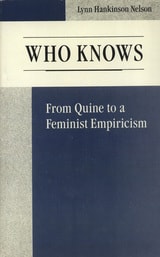
Who Knows
From Quine to a Feminist EmpiricismLynn Hankinson Nelson
Temple University Press, 1992
In the past fifteen years, feminist science critics have, for the most part, rejected empiricism because of its identification with positivism. Various assumptions of both empiricists and feminists, including the "tenet" that individualism is an essential element of empiricism, have led to the belief that feminist science criticism is not a part of science. This view continues the myth that science is an autonomous and apolitical activity. Building on the work of W.V.0. Quine, Lynn Nelson clears away these obstacles and establishes a framework for a much-needed dialogue between feminist science critics and other scientists and scholars about the nature of science. She makes a case for a feminist empiricism that retains a crucial role for experience, but separates empiricism from individualism.
Following Quine, Nelson argues that empiricism is a theory of evidence and is distinct from empiricist accounts of science that have been built on it. She urges feminists and empiricists to work together to develop a feminist empiricism, a view of science that can account for its obvious success in explaining and predicting experience and can encompass feminist insights into relationships among gender, politics, and science.
Basing her arguments on Quine’s non-foundationalist view that theories are bridges of our own construction, the author insists, as does Quine, that the construction of these bridges is constrained by experience. She determines that individualism is inconsistent with key Quinean positions and that empiricism can survive the demise of individualism. Clearly diverging from Quine, Nelson proposes the view that the evolving network of our theories does and should incorporate political views, including those shaped by, and shaping in turn, our experiences of gender.