Results by title
6 books match the query 'Qur'an'
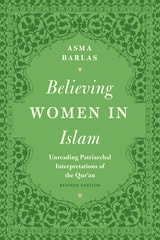
Believing Women in Islam
Unreading Patriarchal Interpretations of the Qur'anBy Asma Barlas
University of Texas Press, 2019
Does Islam call for the oppression of women? Non-Muslims point to the subjugation of women that occurs in many Muslim countries, especially those that claim to be "Islamic," while many Muslims read the Qur’an in ways that seem to justify sexual oppression, inequality, and patriarchy. Taking a wholly different view, Asma Barlas develops a believer’s reading of the Qur’an that demonstrates the radically egalitarian and antipatriarchal nature of its teachings.
Beginning with a historical analysis of religious authority and knowledge, Barlas shows how Muslims came to read inequality and patriarchy into the Qur’an to justify existing religious and social structures and demonstrates that the patriarchal meanings ascribed to the Qur’an are a function of who has read it, how, and in what contexts. She goes on to reread the Qur’an’s position on a variety of issues in order to argue that its teachings do not support patriarchy. To the contrary, Barlas convincingly asserts that the Qur’an affirms the complete equality of the sexes, thereby offering an opportunity to theorize radical sexual equality from within the framework of its teachings. This new view takes readers into the heart of Islamic teachings on women, gender, and patriarchy, allowing them to understand Islam through its most sacred scripture, rather than through Muslim cultural practices or Western media stereotypes.
For this revised edition of Believing Women in Islam, Asma Barlas has written two new chapters—“Abraham’s Sacrifice in the Qur’an” and “Secular/Feminism and the Qur’an”—as well as a new preface, an extended discussion of the Qur’an’s “wife-beating” verse and of men’s presumed role as women’s guardians, and other updates throughout the book.
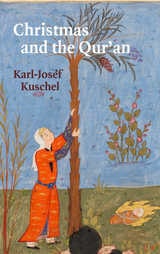
Christmas and the Qur'an
Karl-Josef Kuschel
Gingko, 2017
Christmas and the Qur’an is a sensitive and precise analysis of the Christmas story as it appears in the Gospels and the Qur’an. Karl-Josef Kuschel presents both scriptures in a convincing comparative exegesis and reveals startling similarities as well as significant differences. Kuschel explores how Christians and Muslims read these texts and reveals an intertwining legacy that serves as a base for greater understanding. Without leaving the realm of theology, Kuschel approaches his analysis in a theocentric way by emphasizing the shared belief that God is almighty, which, he argues, can act as a healing suture between Christianity and Islam. Christmas and the Qur’an gives the reader the chance to remember the message of hope that the birth of Jesus brings and invites to a dialogue between Muslims and Christians.
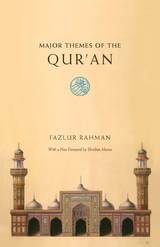
Major Themes of the Qur'an
Second EditionFazlur Rahman
University of Chicago Press, 2009
Major Themes of the Qur’an is Fazlur Rahman’s introduction to one of the richest texts in the history of religious thought. In this classic work, Rahman unravels the Qur’an’s complexities on themes such as God, society, revelation, and prophecy with the deep attachment of a Muslim educated in Islamic schools and the clarity of a scholar who taught for decades in the West.
“Generations of scholars have profited from [Rahman’s] pioneering scholarly work by taking the questions he raised and the directions he outlined to new destinations.”--Ebrahim Moosa, from his new foreword
“The religious future of Islam and the future of interfaith relationship . . . will be livelier and saner for the sort of Quranic centrality which Major Themes of the Qur’an exemplifies and serves.”--Kenneth Cragg, Middle East Journal
“There shines through [a] rare combination of balanced scholarly judgment and profound personal commitment. . . . [Rahman is] eager to open up the mysteries of the Qur’an to a shrinking world sorely in need of both moral regeneration and better mutual understanding.”--Patrick D. Gaffney, Journal of Religion
“I can’t think of any book more important, still, than Major Themes of the Qur’an.”--Michael Sells, author of Approaching the Qur’an
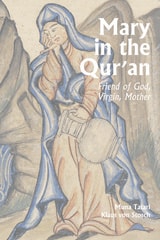
Mary in the Qur'an
Friend of God, Virgin, MotherMuna Tatari and Klaus von Stosch
Gingko, 2025
An entire chapter (surah) is dedicated to her, and she is the only woman mentioned by name in the Qur’an—indeed, her name appears more frequently than that of either Muhammad or Jesus. From the earliest times to the present day, Mary, the mother of Jesus, continues to be held in high regard by Christians and Muslims alike, yet she has also been the cause of much tension between these two religions.
In this groundbreaking study, Muna Tatari and Klaus von Stosch painstakingly reconstruct the picture of Mary that is presented in the Qur’an and show how veneration of the Blessed Virgin Mary in the Roman Catholic Church intersects and interacts with the testimony of the Qur’an. This sensitive and scholarly treatise offers a significant contribution to contemporary interfaith dialogue.
The Art of Reciting the Qur'an
By Kristina Nelson
University of Texas Press, 1985
For the Muslim faithful, the familiar sound of the Qurʾanic recitation is the predominant and most immediate means of contact with the Word of God. Heard day and night, on the street, in taxis, in shops, in mosques, and in homes, the sound of recitation is far more than the pervasive background music of daily life in the Arab world. It is the core of religious devotion, the sanctioning spirit of much cultural and social life, and a valued art form in its own right. Participation in recitation, as reciter or listener, is itself an act of worship, for the sound is basic to a Muslim’s sense of religion and invokes a set of meanings transcending the particular occasion.
For the most part, Westerners have approached the Qurʾan much as scriptural scholars have studied the Bible, as a collection of written texts. The Art of Reciting the Qurʾan aims at redirecting that focus toward a deeper understanding of the Qurʾan as a fundamentally oral phenomenon. By examining Muslim attitudes toward the Qurʾan, the institutions that regulate its recitation, and performer-audience expectations and interaction, Kristina Nelson, a trained Arabist and musicologist, casts new light on the significance of Qurʾanic recitation within the world of Islam. Her landmark work is of importance to all scholars and students of the modern Middle East, as well as ethnomusicologists, anthropologists, linguists, folklorists, and religious scholars.
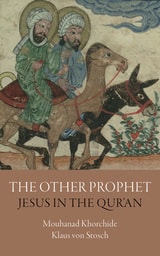
The Other Prophet
Jesus in the Qur’anMouhanad Khorchide and Klaus von Stosch
Gingko, 2025
The Qur’an identifies Jesus as a sign of God, and he holds a place as one of the most important prophets in Islam. Looking at Jesus in Islam also reveals both deep differences from and rich connections to the view of Jesus in Christianity. In The Other Prophet, Mouhanad Khorchide and Klaus von Stosch explore and explain the position of the Qur’anic Jesus, with one scholar working from the Muslim and the other from the Christian theological perspective. Their combined research presents a history of Jesus’ presence in the Qur’an and provides astute observations to deepen the understanding of both Christians and Muslims. Here we find that a common view of Jesus from the Muslim and Christian sides is not only possible but also expands our understanding of Jesus and his message.