Results by title
4 books match the query 'Race in musical theater'
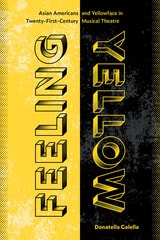
Feeling Yellow
Asian Americans and Yellowface in Twenty-First-Century Musical TheatreDonatella Galella
University of Michigan Press, 2026
Feeling Yellow examines how yellowface has persisted on the contemporary musical stage and how Asian Americans have contested yellowface, as they stake their own claim to the theatrical stage and nation state. Donatella Galella boldly argues that the pleasures of musical theatre and the disavowal of systemic anti-Asian racism enable the ongoing portrayal of Asian and Asian American characters by non-Asian actors. Galella offers two concepts to understand these phenomena: feeling yellow and yellowface without yellowed faces. Feeling yellow encapsulates the racialized anger, despair, and alienation of Asian American artists and audiences. Yellowface without yellowed faces denotes subtle ways of conveying Asianness, such as performing Asianness with exaggerated irony, using racialized costumes rather than yellow skin and slanted eye makeup, and setting musicals in fantasy Asian lands populated by multiracial casts.
Galella utilizes musicals such as Thoroughly Modern Millie, Anything Goes, The Mikado, and Soft Power, to understand how Asian and Asian American representation is connected to larger questions: How does racial identity shape emotional reactions to musical theatre? Why does yellowface and anti-Asian racism persist? What are the terms for Asian Americans belonging in the United States? Using a range of approaches from dramaturgy to auto-ethnography and materials from interviews to Reddit posts, Feeling Yellow spotlights Asian American affect, artistry, and activism.
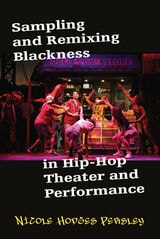
Sampling and Remixing Blackness in Hip-Hop Theater and Performance
Nicole Hodges Persley
University of Michigan Press, 2021
Sampling and Remixing Blackness is a timely and accessible book that examines the social ramifications of cultural borrowing and personal adaptation of Hip-hop culture by non-Black and non-African American Black artists in theater and performance. In a cultural moment where Hip-hop theater hits such as Hamilton offer glimpses of Black popular culture to non-Black people through musical soundtracks, GIFs, popular Hip-hop music, language, clothing, singing styles and embodied performance, people around the world are adopting a Blackness that is at once connected to African American culture--and assumed and shed by artists and consumers as they please. As Black people around the world live a racial identity that is not shed, in a cultural moment of social unrest against anti-blackness, this book asks how such engagements with Hip-hop in performance can be both dangerous and a space for finding cultural allies. Featuring the work of some of the visionaries of Hip-hop theater including Lin-Manuel Miranda, Sarah Jones and Danny Hoch, this book explores the work of groundbreaking Hip-hop theater and performance artists who have engaged Hip-hop's Blackness through popular performance. The book challenges how we understand the performance of race, Hip-hop and Blackness in the age of Instagram, TikTok and Facebook. In a cultural moment where racial identity is performed through Hip-hop culture's resistance to the status quo and complicity in maintaining it, Hodges Persley asks us to consider who has the right to claim Hip-hop's blackness when blackness itself is a complicated mixtape that offers both consent and resistance to transgressive and inspiring acts of performance.
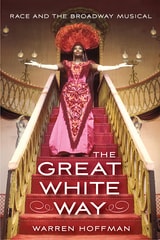
The Great White Way
Race and the Broadway MusicalHoffman, Warren
Rutgers University Press, 2014
Broadway musicals are one of America’s most beloved art forms and play to millions of people each year. But what do these shows, which are often thought to be just frothy entertainment, really have to say about our country and who we are as a nation?
The Great White Way is the first book to reveal the racial politics, content, and subtexts that have haunted musicals for almost one hundred years from Show Boat (1927) to The Scottsboro Boys (2011). Musicals mirror their time periods and reflect the political and social issues of their day. Warren Hoffman investigates the thematic content of the Broadway musical and considers how musicals work on a structural level, allowing them to simultaneously present and hide their racial agendas in plain view of their audiences. While the musical is informed by the cultural contributions of African Americans and Jewish immigrants, Hoffman argues that ultimately the history of the American musical is the history of white identity in the United States.
Presented chronologically, The Great White Way shows how perceptions of race altered over time and how musicals dealt with those changes. Hoffman focuses first on shows leading up to and comprising the Golden Age of Broadway (1927–1960s), then turns his attention to the revivals and nostalgic vehicles that defined the final quarter of the twentieth century. He offers entirely new and surprising takes on shows from the American musical canon—Show Boat (1927), Oklahoma! (1943), Annie Get YourGun (1946), The Music Man (1957), West Side Story (1957), A Chorus Line (1975), and 42nd Street (1980), among others.
New archival research on the creators who produced and wrote these shows, including Leonard Bernstein, Jerome Robbins, Stephen Sondheim, and Edward Kleban, will have theater fans and scholars rethinking forever how they view this popular American entertainment.
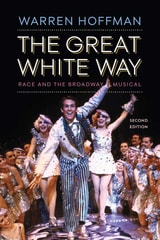
The Great White Way
Race and the Broadway MusicalWarren Hoffman
Rutgers University Press, 2020
Now in a new second edition, The Great White Way is the first book to reveal the racial politics, content, and subtexts that have haunted musicals for almost one hundred years from Show Boat (1927) to Hamilton (2015). This revised edition includes a new introduction and conclusion, updated chapters, as well as a brand-new chapter that looks at the blockbuster musicals The Book of Mormon and Hamilton.
Musicals mirror their time periods and reflect the political and social issues of their day. Warren Hoffman investigates the thematic content of the Broadway musical and considers how musicals work on a structural level, allowing them to simultaneously present and hide their racial agendas in plain view of their audiences. While the musical is informed by the cultural contributions of African Americans and Jewish immigrants, Hoffman argues that ultimately the history of the American musical is the history of white identity in the United States.
Presented chronologically, The Great White Way shows how perceptions of race altered over time and how musicals dealt with those changes. Hoffman focuses first on shows leading up to and comprising the Golden Age of Broadway (1927–1960s), then turns his attention to the revivals and nostalgic vehicles that defined the final quarter of the twentieth century. He offers entirely new and surprising takes on shows from the American musical canon—Show Boat (1927), Oklahoma! (1943), Annie Get Your Gun (1946), The Music Man (1957), West Side Story (1957), A Chorus Line (1975), and 42nd Street (1980), among others. In addition to a new chapter on Hamilton and The Book of Mormon, this revised edition brings The Great White Way fully into the twenty-first century with an examination of jukebox musicals and the role of off-Broadway and regional theaters in the development of the American musical.
New archival research on the creators who produced and wrote these shows, including Leonard Bernstein, Jerome Robbins, Stephen Sondheim, and Edward Kleban, will have theater fans and scholars rethinking forever how they view this popular American entertainment.