Results by title
13 books match the query 'Race in the theater'

Barbarous Play
Race on the English Renaissance StageLara Bovilsky
University of Minnesota Press, 2008
Like our own, early modern beliefs about race depended on metaphorical, selective, and contradictory understandings of how membership in groups is determined. Although race took distinctive forms in the past, the fallacies that underlie early modern racial experience generally are precisely-and surprisingly-the same as those in contemporary culture.
Exploring the similar underpinnings of early modern and contemporary ideas of difference, Barbarous Play examines English Renaissance understandings of race as depicted in drama. Reading plays by Shakespeare, Marlowe, Webster, and Middleton, Bovilsky offers case studies of how racial meanings are generated by narratives of boundary crossing-especially miscegenation, religious conversion, class transgression, and moral and physical degeneracy. In the process, she reveals deep parallels between the period’s conceptions of race and gender.
Barbarous Play contests the widely held view that race and racism depend on modern science for their existence and argues that understanding just what is false and figurative in past depictions of race, such as those found in Othello, The Merchant of Venice, The White Devil, and The Changeling, can clarify the illogic of present-day racism.
Lara Bovilsky is assistant professor of English at Washington University in St. Louis.
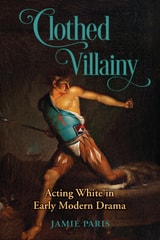
Clothed Villainy
Acting White in Early Modern DramaJamie Paris
University of Alabama Press, 2026
Examines how centuries-old stagecraft shaped modern racial politics—and why the performance of whiteness still commands the spotlight.
From Shakespearean blackface to the alt-right’s khaki-clad protests, Clothed Villainy: Acting White in in Early Modern Drama by Jamie Paris confronts the uncomfortable truths of racial performance across centuries. Paris argues that whiteness is not a fixed identity but a precarious and performative construct—shaped and sustained through actions, appearances, and cultural scripts.
Drawing on critical race theory, performance studies, and Indigenous scholarship, Clothed Villainy traces how racial scripts—whether “playing Black,” “playing Indian,” or especially “playing white”—have been used to uphold white supremacy and erase marginalized identities. By examining the costuming and characterization of white actors portraying Black villains on the early modern stage, Paris reveals how these theatrical traditions continue to echo in contemporary racial politics.
Written with bold clarity and personal insight, this book opens space for reimagining race, history, and identity through a more critical and inclusive lens. Clothed Villainy is essential reading for scholars, students, and anyone seeking to understand the deep-rooted performance of race in society and how we might reimagine it for a more equitable future.
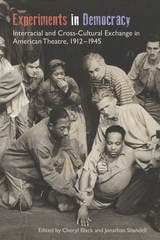
Experiments in Democracy
Interracial and Cross-Cultural Exchange in American Theatre, 1912-1945Edited by Cheryl Black and Jonathan Shandell
Southern Illinois University Press, 2016
In Experiments in Democracy, edited by Cheryl Black and Jonathan Shandell, theatre historians examine a wide range of performances—from Broadway, folk plays and dance productions to scripted political rallies and radio dramas. Contributors look at such diverse groups as the Theatre Union, La Unión Martí-Maceo, and the American Negro Theatre, as well as individual playwrights and their works, including Theodore Browne’s folk opera Natural Man, Josefina Niggli’s Soldadera, and playwright Lynn Riggs’s Cherokee Night and Green Grow the Lilacs (the basis for the musical Oklahoma!). Exploring the ways progressive artists sought to connect isolated racial and cultural groups in pursuit of a more just and democratic society, contributors take into account the blind spots, compromised methods, and unacknowledged biases at play in their practices and strategies. Essays demonstrate how the gap between the ideal of American democracy and its practice—mired in entrenched systems of white privilege, economic inequality, and social prejudice—complicated the work of these artists.
Focusing on questions of race, ethnicity, gender, and sexuality on the stage in the decades preceding the Civil Rights era, Experiments in Democracy fills an important gap in our understanding of the history of the American stage—and sheds light on these still-relevant questions in contemporary American society.
Hemispheric Blackface
Impersonation and Nationalist Fictions in the AmericasDanielle Roper
Duke University Press, 2025
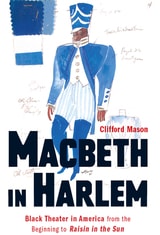
Macbeth in Harlem
Black Theater in America from the Beginning to Raisin in the SunClifford Mason
Rutgers University Press, 2020
2021 PROSE Awards Finalist, Music & the Performing Arts
In 1936 Orson Welles directed a celebrated all-black production of Macbeth that was hailed as a breakthrough for African Americans in the theater. For over a century, black performers had fought for the right to perform on the American stage, going all the way back to an 1820s Shakespearean troupe that performed Richard III, Othello, and Macbeth, without relying on white patronage.
"Macbeth" in Harlem tells the story of these actors and their fellow black theatrical artists, from the early nineteenth century to the dawn of the civil rights era. For the first time we see how African American performers fought to carve out a space for authentic black voices onstage, at a time when blockbuster plays like Uncle Tom’s Cabin and The Octoroon trafficked in cheap stereotypes. Though the Harlem Renaissance brought an influx of talented black writers and directors to the forefront of the American stage, they still struggled to gain recognition from an indifferent critical press.
Above all, "Macbeth" in Harlem is a testament to black artistry thriving in the face of adversity. It chronicles how even as the endemic racism in American society and its theatrical establishment forced black performers to abase themselves for white audiences’ amusement, African Americans overcame those obstacles to enrich the nation’s theater in countless ways.
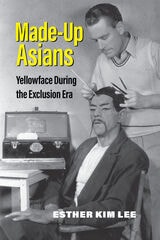
Made-Up Asians
Yellowface During the Exclusion EraEsther Kim Lee
University of Michigan Press, 2022
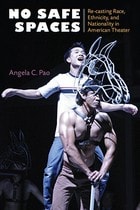
No Safe Spaces
Re-casting Race, Ethnicity, and Nationality in American TheaterAngela C. Pao
University of Michigan Press, 2010
"No Safe Spaces opens up a conversation beyond narrow polemics . . . Although cross-racial casting has been the topic of heated discussion, little sustained scholarship addresses both the historical precedents and theoretical dimensions. Pao illustrates the tensions and contradictions inherent not only in stage representations, but also in the performance of race in everyday life. A wonderful book whose potential readership goes well beyond theater and performance scholars."
---Josephine Lee, University of Minnesota
"Non-traditional casting, increasingly practiced in American theater, is both deeply connected to our country's racial self-image(s) and woefully under-theorized. Pao takes on the practice in its entirety to disentangle the various strands of this vitally important issue."
---Karen Shimakawa, New York University
No Safe Spaces looks at one of the most radical and enduring changes introduced during the Civil Rights era---multiracial and cross-racial casting practices in American theater. The move to cast Latino/a, African American, and Asian American actors in classic stage works by and about white Europeans and Americans is viewed as both social and political gesture and artistic innovation. Nontraditionally cast productions are shown to have participated in the national dialogue about race relations and ethnic identity and served as a source of renewed creativity for the staging of the canonical repertory.
Multiracial casting is explored first through its history, then through its artistic, political, and pragmatic dimensions. Next, the book focuses on case studies from the dominant genres of contemporary American theater: classical tragedy and comedy, modern domestic drama, antirealist drama, and the Broadway musical, using a broad array of archival source materials to enhance and illuminate its arguments.
Angela C. Pao is Associate Professor of Comparative Literature at Indiana University.
A volume in the series Theater: Theory/Text/Performance
Privileged Spectatorship
Theatrical Interventions in White SupremacyDani Snyder-Young
Northwestern University Press, 2021
Many professional theater artists attempt to use live performances in formal theater spaces to disrupt racism and create a more equitable society. Privileged Spectatorship: Theatrical Interventions in White Supremacy examines the impact of such projects, looking at how and why they do and do not intervene in white supremacy. In this incisive study, Dani Snyder-Young examines audience responses to a range of theatrical events that focus on race‑related conflict or racial identity in the contemporary United States. The audiences for these performances, produced at mainstream not‑for‑profit professional theaters in major American cities in 2013–18, reflect dominant patterns of theater attendance: the majority of spectators are older, affluent, white, and describe themselves as politically progressive. Snyder-Young studies the ways these audience members consume the stories of racialized others and analyzes how different artistic, organizational, and programmatic strategies can (or cannot) mitigate white privilege.
This book is essential reading for scholars and students of theater, performance studies, and critical ethnic studies and for theater practitioners interested in equity and inclusion.
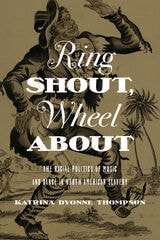
Ring Shout, Wheel About
The Racial Politics of Music and Dance in North American SlaveryKatrina D. Thompson
University of Illinois Press, 2014
In this ambitious project, historian Katrina Thompson examines the conceptualization and staging of race through the performance, sometimes coerced, of black dance from the slave ship to the minstrel stage. Drawing on a rich variety of sources, Thompson explicates how black musical performance was used by white Europeans and Americans to justify enslavement, perpetuate the existing racial hierarchy, and mask the brutality of the domestic slave trade. Whether on slave ships, at the auction block, or on plantations, whites often used coerced performances to oppress and demean the enslaved.
As Thompson shows, however, blacks' "backstage" use of musical performance often served quite a different purpose. Through creolization and other means, enslaved people preserved some native musical and dance traditions and invented or adopted new traditions that built community and even aided rebellion.
Thompson shows how these traditions evolved into nineteenth-century minstrelsy and, ultimately, raises the question of whether today's mass media performances and depictions of African Americans are so very far removed from their troublesome roots.
The Whiteness Between Us
Early Modern Playbooks of Racial TriangulationNoémie Ndiaye
University of Chicago Press, 2026
A theorization of the representational juxtapositions, frictions, and connections between Black people and other non-white people in early modern European theatre.
Over the course of the seventeenth century, European drama was an important tool for whiteness to imagine itself at the top of an aspirational structure of power relations. Indeed, that structure could only be aspirational at a time when Europeans were profoundly divided along easily racializable religious and ethnic lines, and when their sovereignty was threatened by the Ottoman empire. It was to strengthen this emerging consciousness of racial whiteness, Noémie Ndiaye argues, that European drama engaged in a form of racial triangulation, fitting Muslim, Jewish, Indigenous, Romani, and Asian characters into a spurious black/white racial binary.
Focusing on English, Spanish, and French drama from 1580 to 1715, The Whiteness Between Us shows how plays became a crucial tool to position not only black people but any non-white community in the new racial architecture that white supremacy sought to build. Ndiaye reveals the stage of this era as a space for wish fulfillment, enabling participants to imagine and work towards a whiter future.
The early modern playbooks of racial triangulation that Ndiaye brings to light can and have been reactivated for white supremacist purposes in our own day and age. Partly in response to the contemporary threat of white nationalism, scholars and students have sought to unearth the early modern roots of racial whiteness and white supremacy. Ndiaye’s book participates in this wave of interest, offering several innovations, including its capacious transnational claims.
Theatre Symposium, Vol. 29
Theatre and RaceEdited by Andrew Gibb
University of Alabama Press, 2022
Essays whose composition and editing were undertaken almost entirely within the transformed cultural and professional landscape of 2020
A few weeks prior to the submission deadline for this volume of Theatre Symposium, the murder of George Floyd by officers of the Minneapolis Police Department sparked a movement for racial justice that reverberated at every level of US society. At predominantly and historically white academic institutions (including Theatre Symposium and its parent organization, the Southeastern Theatre Conference) leaders were compelled, as perhaps never before, to account for the role of systematic racism in the foundation and perpetuation of their organizations. While the present volume’s theme of “Theatre and Race” was announced in the waning days of 2019, the composition and editing of the issue’s essays were undertaken almost entirely within the transformed cultural and professional landscape of 2020. Throughout its twenty-nine years of publication, Theatre Symposium’s pages have included many excellent essays whose authors have deployed theories of race as an analytical framework, and (less often) treated BIPOC-centered art and artists as subject. The intent of the current editors in conceiving this issue was to center such subjects and theorizations, a goal that has since taken on a more widely recognized urgency.
Taken together, these twelve essays represent a wide range of scholarly responses to the theme of “theatre and race.” The fact that there is so much to say on the topic, from so many different perspectives, is a sign of how profoundly theatre practices have been—and continue to be—shaped by racial discourses and their material manifestations.
Transoceanic Blackface
Empire, Race, PerformanceKellen Hoxworth
Northwestern University Press, 2024
A material history of racialized performance throughout the Anglophone imperial world, Transoceanic Blackface: Empire, Race, Performance revises prevailing understandings of blackface and minstrelsy as distinctively US American cultural practices. Tracing intertwined histories of racialized performance from the mid-eighteenth through the early twentieth century across the United States and the British Empire, this study maps the circulations of blackface repertoires in theatrical spectacles, popular songs, visual materials, comic operas, closet dramas, dance forms, and Shakespearean burlesques.
Kellen Hoxworth focuses on overlooked performance histories, such as the early blackface minstrelsy of T. D. Rice’s “Jump Jim Crow” and the widely staged blackface burlesque versions of Othello, as traces of the racial and sexual anxieties of empire. From the nascent theatrical cultures of Australia, Britain, Canada, India, Jamaica, South Africa, and the United States, Transoceanic Blackface offers critical insight into the ways racialized performance animated the imperial “common sense” of white supremacy on a global scale.
Viewers in Distress
Race, Gender, Religion, and Avant-Garde Performance at the Turn of the Twenty-First CenturyStefka G. Mihaylova
University of Michigan Press, 2023
Honorable Mention: American Society for Theatre Research Barnard Hewitt Award | November 8, 2024
Conventional notions of avant-garde art suggest innovative artists rebelling against artistic convention and social propriety, shocking unwilling audiences into new ways of seeing and living. Viewers in Distress tells a different story. Beginning in the tumultuous 1990s, after the fall of the Berlin Wall and in the wake of the Los Angeles riots, rebellious spectators in American and British theaters broke with theater decorum and voiced their radical interpretations of shows that were not meant to be radical. In doing so, audiences tried to understand the complex racial, gender, and religious politics of their times, while insisting that liberal societies fulfill their promise of dignity for all. Stefka Mihaylova argues that such non-conforming viewing amounts to an avant-garde of its own: a bold reimagining of how we live together and tell stories of our lives together, aimed to achieve liberalism’s promise. In telling this story, she analyzes the production and reception politics of works by Susan-Lori Parks, Sarah Kane, Forced Entertainment, Gurpreet Kaur Bhatti, and Young Jean Lee, as well as non-theatrical controversies such as the conflict over Halloween costumes at Yale in 2015. At the core of spectators’ discontent, this book suggests, is an effort to figure out how to get along with people different from ourselves in the diverse U.S. and British societies in which we live.