Results by title
6 books match the query 'Racial Identity'
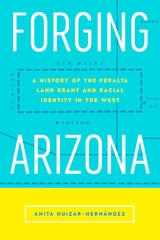
Forging Arizona
A History of the Peralta Land Grant and Racial Identity in the WestAnita Huizar-Hernández
Rutgers University Press, 2019
In Forging Arizona Anita Huizar-Hernández looks back at a bizarre nineteenth-century land grant scheme that tests the limits of how ideas about race, citizenship, and national expansion are forged. During the aftermath of the U.S.-Mexico War and the creation of the current border, a con artist named James Addison Reavis falsified archives around the world to pass his wife off as the heiress to an enormous Spanish land grant so that they could claim ownership of a substantial portion of the newly-acquired Southwestern territories. Drawing from a wide variety of sources including court records, newspapers, fiction, and film, Huizar-Hernández argues that the creation, collapse, and eventual forgetting of Reavis’s scam reveal the mechanisms by which narratives, real and imaginary, forge borders. An important addition to extant scholarship on the U.S Southwest border, Forging Arizona recovers a forgotten case that reminds readers that the borders that divide nations, identities, and even true from false are only as stable as the narratives that define them.
[more]
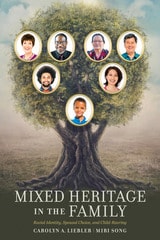
Mixed Heritage in the Family
Racial Identity, Spousal Choice, and ChildrearingCarolyn Liebler
Russell Sage Foundation, 2025
As interracial unions and multiracial people become more common in the United States, mixed-heritage people have come to be regarded by some as a bellwether of race relations in the country. Is the growth of this population a sign that we are now in a post-racial era and our racial identities no longer impact our daily lives? In Mixed Heritage in the Family,sociologists Carolyn A. Liebler and Miri Song explore how racially mixed people navigate racial boundaries as they choose spouses and raise families.
Liebler and Song break new ground by being the first to combine and integrate the study of three aspects of life for people of mixed racial heritage – identity, spouse choice, and childrearing. This integrated approach reveals how complicated racial identification can be, and how it can be expressed in one’s choice of partner or in how one raises their children. The authors draw on census data and interviews with Asian-White, Black-White, and American Indian/Alaska Native-White mixed people to better understand how their identity choices are related to their choice of spouse and how they racially identify and raise their children.
Increasingly, mixed people in the United States are identifying with multiple races. However, the authors find that mixed-race people are not a monolith and that how and why they identify varies considerably between and within each group. They found several common factors that influenced whether mixed-race people choose to identify as biracial, solely White, or solely as a racial minority. These factors include the history of the specific minority race in the U.S., the racial demographics of where they were raised, their social and cultural exposure to their White and non-White backgrounds, their attachment to their racial backgrounds, and how they are seen racially by others.
The way mixed-heritage people identify was closely tied to the race of their spouse. However, having a White spouse did not necessarily mean the mixed-race person felt disconnected from their non-White heritage. White spouses varied in their racial consciousness and their interest in the culture of their mixed-race spouse’s minority ancestry. The spouse’s race, and the nature of racial overlap between the spouses, was also key in the racial upbringing of a mixed-heritage person’s child. In families where the parents share a minority racial heritage, couples lean into their shared ‘family race’, which guides their parenting choices and family life. Many mixed heritage parents found it important to foster racial pride in their children and combat negative racial stereotypes.
Liebler and Song caution against making superficial predictions about the state of race relations in the U.S. based on an increase in the multiracial population. They show that race has not become less salient in the lives of many mixed-race people—American society is not post-racial.
Mixed Heritage in the Family breaks new ground, provides compelling insights in its examination of the lives of mixed-race people, and shows how complicated racial identification can be.
[more]
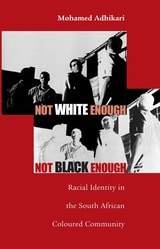
Not White Enough, Not Black Enough
Racial Identity in the South African Coloured CommunityMohamed Adhikari
Ohio University Press, 2005
The concept of Colouredness—being neither white nor black—has been pivotal to the brand of racial thinking particular to South African society. The nature of Coloured identity and its heritage of oppression has always been a matter of intense political and ideological contestation. Not White Enough, Not Black Enough: Racial Identity in the South African Coloured Community is the first systematic study of Coloured identity, its history, and its relevance to South African national life. Mohamed Adhikari engages with the debates and controversies thrown up by the identity’s troubled existence and challenges much of the conventional wisdom associated with it. A combination of wide-ranging thematic analyses and detailed case studies illustrates how Colouredness functioned as a social identity from the time of its emergence in the late nineteenth century through its adaptation to the postapartheid environment. Adhikari demonstrates how the interplay of marginality, racial hierarchy, assimilationist aspirations, negative racial stereotyping, class divisions, and ideological conflicts helped mold people’s sense of Colouredness over the past century. Knowledge of this history, and of the social and political dynamic that informed the articulation of a separate Coloured identity, is vital to an understanding of present-day complexities in South Africa.
[more]
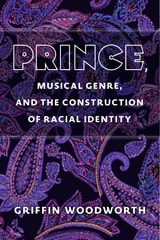
Prince, Musical Genre, and the Construction of Racial Identity
Griffin Woodworth
University of Michigan Press, 2025
Throughout his career, the Minneapolis musician Prince was known for fusing different musical genres as well as moving between different identities—sexual lothario, devout man of God, androgynous sprite—qualities that fit the postmodernism of the 1980s. This volume takes a fresh look at Prince’s work, arguing that his music was deeply informed by the history and techniques of Black culture, and that his multigenre fluency and changeable image were weapons that he deployed in a career-long fight against the racially segregated structures of the American music industry. Using a methodology that mixes musicology with African American literary theory, queer theory, and gender studies, this book analyzes the ways that Prince mixed and manipulated musical genres that are indexed to racial identities—such as “White” rock or new-wave, and “Black” funk, gospel, or R&B—in order to construct pluralistic identities.
Each chapter includes detailed musical analyses and transcriptions of Prince’s songs, focusing on his use of rock guitar, new-wave synthesizers, funk drumming, gospel singing, and R&B horns. By tracking Prince’s transformations of instrumental and vocal idioms derived from specific musical genres, and considering the historical and cultural values embedded within those genres, Griffin Woodworth explores the ways that Prince musically broke down stereotypes of Black masculinity. With its intersectional approach to musical analysis, this book captures the sounds of American racial politics in the 1980s, 90s, and 2000s as heard through the music of one of the era’s most popular artists as he worked to transform and transcend those politics.
Each chapter includes detailed musical analyses and transcriptions of Prince’s songs, focusing on his use of rock guitar, new-wave synthesizers, funk drumming, gospel singing, and R&B horns. By tracking Prince’s transformations of instrumental and vocal idioms derived from specific musical genres, and considering the historical and cultural values embedded within those genres, Griffin Woodworth explores the ways that Prince musically broke down stereotypes of Black masculinity. With its intersectional approach to musical analysis, this book captures the sounds of American racial politics in the 1980s, 90s, and 2000s as heard through the music of one of the era’s most popular artists as he worked to transform and transcend those politics.
[more]
Senegal Abroad
Linguistic Borders, Racial Formations, and Diasporic ImaginariesMaya Angela Smith
University of Wisconsin Press, 2020
Senegal Abroad explores the fascinating role of language in national, transnational, postcolonial, racial, and migrant identities. Capturing the experiences of Senegalese in Paris, Rome, and New York, it depicts how they make sense of who they are—and how they fit into their communities, countries, and the larger global Senegalese diaspora. Drawing on extensive interviews with a wide range of emigrants as well as people of Senegalese heritage, Maya Angela Smith contends that they shape their identity as they purposefully switch between languages and structure their discourse.
The Senegalese are notable, Smith suggests, both in their capacity for movement and in their multifaceted approach to language. She finds that, although the emigrants she interviews express complicated relationships to the multiple languages they speak and the places they inhabit, they also convey pleasure in both travel and language. Offering a mix of poignant, funny, reflexive, introspective, and witty stories, they blur the lines between the utility and pleasure of language, allowing a more nuanced understanding of why and how Senegalese move.
The Senegalese are notable, Smith suggests, both in their capacity for movement and in their multifaceted approach to language. She finds that, although the emigrants she interviews express complicated relationships to the multiple languages they speak and the places they inhabit, they also convey pleasure in both travel and language. Offering a mix of poignant, funny, reflexive, introspective, and witty stories, they blur the lines between the utility and pleasure of language, allowing a more nuanced understanding of why and how Senegalese move.
[more]
Whiteness Interrupted
White Teachers and Racial Identity in Predominantly Black SchoolsMarcus Bell
Duke University Press, 2021
In Whiteness Interrupted Marcus Bell presents a revealing portrait of white teachers in majority-black schools in which he examines the limitations of understandings of how white racial identity is formed. Through in-depth interviews with dozens of white teachers from a racially segregated, urban school district in Upstate New York, Bell outlines how whiteness is constructed based on localized interactions and takes a different form in predominantly black spaces. He finds that in response to racial stress in a difficult teaching environment, white teachers conceptualized whiteness as a stigmatized category predicated on white victimization. When discussing race outside majority-black spaces, Bell's subjects characterized American society as postracial, in which race seldom affects outcomes. Conversely, in discussing their experiences within predominantly black spaces, they rejected the idea of white privilege, often angrily, and instead focused on what they saw as the racial privilege of blackness. Throughout, Bell underscores the significance of white victimization narratives in black spaces and their repercussions as the United States becomes a majority-minority society.
[more]