Results by title
3 books match the query 'Racism in law enforcement'

Black Life Matter
Blackness, Religion, and the SubjectBiko Mandela Gray
Duke University Press, 2022
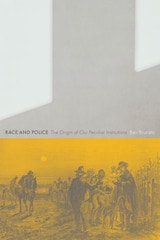
Race and Police
The Origin of Our Peculiar InstitutionsBen Brucato
Rutgers University Press, 2024
Race and Police corrects the Eurocentrism in the orthodox history of American police and in predominating critical theories of police. That orthodoxy rests on an origin story that begins with Sir Robert Peel and the London Metropolitan Police Service. Predating the Met by more than a century, America’s first police, often called slave patrols, did more than maintain order—it fabricated a racial order. Prior to their creation, all white citizens were conscripted to police all Blacks. Their participation in the coercive control of Blacks gave definition to their whiteness. Targeted as threats to the security of the economy and white society, being policed defined Blacks who, for the first time, were treated as a single racial group. The boundaries of whiteness were first established on the basis of who was required to regulate slaves, given a specific mandate to prevent Black insurrection, a mandate that remains core to the police role to this day.
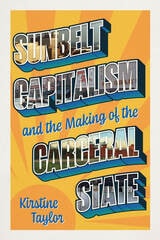
Sunbelt Capitalism and the Making of the Carceral State
Kirstine Taylor
University of Chicago Press, 2025
The story of how the American South became the most incarcerated region in the world’s most incarcerated nation.
Sunbelt Capitalism and the Making of the Carceral State examines the evolution of southern criminal punishment from Jim Crow to the dawn of mass incarceration, charting this definitive era of carceral transformation and expansion in the southern United States. The demise of the county chain gang, the professionalization of police, and the construction of large-scale prisons were among the sweeping changes that forever altered the southern landscape and bolstered the region’s capacity to punish. What prompted this southern revolution in criminal punishment?
Kirstine Taylor argues that the crisis in the cotton fields and the arrival of Sunbelt capitalism in the south’s rising metropolises prompted lawmakers to build expansive, modern criminal punishment systems in response to Brown v. Board of Education and the Black freedom movements of the 1960s and ‘70s. Taking us inside industry-hunting expeditions, school desegregation battles, the sit-in movement, prisoners’ labor unions, and policy commissions, Taylor tells the story of how a modernizing south became the most incarcerated region in the globe’s most incarcerated nation.