Results by title

8 books match the query 'Racism in mass media'
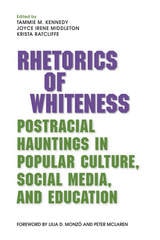
cover of Rhetorics of Whiteness: Postracial Hauntings in Popular Culture, Social Media, and Education

Rhetorics of Whiteness

Postracial Hauntings in Popular Culture, Social Media, and Education

Edited by Tammie M. Kennedy, Joyce Irene Middleton, Krista Ratcliffe, with a foreword by Lilia D. Monzó and Peter McLaren

Southern Illinois University Press, 2017

Winner, CCCC Outstanding Book Award in the Edited Collection Category, 2018

With the election of our first black president, many Americans began to argue that we had finally ended racism, claiming that we now live in a postracial era. Yet near-daily news reports regularly invoke white as a demographic category and recount instances of racialized violence as well as an increased sensitivity to expressions of racial unrest. Clearly, American society isn’t as color-blind as people would like to believe. In Rhetorics of Whiteness: Postracial Hauntings in Popular Culture, Social Media, and Education, contributors reveal how identifications with racialized whiteness continue to manifest themselves in American culture.

The sixteen essays that comprise this collection not only render visible how racialized whiteness infiltrates new twenty-first-century discourses and material spaces but also offer critical tactics for disrupting this normative whiteness. Specifically, contributors examine popular culture (novels, films, TV), social media (YouTube, eHarmony, Facebook), education (state law, the textbook industry, dual credit programs), pedagogy (tactics for teaching via narratives, emotional literacy, and mindfulness) as well as cultural theories (concepts of racialized space, anti-dialogicism, and color blindness). Offering new approaches to understanding racialized whiteness, this volume emphasizes the importance of a rhetorical lens for employing whiteness studies’ theories and methods to identify, analyze, interpret, and interrupt representations of whiteness.

Although whiteness studies has been waning as an active research field for the past decade, the contributors to Rhetorics of Whiteness assert that it hasn’t lost its relevancy because racialized whiteness and issues of systemic racism persist in American society and culture today. Few whiteness studies texts have been published in rhetoric and composition in the past decade, so this collection should quickly become mandatory reading. By focusing on common, yet often overlooked, contemporary examples of how racialized whiteness haunts U.S. society, Rhetorics of Whiteness serves as a valuable text for scholars in the field as well as anyone else interested in the topic.

[more]
cover of The Message Is Murder: Substrates of Computational Capital

The Message Is Murder

Substrates of Computational Capital

Jonathan Beller

Pluto Press, 2017

More than fifty years ago, Marshall McLuhan proclaimed that “the medium is the message,” profoundly influencing future generations of media theorists. A long-overdue wakeup call for the field of media studies, The Message is Murder analyzes the formations of violence still imbued in the everyday functions of the media. Jonathan Beller introduces the concept of computational capital to argue that contemporary media are not neutral, but rather they are technologies of political economy that became entangled with gendered and racialized capitalism in the twentieth and twenty-first centuries. Engaging with Borges, Turing, Hitchcock, and Marx, Beller offers an ambitious and provocative critique of contemporary media studies. 
 
[more]
cover of Trafficking in Antiblackness: Modern-Day Slavery, White Indemnity, and Racial Justice

Trafficking in Antiblackness

Modern-Day Slavery, White Indemnity, and Racial Justice

Lyndsey P. Beutin

Duke University Press, 2023
In Trafficking in Antiblackness Lyndsey P. Beutin analyzes how campaigns to end human trafficking—often described as “modern-day slavery”—invoke the memory of transatlantic slavery to support positions ultimately grounded in antiblackness. Drawing on contemporary antitrafficking visual culture and media discourse, she shows how a constellation of media, philanthropic, NGO, and government actors invested in ending human trafficking repurpose the history of transatlantic slavery and abolition in ways that undermine contemporary struggles for racial justice and slavery reparations. The recurring narratives, images, and figures such as “slavery in Africa,” “Arab slave traders,” and “Black incapacity for self-governance” discursively turn Black people across the diaspora into the enslavers of the past and present in place of white Americans and Europeans. Doing so, Beutin contends, creates a rhetorical defense against being held liable for slavery’s dispossessions and violence. Despite these implications, Beutin demonstrates that antitrafficking discourse remains popular and politically useful for former slaving nations and their racial beneficiaries because it refashions historic justifications for white supremacy into today’s abolition of slavery.
[more]
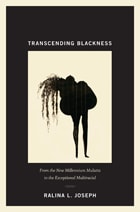
cover of Transcending Blackness: From the New Millennium Mulatta to the Exceptional Multiracial

Transcending Blackness

From the New Millennium Mulatta to the Exceptional Multiracial

Ralina L. Joseph

Duke University Press, 2012

Representations of multiracial Americans, especially those with one black and one white parent, appear everywhere in contemporary culture, from reality shows to presidential politics. Some depict multiracial individuals as mired in painful confusion; others equate them with progress, as the embodiment of a postracial utopia. In Transcending Blackness, Ralina L. Joseph critiques both depictions as being rooted in—and still defined by—the racist notion that blackness is a deficit that must be overcome.

Analyzing emblematic representations of multiracial figures in popular culture—Jennifer Beals's character in the The L Word; the protagonist in Danny Senza's novel Caucasia; the title character in the independent film Mixing Nia; and contestants in a controversial episode of the reality show America's Next Top Model, who had to "switch ethnicities" for a photo shoot—Joseph identifies the persistence of two widespread stereotypes about mixed-race African Americans, those of "new millennium mulattas" and "exceptional multiracials." The former inscribes multiracial African Americans as tragic figures whose blackness predestines them for misfortune; the latter rewards mixed-race African Americans for successfully erasing their blackness. Addressing questions of authenticity, sexuality, and privilege, Transcending Blackness refutes the idea that race no longer matters in American society.
[more]
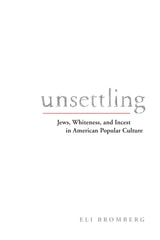
cover of Unsettling: Jews, Whiteness, and Incest in American Popular Culture

Unsettling

Jews, Whiteness, and Incest in American Popular Culture

Eli Bromberg

Rutgers University Press, 2021
By analyzing how various media told stories about Jewish celebrities and incest, Unsettling illustrates how Jewish community protective politics impacted the representation of white male Jewish masculinity in the 1990s. Chapters on Woody Allen, Roseanne Barr, and Henry Roth demonstrate how media coverage of their respective incest denials (Allen), allegations (Barr), and confessions (Roth) intersect with a history of sexual antisemitism, while an introductory chapter on Jewish second-wave feminist criticism of Sigmund Freud considers how Freud became “white” in these discussions. Unsettling reveals how film, TV, and literature have helped displace once prevalent antisemitic stereotypes onto those who are non-Jewish, nonwhite, and poor. In considering how whiteness functions for an ethnoreligious group with historic vulnerability to incest stereotype as well as contemporary white privilege, Unsettling demonstrates how white Jewish men accused of incest, and even those who defiantly confess it, became improbably sympathetic figures representing supposed white male vulnerability.
 
[more]
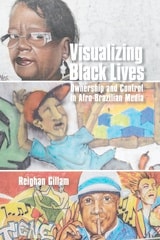
cover of Visualizing Black Lives: Ownership and Control in Afro-Brazilian Media

Visualizing Black Lives

Ownership and Control in Afro-Brazilian Media

Reighan Gillam

University of Illinois Press, 2022

A new generation of Afro-Brazilian media producers have emerged to challenge a mainstream that frequently excludes them. Reighan Gillam delves into the dynamic alternative media landscape developed by Afro-Brazilians in the twenty-first century. With works that confront racism and focus on Black characters, these artists and the visual media they create identify, challenge, or break with entrenched racist practices, ideologies, and structures. Gillam looks at a cross-section of media to show the ways Afro-Brazilians assert control over various means of representation in order to present a complex Black humanity. These images--so at odds with the mainstream--contribute to an anti-racist visual politics fighting to change how Brazilian media depicts Black people while highlighting the importance of media in the movement for Black inclusion.

An eye-opening union of analysis and fieldwork, Visualizing Black Lives examines the alternative and activist Black media and the people creating it in today's Brazil.
[more]
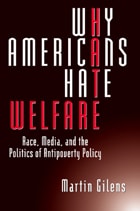
cover of Why Americans Hate Welfare: Race, Media, and the Politics of Antipoverty Policy

Why Americans Hate Welfare

Race, Media, and the Politics of Antipoverty Policy

Martin Gilens

University of Chicago Press, 1999

Tackling one of the most volatile issues in contemporary politics, Martin Gilens's work punctures myths and misconceptions about welfare policy, public opinion, and the role of the media in both. Why Americans Hate Welfare shows that the public's views on welfare are a complex mixture of cynicism and compassion; misinformed and racially charged, they nevertheless reflect both a distrust of welfare recipients and a desire to do more to help the "deserving" poor.

"With one out of five children currently living in poverty and more than 100,000 families with children now homeless, Gilens's book is must reading if you want to understand how the mainstream media have helped justify, and even produce, this state of affairs." —Susan Douglas, The Progressive
"Gilens's well-written and logically developed argument deserves to be taken seriously." —Choice

"A provocative analysis of American attitudes towards 'welfare.'. . . [Gilens] shows how racial stereotypes, not white self-interest or anti-statism, lie at the root of opposition to welfare programs." -Library Journal
[more]
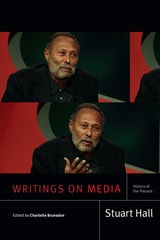
cover of Writings on Media: History of the Present

Writings on Media

History of the Present

Stuart Hall

Duke University Press, 2021

Writings on Media gathers more than twenty of Stuart Hall's media analyses, from scholarly essays such as “Encoding and Decoding in the Television Discourse” (1973) to other writings addressed to wider publics. Hall explores the practices of news photography, the development of media and cultural studies, the changing role of television, and how the nation imagines itself through popular media. He attends to Britain's imperial history and the politics of race and cultural identity as well as the media's relationship to the political project of the state. Testifying to the range and agility of Hall's critical and pedagogic engagement with contemporary media culture—and also to his collaborative mode of working—this volume reaffirms his stature as an innovative media theorist while demonstrating the continuing relevance of his methods of analysis.
[more]