Results by title
2 books match the query 'Radical Thought'
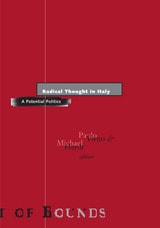
Radical Thought in Italy
A Potential PoliticsPaolo Virno
University of Minnesota Press, 2006
Over the past several decades, Italian revolutionary politics has offered a model for new forms of political thinking. Radical Thought in Italy continues that tradition by providing an original view of the potential for a radical democratic politics today that speaks not only to the Italian situation but also to a broadly international context. First, the essays settle accounts with the culture of cynicism, opportunism, and fear that has come to permeate the Left. They then proceed to analyze the new difficulties and possibilities opened by current economic conditions and the crisis of the welfare state. Finally, the authors propose a series of new concepts that are helpful in rethinking revolution for our times. Contributors: Giorgio Agamben, U of Verona and Collège Internationale de Philosophie, Paris; Massimo De Carolis, U of Salerno; Alisa Del Re, U of Padua; Augusto Illuminati, U of Urbino; Maurizio Lazzarato; Antonio Negri, U of Paris VIII; Franco Piperno, U of Calabria; Marco Revelli, U of Turin; Rossana Rossanda; Carlo Vercellone; Adelino Zanini. Paolo Virno is the author of several books, including the recently translated A Grammar of the Multitude. Michael Hardt is professor of literature and romance studies at Duke University.
[more]
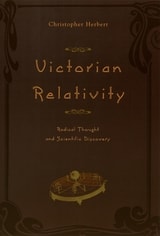
Victorian Relativity
Radical Thought and Scientific DiscoveryChristopher Herbert
University of Chicago Press, 2001
One of the articles of faith of twentieth-century intellectual history is that the theory of relativity in physics sprang in its essentials from the unaided genius of Albert Einstein; another is that scientific relativity is unconnected to ethical, cultural, or epistemological relativisms. Victorian Relativity challenges these assumptions, unearthing a forgotten tradition of avant-garde speculation that took as its guiding principle "the negation of the absolute" and set itself under the militant banner of "relativity."
Christopher Herbert shows that the idea of relativity produced revolutionary changes in one field after another in the nineteenth century. Surveying a long line of thinkers including Herbert Spencer, Charles Darwin, Alexander Bain, W. K. Clifford, W. S. Jevons, Karl Pearson, James Frazer, and Einstein himself, Victorian Relativity argues that the early relativity movement was bound closely to motives of political and cultural reform and, in particular, to radical critiques of the ideology of authoritarianism. Recuperating relativity from those who treat it as synonymous with nihilism, Herbert portrays it as the basis of some of our crucial intellectual and ethical traditions.
Christopher Herbert shows that the idea of relativity produced revolutionary changes in one field after another in the nineteenth century. Surveying a long line of thinkers including Herbert Spencer, Charles Darwin, Alexander Bain, W. K. Clifford, W. S. Jevons, Karl Pearson, James Frazer, and Einstein himself, Victorian Relativity argues that the early relativity movement was bound closely to motives of political and cultural reform and, in particular, to radical critiques of the ideology of authoritarianism. Recuperating relativity from those who treat it as synonymous with nihilism, Herbert portrays it as the basis of some of our crucial intellectual and ethical traditions.
[more]