Results by title

5 books match the query 'Rahner, Karl'
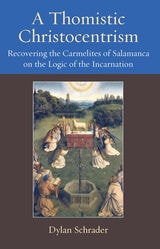
cover of A Thomistic Christocentrism: Recovering the Carmelites of Salamanca on the Logic of the Incarnation

A Thomistic Christocentrism

Recovering the Carmelites of Salamanca on the Logic of the Incarnation

Dylan Schrader

Catholic University of America Press, 2021
Saint Thomas Aquinas famously held the opinion that, in God’s actual plan for the world, the Word would not have become flesh except to redeem us from sin. Conversely, Blessed John Duns Scotus argued that God intended Christ first, such that Christ would have come even if there had been no sin. While Aquinas and Scotus were far from the first to consider this question, they became emblematic of two seemingly irreconcilable approaches. In this book, Father Dylan Schrader recovers the thought of the Salmanticenses, the Discalced Carmelites writing at the University of Salamanca in the seventeenth century. The Salmanticenses argue that Christ is primary in God’s intention precisely as redeemer, so that it is true both that God has made everything else for the sake of Christ and that Christ’s coming is essentially redemptive, connected with sin. In this way, the Salmanticenses offer a Thomistic Christocentrism. This book summarizes the historical background to the Salmanticenses, from the time of Anselm up through the early-modern period. Next, it presents and defends the Salmanticenses’ argument for the primacy of Christ the redeemer. A Thomistic Christocentrism then turns to two key post-conciliar figures, Karl Rahner and Hans Urs von Balthasar. Rahner sees Christ as the culmination of the world’s opening up to God. Balthasar sees Christ as the reconciler of divine and human freedom through his cross, descent, and resurrection. Both Christocentric approaches have good aspirations but suffer from serious flaws. In its final chapters, this book applies the Salamanca theory to Rahner and Balthasar, showing its enduring value for post-conciliar Christocentrism.
[more]
cover of Encounters With Silence

Encounters With Silence

Karl Rahner

St. Augustine's Press, 1999

One of the classics of modern spirituality, Encounters with Silence is one of Karl Rahner’s most lucid and powerful books. A book of meditations about man’s relation with God, it is not a work of dry theology, but rather a book of prayerful reflections on love, knowledge, and faith, obedience, everyday routines, life with our friends and neighbors, our work and vocation, and human goodness. The immense success of this moving work is a tribute to its practicality and the ability of the great theologian to speak simply and yet profoundly to ordinary men and women seeking an inspiring guide to the inner life, one that never forsakes the world of reality. The book is cast in the form of a dialogue with God that moves from humble but concerned inquiry to joyful contemplation.

“You will come again because the fact that you have already come must continue to be revealed ever more clearly. It must become progressively manifest to the world that the heart of all things is already transformed, because you have taken them all to your heart. . . . The false appearance of our world, the shabby pretense that it has not been liberated . . . must be more and more thoroughly rooted out and destroyed. . . . And your coming is neither past nor future, but the present, which has only to reach its fulfillment. Now it is still the one single hour of your advent.” (from the book)

[more]
cover of Freedom Made Manifest

Freedom Made Manifest

Peter Joseph Fritz

Catholic University of America Press, 2019
Freedom Made Manifest explicates Rahner’s theology of freedom by elucidating its configuration and sources. Much of its inquiry centers on the fundamental option: each human person’s eternal decision made, paradoxically, in time, as a definitive answer to God’s personally-tailored call to salvation. This idea stems from three principal sources: Catholic conversations with transcendental-idealist philosophy, penitential theology and practice, and Ignatian spirituality. Rahner’s unique redeployment of these sources inflects the fundamental option with theologies of concupiscence, mercy and forgiveness (especially as ecclesially mediated), and devotion to Jesus Christ. Awareness of these inflections can show how Rahner’s theology of freedom may assist in theological reflection on freedom’s susceptibility to injury and trauma.
[more]
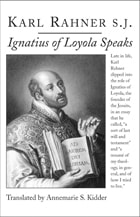
cover of Ignatius of Loyola Speaks

Ignatius of Loyola Speaks

Karl Rahner

St. Augustine's Press, 2013
[more]
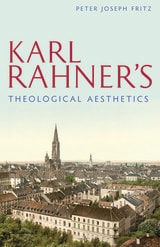
cover of Karl Rahner's Theological Aesthetics

Karl Rahner's Theological Aesthetics

Peter Joseph Fritz

Catholic University of America Press, 2014

This innovative book discloses Karl Rahner's foremost achievement: discovering and delineating an ethos of Catholicism, a multi-faceted and comprehensive approach to life in Christ. Karl Rahner's Theological Aesthetics does so by placing the German Jesuit and his teacher, philosopher Martin Heidegger, into a richly detailed dialogue on aesthetics. The book treats classic Rahner topics such as anthropology and Christology. But it breaks new ground by exploring themes such as angels, Mary, and the apocalypse, juxtaposed with analogous philosophical topics in Heidegger.
[more]