Results by title
72 books match the query 'Railroads' and 6 start with a
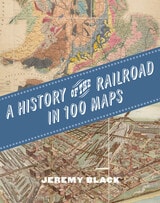
A History of the Railroad in 100 Maps
Jeremy Black
University of Chicago Press, 2024
The first international history of railroads and railroad infrastructure told through stunningly reproduced maps.
Since their origins in eighteenth-century England, railroads have spread across the globe, changing everything in their path, from where and how people grew and made things to where and how they lived and moved. Railroads rewrote not only world geography but also the history of maps and mapping. Today, the needs of train companies and their users continue to shape the maps we consume and consult.
Featuring full-color maps primarily from the British Library's distinguished collection—many of them never before published—A History of the Railroad in 100 Maps is the first international history of railroads and railroad infrastructure told through maps. Jeremy Black includes examples from six continents, spanning a variety of uses from railroad planning and operations to guides for passengers, shippers, and tourists.
Arranged chronologically, the maps are accompanied by explanatory text that sheds light on the political, military, and urban development histories associated with the spread of railroads. A final chapter considers railroad maps from games, books, and other cultural artifacts. For anyone interested in the history of railroads or maps, A History of the Railroad in 100 Maps will offer new and unexpected insights into their intertwined global history.
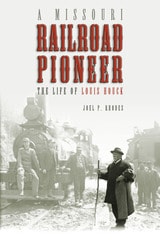
A Missouri Railroad Pioneer
The Life of Louis HouckJoel P. Rhodes
University of Missouri Press, 2013
Lawyer and journalist, entrepreneur and philanthropist, Louis Houck is often called the “Father of Southeast Missouri” because he brought the railroad to the region and opened this backwater area to industrialization and modernization. Although Houck’s name is little known today outside Missouri, Joel Rhodes shows how his story has relevance for both the state and the nation.
Rhodes presents a more complete picture of Houck than has ever been available: reviewing his life from his German immigrant roots, considering his career from both social and political perspectives, and grounding the story in both state and national history. He especially tells how, from 1880 to the 1920s, this self-taught railroader constructed a network of five hundred miles of track through the wilderness of wetlands known as “Swampeast Missouri”—and how these “Houck Roads” provided a boost for population, agriculture, lumbering, and commerce that transformed Cape Girardeau and the surrounding area.
Rhodes discusses how Houck fits into the era of economic individualism—a time when men with little formal training shaped modern industry—and also gives voice to Houck’s critics and shows that he was not always an easy man to work with. In telling the story of his railroading enterprise, Rhodes chronicles Houck’s battle with the Jay Gould railroad empire and offers key insight into the development of America’s railway system, from the cutthroat practices of ruthless entrepreneurs to the often-comic ineptness of start-up rail lines.
More than simply a biography of a business entrepreneur, the book tells how Houck not only developed the region economically but also followed the lead of Andrew Carnegie by making art, culture, and formal education available to all social classes. Houck also served for thirty-six years as president of the Board of Regents of Southeast Missouri State Teacher’s College, and as a self-taught historian he wrote the first comprehensive accounts of Missouri’s territorial period.
A Missouri Railroad Pioneer chronicles a multifaceted career that transformed a region. Solidly researched, this lively narrative also offers an entertaining read for anyone interested in Missouri history.
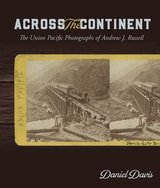
Across the Continent
The Union Pacific Photographs of Andrew Joseph RussellDaniel Davis
University of Utah Press, 2018
Copublished with the Utah State Historical Society. Affiliated with the Utah Division of State History, Utah Department of Heritage & Arts
Andrew J. Russell is primarily known as the man who photographed the famous “East and West Shaking Hands” image of the Golden Spike ceremony on May 10, 1869. He also took nearly one thousand other images that document almost every aspect of the construction of the Union Pacific Railroad. Across the Continent is the most detailed study to date of the life and work of an often-overlooked but prolific artist who contributed immensely not only to documentation of the railroad but also to the nation’s visualization of the American West and, earlier, the Civil War.
The central focus in the book is on the large body of work Russell produced primarily to satisfy the needs of the Union Pacific. Daniel Davis posits that this set of Russell’s photos is best understood not through one or a handful of individual images, but as a photographic archive. Taken as a whole, that archive shows that Russell intended for viewers never to forget who built the Union Pacific. His images celebrate working people—masons working on bridge foundations, freighters and their wagons, surveyors with their transits, engine crews posed on their engines, as well as tracklayers, laborers, cooks, machinists, carpenters, graders, teamsters, and clerks pushing paper.
Russell contributed to a golden age of Western photography that visually introduced the American West to the nation, changing its public image from that of a Great American Desert to a place of apparently unlimited economic potential.
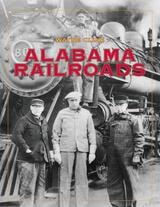
Alabama Railroads
Wayne Cline
University of Alabama Press, 1997
A comprehensive, illustrated history that shows Alabama's important role in the development of the nation's railroad system
Alabama Railroads is the first extensive history of the state’s railway system, from the chartering of the Tuscumbia Railway Company in January 1830, to the maturity of the system in the latter half of the 20th century, when Amtrak assumed control of the nation’s passenger service.
Railroads built Alabama. Without them the state’s vast natural resources could not have been developed. Scores of Alabama towns, including the city of Birmingham, owe their existence to the railroads. Moreover, Alabama legislators were instrumental in securing passage of momentous land grant legislation that brought the railroad—and settlers—to every section of the American frontier.
During the Civil War, the state’s rail system was a primary objective of Union raiders, and an Alabama rail connection into Chattanooga proved to be a vital key to victory. After the war, the railroad shaped politics and economic development in the state. Indeed, most of the important events of the first 100 years of Alabama history were influenced in a significant manner by the railroad. Alabama Railroads chronicles these events—from land grant legislation and the strategic importance of Alabama’s railroads in the Civil War to the founding of Birmingham and the development of the state’s agricultural, mineral, and timber regions.
Wayne Cline traces the development of all the major lines as well as the most prominent short lines, from the day in 1832 when the first horse-drawn cars rolled over primitive tracks at Tuscumbia, to the night in 1971 at Sylacauga when the final operating order was issued for one of the 20th century’s most famous streamliners. Along the way we meet the varied cast of colorful characters who pioneered the railway system that serves the state today. With more than 100 rare and vintage illustrations from the 19th and early 20th centuries, Alabama Railroads places Alabama’s rail heritage in a national context and allows students of southern history as well as railroad enthusiasts to view this Deep South state from an entirely fresh perspective.
American Railroads
John F. Stover
University of Chicago Press, 1997
A fascinating account of the rise, decline, and rebirth of railroads in the United States, John F. Stover's American Railroads traces their history from the first lines that helped eastern seaports capture western markets to today's newly revitalized industry. Stover describes the growth of the railroads' monopoly, with the consequent need for state and federal regulations; relates the vital part played by the railroads during the Civil War and the two World Wars; and charts the railroads' decline due to the advent of air travel and trucking during the 1950s.
In two new chapters, Stover recounts the remarkable recovery of the railroads, along with other pivotal events of the industry's recent history. During the 1960s declining passenger traffic and excessive federal regulation led to the federally-financed creation of Amtrak to revive passenger service and Conrail to provide freight service on bankrupt northeastern railroads. The real savior for the railroads, though, proved to be the Staggers Rail Act of 1980, which brought prosperity to rail freight carriers by substantially deregulating the industry. By 1995, renewed railroad freight traffic had reached nearly twice its former peak in 1944.
Bringing both a seasoned eye and new insights to bear on one of the most American of industries, Stover has produced the definitive history of railroads in the United States.
An Anthropology of the Machine
Tokyo's Commuter Train NetworkMichael Fisch
University of Chicago Press, 2018
An Anthropology of the Machine is a creative ethnographic study of the culture, history, and experience of commuting in Tokyo. At the same time, it is a theoretically ambitious attempt to think through our very relationship with technology and our possible ecological futures. Fisch provides an unblinking glimpse into what it might be like to inhabit a future in which more and more of our infrastructure—and the planet itself—will have to operate beyond capacity to accommodate our ever-growing population.