Results by title
5 books match the query 'Rainbow'
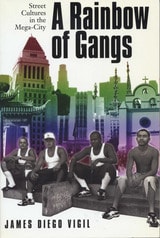
A Rainbow of Gangs
Street Cultures in the Mega-CityBy James Diego Vigil
University of Texas Press, 2002
Winner, Best Book on Ethnic and Racial Politics in a Local or Urban Setting , Organized Section on Race, Ethnicity, and Politics of the American Political Science Association, 2002
This cross-cultural study of Los Angeles gangs identifies the social and economic factors that lead to gang membership and underscores their commonality across four ethnic groups--Chicano, African American, Vietnamese, and Salvadorian.
With nearly 1,000 gangs and 200,000 gang members, Los Angeles holds the dubious distinction of being the youth gang capital of the United States. The process of street socialization that leads to gang membership now cuts across all ethnic groups, as evidenced by the growing numbers of gangs among recent immigrants from Asia and Latin America.
This cross-cultural study of Los Angeles gangs identifies the social and economic factors that lead to gang membership and underscores their commonality across four ethnic groups—Chicano, African American, Vietnamese, and Salvadorian. James Diego Vigil begins at the community level, examining how destabilizing forces and marginalizing changes have disrupted the normal structures of parenting, schooling, and policing, thereby compelling many youths to grow up on the streets. He then turns to gang members' life stories to show how societal forces play out in individual lives. His findings provide a wealth of comparative data for scholars, policymakers, and law enforcement personnel seeking to respond to the complex problems associated with gangs.
A Rainbow of Gangs
Street Cultures in the Mega-CityBy James Diego Vigil
University of Texas Press, 2002
Winner, Best Book on Ethnic and Racial Politics in a Local or Urban Setting , Organized Section on Race, Ethnicity, and Politics of the American Political Science Association, 2002
This cross-cultural study of Los Angeles gangs identifies the social and economic factors that lead to gang membership and underscores their commonality across four ethnic groups--Chicano, African American, Vietnamese, and Salvadorian.
With nearly 1,000 gangs and 200,000 gang members, Los Angeles holds the dubious distinction of being the youth gang capital of the United States. The process of street socialization that leads to gang membership now cuts across all ethnic groups, as evidenced by the growing numbers of gangs among recent immigrants from Asia and Latin America.
This cross-cultural study of Los Angeles gangs identifies the social and economic factors that lead to gang membership and underscores their commonality across four ethnic groups—Chicano, African American, Vietnamese, and Salvadorian. James Diego Vigil begins at the community level, examining how destabilizing forces and marginalizing changes have disrupted the normal structures of parenting, schooling, and policing, thereby compelling many youths to grow up on the streets. He then turns to gang members' life stories to show how societal forces play out in individual lives. His findings provide a wealth of comparative data for scholars, policymakers, and law enforcement personnel seeking to respond to the complex problems associated with gangs.
Over the Rainbow
Queer Children's and Young Adult LiteratureEdited by Michelle Ann Abate and Kenneth Kidd
University of Michigan Press, 2011
"Over the Rainbow is lively, engaging, and thoughtful. More to the point, the field of children's literature needs such a collection."
---Katherine Capshaw Smith, University of Connecticut
In spite of the growing critical interest concerning gender and sexual nonnormativity in and around narratives written for young readers, no book-length volume on the subject has yet appeared. Over the Rainbow: Queer Children's and Young Adult Literature is the first collection of essays dedicated to LGBTQ issues in children's literature. Bringing together significant essays and introducing new work, Over the Rainbow is intended to serve both as a scholarly reference and as a textbook for students of children's studies; gender/queer studies; and related disciplines such as English, history, sociology, and education. Editors Michelle Ann Abate and Kenneth Kidd showcase important essays on the subject of LGBTQ children's and young adult literature ---including Harriet the Spy, Rainbow Boys, Little Women, the Harry Potter series, and A Separate Peace---while providing a provisional history of both the literature and the scholarship and examining the field's origins, current status, and possible future orientations.
Over the Rainbow collects essays by Jes Battis, Robin Bernstein, Thomas Crisp, June Cummins, Elizabeth A. Ford, Sherrie A. Inness, Christine A. Jenkins, Vanessa Wayne Lee, Biddy Martin, Robert McRuer, Claudia Nelson, Jody Norton, Tison Pugh, Catherine Tosenberger, Eric L. Tribunella, Roberta Seelinger Trites, and Andrea Wood. These pieces will be of interest to scholars and students in the fields of children's literature, American Studies, LGBTQ and queer studies, cultural studies, and literary criticism.
Cover art: Original title page of The Wonderful Wizard of Oz, by Frank L. Baum, illustrated by W. W. Denslow. New York: George M. Hill, 1900.
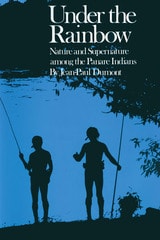
Under the Rainbow
Nature and Supernature among the Panare IndiansBy Jean-Paul Dumont
University of Texas Press, 1976
This ethnographic study of the Panare Indians of Venezuela is the first extensive look at a tribe of this region of the Amazonia. It is an important book not only because it delves into the myth-filled Panare culture, but also because the author has used a modified version of the structural analysis of Claude Lévi-Strauss in examining the Panare.
Lévi-Strauss applied his method of structural analysis to the mythology of many societies in Amazonia, but never to any single society. Jean-Paul Dumont has filled that gap and has shown how the approach works in practice when applied to the intensive study of a single, small-scale culture. His book significantly expands the discussion of the strengths and weaknesses of the method.
The work deals specifically with the implicit mythology of the Panare and is concerned with the symbolic activities manifested in the daily behavior of this group. The analysis of the symbolism, explains Dumont, allows for the discovery of the conceptual system through which the Panare conceive of themselves.
The study is organized into two parts: a presentation of the data and an analysis. The presentation includes a geographical and historical account of the Panare and a general ethnological profile. The analysis is organized into the conceptual categories of inhabited space, time, astrosexuality, hearing, and taste. A concluding chapter summarizes the analysis.
Under the Rainbow will be of interest and of value not only to anthropologists but also to linguists, philosophers, psychologists, and others interested in the general intellectual movement represented by French structuralism. The fieldwork for Under the Rainbow was conducted in Venezuelan Guiana from September 1967 to July 1969.
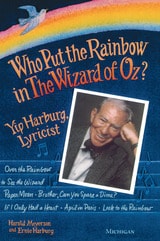
Who Put the Rainbow in The Wizard of Oz?
Yip Harburg, LyricistHarold Meyerson and Ernie Harburg
University of Michigan Press, 1995
Many of us can sing along with Dorothy when she imagines a place "Over the Rainbow." And we all remember the Depression-era classic "Brother, Can You Spare a Dime?" But very few can name the man who put the words to these celebrated hallmarks of American music- Yip Harburg. Five hundred songs spanning a fifty-year career bear witness to the brilliance of this until-now obscure figure.
Plunge into this scrupulously documented volume and discover how Harburg, once a poet of light verse, played a major role in the transformation of the Broadway revue into the sophisticated musical of the 1940s and 1950s. With extensive and exclusive interviews and lyrical analysis, the authors capture Harburg's wit, distinctive voice, and creative and collaborative methods.
Inquiry into Harburg's Jewish, New York City roots, apprenticeship in his craft, and involvement in the radical politics of the 1930s- he was blacklisted in the 1950s- puts into context the seemingly irreconcilable skepticism and optimism that contoured this lyrical genius's life and work.
Harold Meyerson is Executive Editor and chief political columnist, L.A. Weekly, and is on the editorial board of Dissent. Ernie Harburg is a social psychologist and epidemiologist at the University of Michigan, coauthor (with Bernard Rosenberg) of The Broadway Musical: Collaboration in Commerce and Art, and Yip Harburg's son.