Results by title
6 books match the query 'Ralph Ellison'
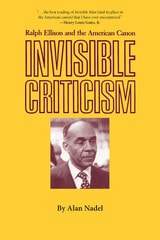
Invisible Criticism
Ralph Ellison and the American CanonAlan Nadel
University of Iowa Press, 1991
In 1952 Ralph Ellison won the National Book Award for his Kafkaesque and claustrophobic novel about the life of a nameless young black man in New York City. Although Invisible Man has remained the only novel that Ellison published in his lifetime, it is generally regarded as one of the most important works of fiction in our century.
This new reading of a classic work examines Ellison's relation to and critique of the American literary canon by demonstrating that the pattern of allusions in Invisible Man forms a literary-critical subtext which challenges the accepted readings of such major American authors as Emerson, Melville, and Twain.
Modeling his argument on Foucault's analysis of the asylum, Nadel analyzes the institution of the South to show how it moved blacks from "enslavement" to "slavery" to "invisibility"—all in the interest of maintaining an organization of power based on racial caste. He then demonstrates the ways Ellison wrote in the modernist/surreal tradition to trace symbolically the history of blacks in America as they moved not only from the nineteenth century to the twentieth, and from the rural South to the urban North, but as they moved (sometimes unnoticed) through American fiction.
It is on this latter movement that Nadel focuses his criticism, first demonstrating theoretically that allusions can impel reconsideration of the alluded-to text and thus function as a form of literary criticism, and then reading the specific criticism implied by Ellison's allusions to Emerson's essays and Lewis Mumford's The Golden Days, as well as to "Benito Cereno" and The Adventures of Huckleberry Finn. Nadel also considers Ellison's allusions to Whitman, Eliot, Joyce, and the New Testament.
Invisible Criticism will be of interest not only to students of American and Afro-American literature but also to those concerned about issues of literary theory, particularly in the areas of intertextual relationships, canonicity, and rehistoricism.
Jazz Country
Ralph Ellison in AmericaHorace A. Porter
University of Iowa Press, 2001
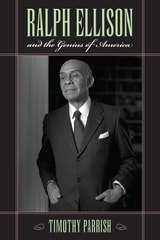
Ralph Ellison and the Genius of America
Timothy Parrish
University of Massachusetts Press, 2012
Ralph Ellison has long been admired as the author of one of the most important American novels of the twentieth century, Invisible Man. Yet he has also been dismissed by some critics as a writer who only published one major work of fiction and a black intellectual out of touch with his times. In this book, Timothy Parrish offers a fundamentally different assessment of Ellison's legacy, describing him as the most important American writer since William Faulkner and someone whose political and cultural achievements have not been fully recognized.
Embracing jazz artist Wynton Marsalis's characterization of Ellison as the unacknowledged “political theorist” of the civil rights movement, Parrish argues that the defining event of Ellison's career was not Invisible Man but the 1954 Supreme Court decision that set his country on the road to racial integration. In Parrish's view, no other American intellectual, black or white, better grasped the cultural implications of the new era than Ellison did; no other major American writer has been so misunderstood.
Drawing on Ellison's recently published “unfinished” novel, newly released archival materials, and unpublished correspondence, Parrish provides a sustained reconsideration of the writer's crucial friendships with Richard Wright, Robert Penn Warren, and C. Vann Woodward to show how his life was dedicated to creating an American society in which all could participate equally. By resituating Ellison's career in the historical context of its making, Parrish challenges the premises that distorted the writer's reception in his own lifetime to make the case for Ellison as the essential visionary of post–Civil War America.

Ralph Ellison
The Next Fifty Years, Volume 23Ronald A. T. Judy and Jonathan Arac, eds.
Duke University Press, 0
Several essays in this collection focus on an area of Ellison’s thinking that has yet to be adequately scrutinized—his study of, and writing about, music, specifically jazz and the blues. Although not a systematic philosopher of music, Ellison exhibited the seriousness and rigor associated with the critical musical writings of Theodor Adorno and Edward Said. Other essays in this special issue examine salient questions raised by Ellison’s work, including the nature of the connection between the novel and the democratic mind, Vietnam and the crisis of liberal society, and the problematic of modernism and freedom. Ralph Ellison addresses the ways in which Ellison’s writings about art were also efforts to think about and discuss political agency.
Contributors. Jonathan Arac, Kevin Bell, Adam Gussow, Ronald A. T. Judy, Robert O’Meally, Donald E. Pease, Barry Shank, Hortense Spillers, Kenneth Warren, Alexander G. Weheliye, John Wright
So Black and Blue
Ralph Ellison and the Occasion of CriticismKenneth W. Warren
University of Chicago Press, 2003
What would it mean to read Invisible Man as a document of Jim Crow America? Using Ralph Ellison's classic novel and many of his essays as starting points, Kenneth W. Warren illuminates the peculiar interrelation of politics, culture, and social scientific inquiry that arose during the post-Reconstruction era and persisted through the Civil Rights movement. Warren argues that Ellison's novel expresses the problem of who or what could represent and speak for the Negro in an age of limited political representation.
So Black and Blue shows that Ellison's successful transformation of these limits into possibilities has also, paradoxically, cast a shadow on the postsegregation world. What can be the direction of African American culture once the limits that have shaped it are stricken down? Here Warren takes up the recent, ongoing, and often contradictory veneration of Ellison's artistry by black writers and intellectuals to reveal the impoverished terms often used in discussions about the political and cultural future of African Americans. Ultimately, by showing what it would mean to take seriously the idea of American novels as creatures of their moment, Warren questions whether there can be anything that deserves the label of classic American literature.
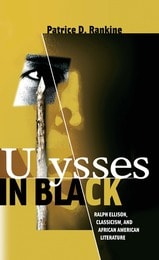
Ulysses in Black
Ralph Ellison, Classicism, and African American LiteraturePatrice D. Rankine
University of Wisconsin Press, 2008
In this groundbreaking work, Patrice D. Rankine asserts that the classics need not be a mark of Eurocentrism, as they have long been considered. Instead, the classical tradition can be part of a self-conscious, prideful approach to African American culture, esthetics, and identity. Ulysses in Black demonstrates that, similar to their white counterparts, African American authors have been students of classical languages, literature, and mythologies by such writers as Homer, Euripides, and Seneca.
Ulysses in Black closely analyzes classical themes (the nature of love and its relationship to the social, Dionysus in myth as a parallel to the black protagonist in the American scene, misplaced Ulyssean manhood) as seen in the works of such African American writers as Ralph Ellison, Toni Morrison, and Countee Cullen. Rankine finds that the merging of a black esthetic with the classics—contrary to expectations throughout American culture—has often been a radical addressing of concerns including violence against blacks, racism, and oppression. Ultimately, this unique study of black classicism becomes an exploration of America’s broader cultural integrity, one that is inclusive and historic.
Outstanding Academic Title, Choice Magazine