Results by title
10 books match the query 'Ranching'
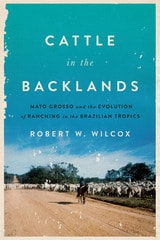
Cattle in the Backlands
Mato Grosso and the Evolution of Ranching in the Brazilian TropicsBy Robert W. Wilcox
University of Texas Press, 2017
Henry A. Wallace Award, The Agricultural History Society, 2018
Brazil has the second-largest cattle herd in the world and is a major exporter of beef. While ranching in the Amazon—and its destructive environmental consequences—receives attention from both the media and scholars, the states of Mato Grosso and Mato Grosso do Sul actually host the most cattle. A significant beef producer in Brazil beginning in the late nineteenth century, the region served as a laboratory for raising cattle in the tropics, where temperate zone ranching practices do not work. Mato Grosso ranchers and cowboys transformed ranching’s relationship with the environment, including the introduction of an exotic cattle breed—the Zebu—that now dominates Latin American tropical ranching.
Cattle in the Backlands presents a comprehensive history of ranching in Mato Grosso. Using extensive primary sources, Robert W. Wilcox explores three key aspects: the economic transformation of a remote frontier region through modern technical inputs; the resulting social changes, especially in labor structures and land tenure; and environmental factors, including the long-term impact of ranching on ecosystems, which, he contends, was not as detrimental as might be assumed. Wilcox demonstrates that ranching practices in Mato Grosso set the parameters for tropical beef production in Brazil and throughout Latin America. As the region was incorporated into national and international economic structures, its ranching industry experienced the entry of foreign investment, the introduction of capitalized processing facilities, and nascent discussions of ecological impacts—developments that later affected many sectors of the Brazilian economy.
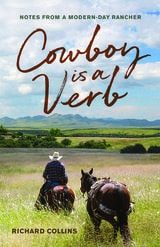
Cowboy is a Verb
Notes from a Modern-day RancherRichard Collins
University of Nevada Press, 2019
A born storyteller with a flair for words, Collins breathes life into the geology, history, and interdependency of land, water, and native and introduced plants and animals. He conjures indelible portraits of the hardworking, dedicated people he comes to know. With both humor and humility, he recounts the day-to-day challenges of ranch life such as how to build a productive herd, distribute your cattle evenly across a rough and rocky landscape, and establish a grazing system that allows pastures enough time to recover. He also intimately recounts a battle over the endangered Gila topminnow and how he and his neighbors worked with university range scientists, forest service conservationists, and funding agencies to improve their ranches as well as the ecological health of the Redrock Canyon watershed.
Ranchers who want to stay in the game don’t dominate the landscape; instead, they have to continually study the land and the animals it supports. Collins is a keen observer of both. He demonstrates that patience, resilience, and a common-sense approach to conservation and range management are what counts, combined with an enduring affection for nature, its animals, and the land. Cowboy is a Verb is not a romanticized story of cowboy life on the range, rather it is a complex story of the complicated work involved with being a rancher in the twenty-first-century West.
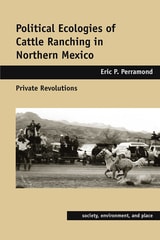
Political Ecologies of Cattle Ranching in Northern Mexico
Private RevolutionsEric P. Perramond
University of Arizona Press, 2010
In this study of the Río Sonora region of northern Mexico, where ranchers own anywhere from several hundred to tens of thousands of acres, Eric Perramond evaluates management techniques, labor expenditures, gender roles, and decision-making on private ranches of varying size. By examining the economic and ecological dimensions of daily decisions made on and off the ranch he shows that, contrary to prevailing notions, ranchers rarely collude as a class unless land titles are at issue, and that their decision-making is as varied as the landscapes they oversee.
Through first-hand observation, field measurements, and intimate ethnographies, Perramond sheds light on a complex set of decisions made, avoided, and confronted by these land managers and their families. He particularly shows that ranching has endured because of its extended kinship network, its reliance on all household members, and its close ties to local politics.
Perramond follows ranchers caught between debt, drought, and declining returns to demonstrate the novel approaches they have developed to adapt to changing economies and ecologies alike—such as strategically marketing the ranches for wild-game hunting or establishing small businesses that subsidize their lifestyles and livelihoods. Even more importantly, he reveals the false dichotomy between private and communal ranching. Political Ecologies of Cattle Ranching in Northern Mexico is essential reading for anyone interested in the future of ranching in western North America.
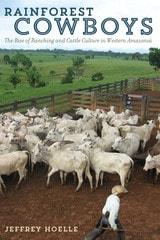
Rainforest Cowboys
The Rise of Ranching and Cattle Culture in Western AmazoniaBy Jeffrey Hoelle
University of Texas Press, 2015
This ambitious interdisciplinary study is the first to examine the interlinked economic uses and cultural practices and beliefs surrounding cattle in Western Amazonia, where cattle raising is at the center of debates about economic development and environ
Winner, Brazil Section Book Award, Latin American Studies Association, 2016
The opening of the Amazon to colonization in the 1970s brought cattle, land conflict, and widespread deforestation. In the remote state of Acre, Brazil, rubber tappers fought against migrant ranchers to preserve the forest they relied on, and in the process, these “forest guardians” showed the world that it was possible to unite forest livelihoods and environmental preservation. Nowadays, many rubber tappers and their children are turning away from the forest-based lifestyle they once sought to protect and are becoming cattle-raisers or even caubois (cowboys). Rainforest Cowboys is the first book to examine the social and cultural forces driving the expansion of Amazonian cattle raising in all of their complexity.
Drawing on eighteen months of fieldwork, Jeffrey Hoelle shows how cattle raising is about much more than beef production or deforestation in Acre, even among “carnivorous” environmentalists, vilified ranchers, and urbanites with no land or cattle. He contextualizes the rise of ranching in relation to political economic structures and broader meanings to understand the spread of “cattle culture.” This cattle-centered vision of rural life builds on local experiences and influences from across the Americas and even resembles East African cultural practices. Written in a broadly accessible and interdisciplinary style, Rainforest Cowboys is essential reading for a global audience interested in understanding the economic and cultural features of cattle raising, deforestation, and the continuing tensions between conservation and development in the Amazon.
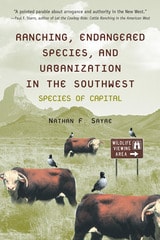
Ranching, Endangered Species, and Urbanization in the Southwest
Species of CapitalNathan F. Sayre
University of Arizona Press, 2002
Nathan Sayre now takes a close look at how the ranching ideal has come into play in the conversion of a large tract of Arizona rangeland from private ranch to National Wildlife Refuge. He tells how the Buenos Aires Ranch, a working operation for a hundred years, became not only a rallying point for multiple agendas in the "rangeland conflict" after its conversion to a wildlife refuge but also an expression of the larger shift from agricultural to urban economies in the Southwest since World War II.
The U.S. Fish and Wildlife Service bought the Buenos Aires Ranch in 1985, removed all livestock, and attempted to restore the land to its "original" grassland in order to protect an endangered species, the masked bobwhite quail. Sayre examines the history of the ranch and the bobwhite together, exploring the interplay of social, economic, and ecological issues to show how ranchers and their cattle altered the land—for better or worse—during a century of ranching and how the masked bobwhite became a symbol for environmentalists who believe that the removal of cattle benefits rangelands and wildlife.
Sayre evaluates both sides of the Buenos Aires controversy—from ranching's impact on the environment to environmentalism's sometimes misguided efforts at restoration—to address the complex and contradictory roles of ranching, endangered species conservation, and urbanization in the social and environmental transformation of the West. He focuses on three dimensions of the Buenos Aires story: the land and its inhabitants, both human and animal; the role of government agencies in shaping range and wildlife management; and the various species of capital—economic, symbolic, and bureaucratic—that have structured the activities of ranchers, environmentalists, and government officials.
The creation of the Buenos Aires National Wildlife Refuge has been a symbolic victory for environmentalists, but it comes at the cost of implicitly legitimizing the ongoing fragmentation and suburbanization of Arizona's still-wild rangelands. Sayre reveals how the polarized politics of "the rangeland conflict" have bound the Fish and Wildlife Service to a narrow, ineffectual management strategy on the Buenos Aires, with greater attention paid to increasing tourism from birdwatchers than to the complex challenge of restoring the masked bobwhite and its habitat. His findings show that the urban boom of the late twentieth century echoed the cattle boom of a century before—capitalizing on land rather than grass, humans rather than cattle—in a book that will serve as a model for restoration efforts in any environment.
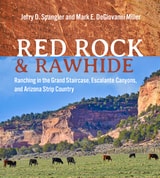
Red Rock and Rawhide
Ranching in the Grand Staircase, Escalante Canyons, and Arizona Strip CountryJerry D. Spangler and Mark E. DeGiovanni Miller
University of Utah Press, 2024
Today, the relatively few cattle ranchers who continue to operate in southern Utah are part of a complex political and social mix of peoples and interests, as Indigenous nations, environmentalists, politicians, and tourists all have differing positions on land use in the region. In Red Rock and Rawhide, Jerry D. Spangler and Mark E. DeGiovanni Miller provide the first comprehensive examination of the history of livestock grazing in the Grand Staircase-Escalante National Monument and surrounding areas, drawing on years of research to show how the culture and industry have changed and continue to evolve.
Roots and Resilience
California Ranchers in Their Own WordsSusan Edinger Marshall
University of Nevada Press, 2024
The editors have drawn together these stories, poems, and musings from ranchers across the state, calling upon real people to share their experiences, and beckoning readers to find a shared understanding concerning often divisive land-use topics. Many perspectives are considered, including those of transplanted suburbanites to seventh-generation heirs. Notably, many women’s writings are including in the book, offering unique and valuable perspectives on ranching culture.
Roots and Resilience gives voice to California’s Indigenous, Mexican American, Basque and other European American ranchers, asking the reader to find common ground in the name of land stewardship and conservation.
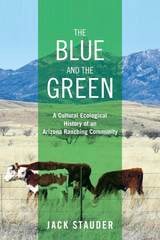
The Blue and the Green
A Cultural Ecological History of an Arizona Ranching CommunityJack Stauder
University of Nevada Press, 2016
In The Blue and the Green, anthropologist Jack Stauder analyzes how large-scale political, social, and environmental processes have transformed ranching and rural life in the West. Focusing on the community of Blue, Arizona, Stauder details how the problems of overgrazing, erosion, and environmental stresses on the open range in the early twentieth century coincided with a push by the newly created US Forest Service to develop fenced grazing allotments on federal lands. Later in the twentieth century, with the enactment of the Endangered Species Act and other laws, the growing power of urban-based environmental groups resulted in the reduction of federal grazing leases throughout the West.
The author combines historical research with oral interviews to explore the impact of these transformations on the ranchers residing in the Blue River Valley of eastern Arizona. Stauder gives voice to these ranchers, along with Forest Service personnel, environmental activists, scientists, and others involved with issues on “the Blue,” shedding light on how the ranchers’ rural way of life has changed dramatically over the course of the past century. This is a fascinating case study of the effects of increasing government regulations and the influence of outsiders on ranching communities in the American West.
The Table
Seasons on a Colorado RanchLara Richardson
University Press of Colorado, 2024
This Ecstatic Nation
The American Landscape and the Aesthetics of PatriotismTerre Ryan
University of Massachusetts Press, 2011
Terre Ryan examines this phenomenon by exploring the overlapping trails of national mythology, landscape aesthetics, patriotic discourse, and public policy. Tracing her journeys around bombing grounds in Nevada, logging sites in Oregon, and energy fields in Wyoming, she argues that business and government agencies often frame commercial projects and national myths according to nineteenth-century beliefs about landscape and bounty. Advertisements and political promotional materials following this aesthetic framework perpetuate frontier-era ideas about the environment as commodity, scenery, and cultural trashlands. Transmitted through all types of media, nineteenth-century perspectives on landscape continue to inform mainstream perceptions of the environment, environmental policies, and representations of American patriotism.
Combining personal narrative with factual reportage, political and cultural critique, and historical analysis, Ryan reframes the images we see every day and places them into a larger national narrative.