Results by title
4 books match the query 'Rancière, Jacques'
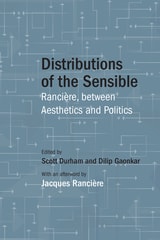
Distributions of the Sensible
Rancière, between Aesthetics and PoliticsEdited by Scott Durham and Dilip Gaonkar With an afterword by Jacques Rancière
Northwestern University Press, 2019
Jacques Rancière’s work is increasingly central to several debates across the humanities. Distributions of the Sensible confronts a question at the heart of his thought: How should we conceive the relationship between the “politics of aesthetics” and the “aesthetics of politics”? Specifically, the book explores the implications of Rancière’s rethinking of the relationship of aesthetic to political democracy from a wide range of critical perspectives.
Distributions of the Sensible contains original essays by leading scholars on topics such as Rancière’s relation to political theory, critical theory, philosophical aesthetics, and film. The book concludes with a new essay by Rancière himself that reconsiders the practice of theory between aesthetics and politics.
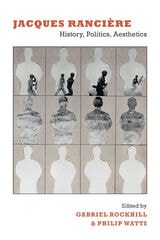
Jacques Rancière
History, Politics, AestheticsGabriel Rockhill and Philip Watts, eds.
Duke University Press, 2009
The contributors to this collection do not simply elucidate Rancière’s project; they also critically respond to it from their own perspectives. They consider the theorist’s engagement with the writing of history, with institutional and narrative constructions of time, and with the ways that individuals and communities can disturb or reconfigure what he has called the “distribution of the sensible.” They examine his unique conception of politics as the disruption of the established distribution of bodies and roles in the social order, and they elucidate his novel account of the relationship between aesthetics and politics by exploring his astute analyses of literature and the visual arts. In the collection’s final essay, Rancière addresses some of the questions raised by the other contributors and returns to his early work to provide a retrospective account of the fundamental stakes of his project.
Contributors. Alain Badiou, Étienne Balibar, Bruno Bosteels, Yves Citton, Tom Conley, Solange Guénoun, Peter Hallward, Todd May, Eric Méchoulan, Giuseppina Mecchia, Jean-Luc Nancy, Andrew Parker, Jacques Rancière, Gabriel Rockhill, Kristin Ross, James Swenson, Rajeshwari Vallury, Philip Watts
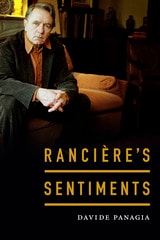
Rancière's Sentiments
Davide Panagia
Duke University Press, 2018
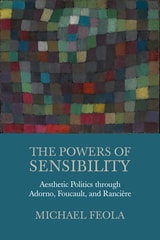
The Powers of Sensibility
Aesthetic Politics through Adorno, Foucault, and RancièreMichael Feola
Northwestern University Press, 2018
Feola provides insightful engagements with the works of Adorno, Foucault, and Rancière as well as a survey of contemporary debates on aesthetics and politics. He uses this aesthetic framework to develop a more robust account of political agency, demonstrating that politics is not reducible to the exchange of views or the building of institutions, but rather incorporates public modes of feeling, seeing, and hearing (or not-seeing and not-hearing). These sensory modes must themselves be transformed in the work of emancipatory politics.
The book explores the core question: what does the aesthetic offer that is missing from the official languages of politics, citizenship, and power? Of interest to readers in the fields of critical theory, political theory, continental philosophy, and aesthetics, The Powers of Sensibility roots itself within the classical tradition of critical theory and yet uses these resources to speak to a variety of contemporary political movements.