Results by title
4 books match the query 'Rape in universities and colleges'

Addressing Violence Against Women on College Campuses
Catherine Kaukinen
Temple University Press, 2017
Violence against women on college campuses has remained underreported and often under addressed by both campus security and local law enforcement, as well as campus administrators. The researchers, practitioners, and activists who contribute to this pertinent volume Addressing Violence Against Women on College Campuses examine the extent, nature, dynamic and contexts of violence against women at institutions of higher education.
This book is designed to facilitate an ongoing discussion and provide direction on how best to prevent and investigate violence against women, and intervene to assist victims while reducing the impact of these crimes. Chapters detail the necessary changes and implications that are part of Title IX and other federal legislation and initiatives as well as the effect these changes have had for higher education actors, including campus administrators, victim advocates, and student activists. The contributors also explore the importance of campus efforts to estimate the extent of violence against women; educating young men and women on the nature of sexual and dating violence; and shifting efforts to both make offenders accountable for their crimes and prompt all bystanders to act.
Addressing Violence Against Women on College Campuses urgently argues to make violence prevention is not separate from but rather an integral part of the student experience.
Contributors include: Antonia Abbey, Joanne Belknap, Ava Blustein, Stephanie Bonnes, Alesha Cameron, Sarah L. Cook, Walter S. DeKeseredy. Helen Eigenberg, Kate Fox, Christopher P. Krebs, Jennifer Leili, Christine Lindquist, Sarah McMahon, Caitlyn Meade, Christine Mouton, Matt R. Nobles, Callie Marie Rennison, Meredith M. Smith, Carmen Suarez, and the editors.
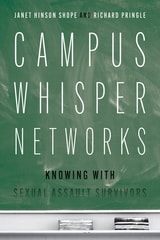
Campus Whisper Networks
Knowing with Sexual Assault SurvivorsJanet Hinson Shope
Rutgers University Press, 2026
Campus Whisper Networks examines how personal knowledge about student sexual assault circulates within college campus communities. Based upon both qualitative and quantitative survey data, Janet Hinson Shope and Richard Pringle's research demonstrates that students who have been sexually assaulted tell someone—almost always a friend. Most college students know someone who has been assaulted. Simply knowing, by means of relationships, that one or more peers have been assaulted affects the knowers, and the effects reverberate unevenly across campuses.
Shope and Pringle highlight the structural properties that prohibit relational knowledge from becoming official institutional knowledge, confining it to whispers and secrecy within informal spheres of knowledge. The rules governing the circulation of such knowledge create an uneven epistemic field of sexual assault. This uneven field is consequential for the communities, affecting survivors and their confidants and shaping student views of the college community. Campus Whisper Networks demonstrates how personal and institutional avoidance, both the “need to not know” and “no need to know,” creates knowledge gaps that hide the community’s wounds and prevent personal knowledge from becoming social knowledge.
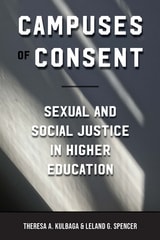
Campuses of Consent
Sexual and Social Justice in Higher EducationTheresa A. Kulbaga and Leland G. Spencer
University of Massachusetts Press, 2019
Winner of the 2020 OSCLG Outstanding Book Award
This new book for scholars and university administrators offers a provocative critique of sexual justice language and policy in higher education around the concept of consent. Complicating the idea that consent is plain common sense, Campuses of Consent shows how normative and inaccurate concepts about gender, gender identity, and sexuality erase queer or trans students' experiences and perpetuate narrow, regressive gender norms and individualist frameworks for understanding violence.
Theresa A. Kulbaga and Leland G. Spencer prove that consent in higher education cannot be meaningfully separated from larger issues of institutional and structural power and oppression. While sexual assault advocacy campaigns, such as It's On Us, federal legislation from Title IX to the Clery Act, and more recent affirmative-consent measures tend to construct consent in individualist terms, as something “given” or “received” by individuals, the authors imagine consent as something that can be constructed systemically and institutionally: in classrooms, campus communication, and shared campus spaces.

Centering Student Activism
Feminist Rhetorical Interruptions of Sexual Assault CultureShari J. Stenberg
Utah State University Press, 2026
Centering Student Activism is a deep exploration of institutional responses to sexual assault. It addresses critical issues facing campuses today, examining how students navigate institutional dynamics and utilize the power of new and traditional rhetorical strategies to effect change. In doing so, it provides a profound understanding of the mechanisms by which coalitions can transform educational environments.
Centering Student Activism features a national interview-based study of contemporary student activists who deploy rhetorical strategies and tactics—old and new, embodied and digital—with agility and awareness. They aim their strategies and tactics of “intersectional rhetorical feminism” to interrupt and transform a sedimented culture. The students’ activism highlights not only the harms experienced by survivors in the aftermath of their assaults but also how their efforts to communicate those harms are often stymied or silenced by official responses and practices. These student activists pair interruption with rhetorical transformation as they seek to create a survivor-centric culture. In so doing they spotlight the systemic roots of sexual violence and respond to sexual assault through intersectional, coalition-based work.
Through detailed analysis and compelling narratives, Shari J. Stenberg underscores the importance of community care and mutual support in advocacy efforts. Centering Student Activism is an essential work for navigating institutional dynamics, providing an important resource to students, educators, and administrators who seek to understand how universities silence survivors and how students create ways to speak back and transform institutional culture.