Results by title
3 books match the query 'Rats'
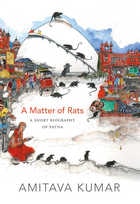
A Matter of Rats
A Short Biography of PatnaAmitava Kumar
Duke University Press, 2014
It is not only the past that lies in ruins in Patna, it is also the present. But that is not the only truth about the city that Amitava Kumar explores in this vivid, entertaining account of his hometown. We accompany him through many Patnas, the myriad cities locked within the city—the shabby reality of the present-day capital of Bihar; Pataliputra, the storied city of emperors; the dreamlike embodiment of the city in the minds and hearts of those who have escaped contemporary Patna's confines. Full of fascinating observations and impressions, A Matter of Rats reveals a challenging and enduring city that exerts a lasting pull on all those who drift into its orbit.
Kumar's ruminations on one of the world's oldest cities, the capital of India's poorest province, are also a meditation on how to write about place. His memory is partial. All he has going for him is his attentiveness. He carefully observes everything that surrounds him in Patna: rats and poets, artists and politicians, a girl's picture in a historian's study, and a sheet of paper on his mother's desk. The result is this unique book, as cutting as it is honest.
Kumar's ruminations on one of the world's oldest cities, the capital of India's poorest province, are also a meditation on how to write about place. His memory is partial. All he has going for him is his attentiveness. He carefully observes everything that surrounds him in Patna: rats and poets, artists and politicians, a girl's picture in a historian's study, and a sheet of paper on his mother's desk. The result is this unique book, as cutting as it is honest.
[more]
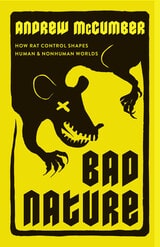
Bad Nature
How Rat Control Shapes Human and Nonhuman WorldsAndrew McCumber
University of Chicago Press, 2025
Offers insights into the social and cultural implications of humans’ relationships with rats and the natural world.
Apart from the occasional pet owner who has rats, most people regard rats as disease-carrying nocturnal pests, scurrying around dumpsters and dragging slices of pizza through New York City subways. Since rats are seemingly omnipresent in human life, why do we harbor such negative feelings about them, and why are they among the creatures most frequently targeted for systematic extermination?
In Bad Nature, sociologist Andrew McCumber draws out the cultural underpinnings of rat extermination across three countries and two continents. Drawing from ethnographic, interview, and textual data from the frigid prairie of Alberta, Canada; the heart of downtown Los Angeles, California; and the iconic Galápagos Islands of Ecuador, McCumber studies how humans have sought to suppress and exterminate rat populations in a variety of environmental, social, and political situations. He shows how, in these disparate locations, rat control is a social practice that draws and clarifies the spatial and symbolic boundaries between “good” and “bad” forms of nature. Rats are near the bottom of a symbolic hierarchy of species that places human life at the top, companion animals and majestic wildlife just below them, and the “invasive species” that call for systematic extermination at the very bottom. This hierarchy of living things that places rats at the bottom, McCumber argues, mirrors human systems of social inequalities and power dynamics.
Both original and engaging, Bad Nature urges readers to consider, when charting a just and sustainable future, where will the rats be placed in the worlds we envision?
[more]

Experimental Leukemia and Mammary Cancer
Induction, Prevention, CureCharles Brenton Huggins
University of Chicago Press, 1979
Charles Brenton Huggins won the Nobel prize in 1966 for his extensive work in cancer research. He has spent fifty years at the laboratory bench exploring the nature of this disease in an attempt to understand and control it. In this volume, based almost exclusively on experiments conducted over the past twenty years at the University of Chicago, is both the record of Huggins's own research and, in Huggins's words, "a do-it-yourself guide for cancer research workers." Written simply and clearly so that the experiments can be easily reproduced, the book presents Huggins's experiments in the induction of breast cancer and leukemia in rodents. It also describes the methods he discovered to prevent cancer and to cure many of the cancers he has been able to induce. Although most of the material concerns breast cancer and leukemia, research on other kinds of tumors is also described.
[more]