Results by title
2 books match the query 'Ravensbrück (Concentration camp)'
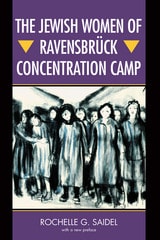
The Jewish Women of Ravensbrück Concentration Camp
Rochelle G. Saidel
University of Wisconsin Press, 2006
While this camp was designed to hold 5,000 women, the actual figure was six times this number. Between 1939 and 1945, 132,000 women from twenty-three countries were imprisoned in Ravensbrück, including political prisoners, Jehovah's Witnesses, "asocials" (including Gypsies, prostitutes, and lesbians), criminals, and Jewish women (who made up about 20 percent of the population). Only 15,000 survived.
Drawing upon more than sixty narratives and interviews of survivors in the United States, Israel, and Europe as well as unpublished testimonies, documents, and photographs from private archives, Rochelle Saidel provides a vivid collective and individual portrait of Ravensbrück’s Jewish women prisoners. She worked for over twenty years to track down these women whose poignant testimonies deserve to be shared with a wider audience and future generations. Their memoirs provide new perspectives and information about satellite camps (there were about 70 slave labor sub-camps). Here is the story of real daily camp life with the women’s thoughts about food, friendships, fear of rape and sexual abuse, hygiene issues, punishment, work, and resistance. Saidel includes accounts of the women's treatment, their daily struggles to survive, their hopes and fears, their friendships, their survival strategies, and the aftermath.
On April 30, 1945, the Soviet Army liberated Ravensbrück. They found only 3,000 extremely ill women in the camp, because the Nazis had sent other remaining women on a death march. The Jewish Women of Ravensbrück Concentration Camp reclaims the lost voices of the victims and restores the personal accounts of the survivors.

Tomorrow Will Be Better
Surviving Nazi GermanyWalter Meyer with the assistance of Matt Valentine
University of Missouri Press, 1999
How does a young German who has been a member of the Hitler Youth and has competed in Nazi-organized athletic competitions become, over the span of two years, an eighty-pound, tuberculosis-stricken concentration camp escapee?
In this larger-than-life memoir, Walter Meyer leads readers from one harrowing moment to the next as he recounts his experiences during and after Hitler's reign. As a teenager, Meyer refused to conform to institutional rules. While serving in the Hitler Youth, he rebelled by joining a subversive group that focused its efforts on pranks against the youth organization. During World War II, Meyer was arrested, interrogated, and beaten for stealing shoes, but he received a sentence of one to four years, as opposed to the standard penalty for looting—death.
The sixteen-year-old Meyer's refusal to conform to prison regulations and his foiled escape attempts resulted in solitary confinement on several occasions. His fiery spirit eventually landed him in a Nazi work camp. Unbeknownst to his family, Meyer became a concentration camp prisoner. Transported to Ravensbrueck, he was forced to work under grueling conditions in a quarry. He struggled to reach his daily work quota so he could dine on watery broth and bits of bread. In these subhuman conditions, Meyer developed tuberculosis. Knowing he would soon die in the camp, he again plotted his escape. This time he succeeded.
Upon returning home to Duesseldorf, Meyer despaired at the destruction of his hometown. He lamented the pallor that had spread throughout the town and the country itself. After recovering his health, he regained his youthful lust for adventure. His postwar travels began with his infiltration of the Russian-occupied zone of Germany to retrieve his family's possessions. Meyer then began a whirlwind odyssey, ducking into train cars and stowing away on ships, occasionally landing in jail for traveling without a passport—from France to Spain, Belgium to Holland, and finally to South America--in pursuit of something other than the aftermath of war.
Meyer's memoir gives insight into the climate in Germany during World War II and in the defeated nation after the war. His experience as a non-Jewish survivor of the Nazi concentration camps provides an enlightening and varied perspective to the Holocaust dialogue.