Results by title
3 books match the query 'Reaction'
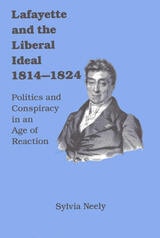
Lafayette and the Liberal Ideal 1814-1824
Politics and Conspiracy in an Age of ReactionSylvia Neely
Southern Illinois University Press, 1991
Sylvia Neely provides both the first scholarly study of Lafayette’s life after the French Revolution and a detailed analysis of French politics during the early Restoration.
Lafayette, advocating a liberalism based on the American example, used both legal and illegal means to overturn a conservative government. The personification of liberalism for many of his contemporaries, he and his friends Benjamin Constant, Voyer d’Argenson, and Charles Goyet saw themselves as fighters in an international struggle that set liberalism against the forces of reaction and obscurantism. Although he ultimately failed, Lafayette was convinced that the liberal ideals derived from the Enlightenment and from his personal mentor, George Washington, would prevail.
Neely makes Lafayette’s actions clear by considering seriously the principles that guided his life and by describing the political climate of the early nineteenth century. She discloses previously overlooked features of the revolutions of the 1820s which account for the divisions among the revolutionary groups. She also examines relationships between Lafayette and the prominent writers and thinkers of the period, among them Augustin Thierry, Jeremy Bentham, Lady Morgan, and Frances Wright.
Reaction and Revolution
Rhetorics of the Radical RightKevin Musgrave
Michigan State University Press, 2027
Reaction and Revolution situates the resurgence of far-right movements and thinkers within a longer intellectual history that emerged primarily in interwar Germany—a philosophical conversation centered on political theology. Arguing that the more radically democratic modes of political theology offer better ways to understand and to counter the far right’s rhetorical appeal, this book offers a rhetorical-intellectual critique of three key thinkers and their allied movements: Paul Gottfried and the American paleoconservatives, Guillaume Faye and the French Identitarians, and Nick Land and the Dark Enlightenment. Kevin Musgrave argues that a radical political theology of race offers meaningful ways of challenging the right’s efforts to build a global imperium of whiteness and of reclaiming the promise of human dignity.
Reaction to World News Events and the Influence of Mass Media in an Indian Village
Thomas Poffenberger and Shirley B. Poffenberger
University of Michigan Press, 1971