Results by title
9 books match the query 'Reading comprehension'
A Writer's Guide to Mindful Reading
Ellen C. Carillo
University Press of Colorado, 2017

Collaborative Strategies for Teaching Reading Comprehension
Judi Moreillon
American Library Association, 2007
Coteaching Reading Comprehension Strategies in Elementary School Libraries
Maximizing Your ImpactJudi Moreillon
American Library Association, 2013
Coteaching Reading Comprehension Strategies in Secondary School Libraries
Maximizing Your ImpactJudi Moreillon
American Library Association, 2012
Linking Literacies
Perspectives on L2 Reading-Writing ConnectionsDiane Belcher and Alan Hirvela, Editors
University of Michigan Press, 2001
Linking Literacies provides the most up to date theoretical overview of the connection between reading and writing in second language acquisition. Belcher and Hirvela have brought together the definitive collection of developments in reading-writing relations research and pedagogy. Papers are organized into these parts:
Ground Practice: Theory, Research, and History
In the Classroom: Teaching Reading as Writing and Writing as Reading
(E)Merging Literacies and the Challenge of Textual Ownership
Technology-Assisted Reading and Writing.
In addition to examining the ways in which L1 influences have affected the development of L2 reading-writing theory and pedagogy, Linking Literacies looks at how L2 reading-writing scholarship has created an identity separate of an L1 framework. Linking Literacies examines a broad range of questions and concerns within the structure of L2 reading-writing connections and L2 academic literacy through discussions of theory, research, and
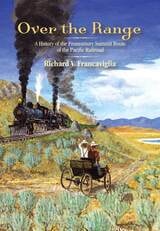
Over the Range
A History of the Promontory Summit Route of the Pacific RailroadRichard V. Francaviglia
Utah State University Press, 2008
Francaviglia looks anew at the geographical-historical context of the driving of the golden spike in May 1869. He gazes outward from the site of the transcontinental railroad's completion—the summit of a remote mountain range that extends south into the Great Salt Lake. The transportation corridor that for the first time linked America's coasts gave this distinctive region significance, but it anchored two centuries of human activity linked to the area's landscape.
Francaviglia brings to that larger story a geographer's perspective on place and society, a railroad enthusiast's knowledge of trains, a cartographic historian's understanding of the knowledge and experience embedded in maps, and a desert lover's appreciation of the striking basin-and-range landscape that borders the Great Salt Lake.
Skim, Dive, Surface
Teaching Digital ReadingJenae Cohn
West Virginia University Press, 2021
Students are reading on screens more than ever—how can we teach them to be better digital readers?
Smartphones, laptops, tablets: college students are reading on-screen all the time, and digital devices shape students’ understanding of and experiences with reading. In higher education, however, teachers rarely consider how digital reading experiences may have an impact on learning abilities, unless they’re lamenting students’ attention spans or the distractions available to students when they’re learning online.
Skim, Dive, Surface offers a corrective to these conversations—an invitation to focus not on losses to student learning but on the spectrum of affordances available within digital learning environments. It is designed to help college instructors across the curriculum teach digital reading in their classes, whether they teach face-to-face, fully online, or somewhere in between. Placing research from cognitive psychology, neuroscience, learning science, and composition in dialogue with insight from the scholarship of teaching and learning, Jenae Cohn shows how teachers can better frame, scaffold, and implement effective digital reading assignments. She positions digital reading as part of a cluster of literacies that students should develop in order to communicate effectively in a digital environment.
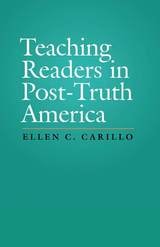
Teaching Readers in Post-Truth America
Ellen C. Carillo
Utah State University Press, 2018
Readers in this post-truth culture are under unprecedented pressure to interpret an overwhelming quantity of texts in many forms, including speeches, news articles, position papers, and social media posts. In response, Carillo describes pedagogical interventions designed to help students become more metacognitive about their own reading and, in turn, better equipped to respond to texts in a post-truth culture.
Teaching Readers in Post-Truth America is an invaluable source of support for writing instructors striving to prepare their students to resist post-truth rhetoric and participate in an information-rich, divisive democratic society.
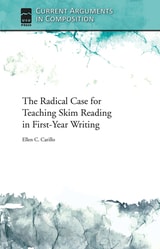
The Radical Case for Teaching Skim Reading in First-Year Writing
Ellen C. Carillo
Utah State University Press, 2025
Data from studies of the lived experiences of undergraduates indicate that students do not need deep reading practices in the majority of their classes across the disciplines and, moreover, that students succeed in their classes by skim reading. Rather than imagining an idealized set of circumstances that allow for sustained deep reading, as does a great deal of the scholarship on reading in writing studies, The Radical Case for Teaching Skim Reading in First-Year Writing argues for teaching students reading practices that will support their success in their college writing assignments rather than those strategies the field believes should support their success.
In our information landscape and our fragile democracy, encouraging skimming as opposed to deep reading may seem like a gamble—this very tendency toward the quick rather than the critical has undoubtedly contributed to the current crisis of mass misinformation. However, teaching students to use skim reading as a strategic tool for purposeful engagement and efficient yet thoughtful information filtering better equips them to navigate the rapidly changing information landscape and manage the fast-paced flow of content from diverse media sources.