Results by title
57 books match the query 'Realism in literature' and 5 start with a
A Probable State
The Novel, the Contract, and the JewsIrene Tucker
University of Chicago Press, 2000
Whereas previous critics have explored the relationship between liberalism and the novel by studying the novel's liberal characters, Tucker argues that the liberal subject is represented not merely within the novel, but in the experience of the novel's form as well. With special attention to George Eliot, Henry James, Oliver Wendell Holmes, and S. Y. Abramovitch, Tucker shows how we can understand liberalism and the novel as modes of recognizing and negotiating with history.

A SUPERFICIAL READING OF HENRY JAMES
PREOCCUPATIONS WITH THE MATERIAL WORLDTHOMAS J OTTEN
The Ohio State University Press, 2006
All Is True
The Claims and Strategies of Realist FictionLilian R. Furst
Duke University Press, 1995
In close textual analyses of works ranging across European and American literature, including paradigmatic texts by Balzac, Flaubert, George Eliot, Zola, Henry James, and Thomas Mann, Furst shows how the handling of time, the presentation of place, and certain narrational strategies have served the realists’ claim. She demonstrates how readers today, like those a hundred years ago, are convinced of the authenticity of the created illusion by such means as framing, voice, perspective, and the slippage from metonymy to metaphor. Further, Furst reveals the pains the realists took to conceal these devices, and thus to protect their claim to be employing a simple form. Taking into account both the claims and the covert strategies of these writers, All Is True puts forward an alternative to the conventional polarized reading of the realist text—which emerges here as neither strictly an imitation of an extraneous model nor simply a web of words but a brilliantly complex imbrication of the two.
A major statement on one of the most enduring forms in cultural history, this book promises to alter not only our view of realist fiction but our understanding of how we read it.
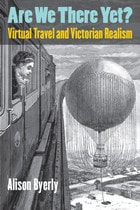
Are We There Yet?
Virtual Travel and Victorian RealismAlison Byerly
University of Michigan Press, 2012
Are We There Yet? Virtual Travel and Victorian Realismconnects the Victorian fascination with "virtual travel" with the rise of realism in nineteenth-century fiction and twenty-first-century experiments in virtual reality. Even as the expansion of river and railway networks in the nineteenth century made travel easier than ever before, staying at home and fantasizing about travel turned into a favorite pastime. New ways of representing place—360-degree panoramas, foldout river maps, exhaustive railway guides—offered themselves as substitutes for actual travel. Thinking of these representations as a form of "virtual travel" reveals a surprising continuity between the Victorian fascination with imaginative dislocation and twenty-first -century efforts to use digital technology to expand the physical boundaries of the self.
At the Limit of the Obscene
German Realism and the Disgrace of MatterErica Weitzman
Northwestern University Press, 2021
As German-language literature turned in the mid-nineteenth century to the depiction of the profane, sensual world, a corresponding anxiety emerged about the terms of that depiction—with consequences not only for realist poetics but also for the conception of the material world itself. At the Limit of the Obscene examines the roots and repercussions of this anxiety in German realist and postrealist literature. Through analyses of works by Adalbert Stifter, Gustav Freytag, Theodor Fontane, Arno Holz, Gottfried Benn, and Franz Kafka, Erica Weitzman shows how German realism’s conflicted representations of the material world lead to an idea of the obscene as an excess of sensual appearance beyond human meaning: the obverse of the anthropocentric worldview that German realism both propagates and pushes to its crisis. At the Limit of the Obscene thus brings to light the troubled and troubling ontology underlying German realism, at the same time demonstrating how its works continue to shape our ideas about representability, alterity, and the relationship of human beings to the non-human well into the present day.