Results by title
5 books match the query 'Receivers and reception'

Microwave and RF Design
A Systems ApproachMichael Steer
The Institution of Engineering and Technology, 2010
[more]

Microwave and RF Design
A Systems Approach, 2nd EditionMichael Steer
The Institution of Engineering and Technology, 2013
[more]

Television
An international history of the formative yearsR.W. Burns
The Institution of Engineering and Technology, 1998
From the first notions of 'seeing by electricity' in 1878, through the period of the first demonstration of rudimentary television in 1926 and up to 1940, when war brought the advance of the technology to a temporary halt, the development of television gathered about it a tremendous history. Following the discovery of the photo-conductive effect, numerous schemes for television were suggested but it was in the wake of Baird's early demonstrations that real industrial interest developed and the pace of progress increased. Much research and development work was undertaken in the UK, the US, Germany and France. By 1936 television technology had advanced to the point where high definition broadcasting was realistic.
[more]

The TVs of Tomorrow
How RCA’s Flat-Screen Dreams Led to the First LCDsBenjamin Gross
University of Chicago Press, 2018
In 1968 a team of scientists and engineers from RCA announced the creation of a new form of electronic display that relied upon an obscure set of materials known as liquid crystals. At a time when televisions utilized bulky cathode ray tubes to produce an image, these researchers demonstrated how liquid crystals could electronically control the passage of light. One day, they predicted, liquid crystal displays would find a home in clocks, calculators—and maybe even a television that could hang on the wall.
Half a century later, RCA’s dreams have become a reality, and liquid crystals are the basis of a multibillion-dollar global industry. Yet the company responsible for producing the first LCDs was unable to capitalize upon its invention. In The TVs of Tomorrow, Benjamin Gross explains this contradiction by examining the history of flat-panel display research at RCA from the perspective of the chemists, physicists, electrical engineers, and technicians at the company’s central laboratory in Princeton, New Jersey.
Drawing upon laboratory notebooks, internal reports, and interviews with key participants, Gross reconstructs the development of the LCD and situates it alongside other efforts to create a thin, lightweight replacement for the television picture tube. He shows how RCA researchers mobilized their technical expertise to secure support for their projects. He also highlights the challenges associated with the commercialization of liquid crystals at RCA and Optel—the RCA spin-off that ultimately manufactured the first LCD wristwatch. The TVs of Tomorrow is a detailed portrait of American innovation during the Cold War, which confirms that success in the electronics industry hinges upon input from both the laboratory and the boardroom.
[more]
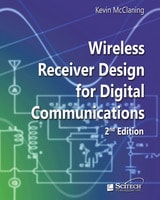
Wireless Receiver Design for Digital Communications
Kevin McClaning
The Institution of Engineering and Technology, 2012
Practical lessons and approaches in radio receiver design for wireless communication systems are the hallmarks of Wireless Receiver Design for Digital Communications, 2nd Edition. Decades of experience 'at the bench' are collected within and the book acts as a virtual replacement for a mentor who teaches basic concepts from a practical perspective and has the war stories that help their 'apprentice' avoid the mistakes of the past.
[more]