Results by title
3 books match the query 'Recognition (Philosophy)'
Indians Playing Indian
Multiculturalism and Contemporary Indigenous Art in North AmericaMonika Siebert
University of Alabama Press, 2015
Explores how American Indian artists have responded to the pervasive misunderstanding of indigenous peoples as cultural minorities in the United States and Canada
Contemporary indigenous peoples in North America confront a unique predicament. While they are reclaiming their historic status as sovereign nations, mainstream popular culture continues to depict them as cultural minorities similar to other ethnic Americans. These depictions of indigenous peoples as “Native Americans” complete the broader narrative of America as a refuge to the world’s immigrants and a home to contemporary multicultural democracies, such as the United States and Canada. But they fundamentally misrepresent indigenous peoples, whose American history has been not of immigration but of colonization.
Monika Siebert’s Indians Playing Indian first identifies this phenomenon as multicultural misrecognition, explains its sources in North American colonial history and in the political mandates of multiculturalism, and describes its consequences for contemporary indigenous cultural production. It then explores the responses of indigenous artists who take advantage of the ongoing popular interest in Native American culture and art while offering narratives of the political histories of their nations in order to resist multicultural incorporation.
Each chapter of Indians Playing Indian showcases a different medium of contemporary indigenous art—museum exhibition, cinema, digital fine art, sculpture, multimedia installation, and literary fiction—and explores specific rhetorical strategies artists deploy to forestall multicultural misrecognition and recover political meanings of indigeneity. The sites and artists discussed include the National Museum of the American Indian in Washington, DC; filmmakers at Inuit Isuma Productions; digital artists/photographers Dugan Aguilar, Pamela Shields, and Hulleah Tsinhnahjinnie; sculptor Jimmie Durham; and novelist LeAnne Howe.
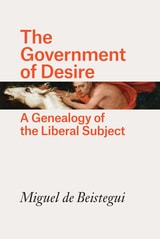
The Government of Desire
A Genealogy of the Liberal SubjectMiguel de Beistegui
University of Chicago Press, 2018
By critically exploring Foucault’s claim that Western civilization is a civilization of desire, de Beistegui crafts a provocative and original genealogy of this shift in thinking. He shows how the relationship between identity, desire, and government has been harnessed and transformed in the modern world, shaping our relations with others and ourselves, and establishing desire as an essential driving force for the constitution of a new and better social order. But is it? The Government of Desire argues that this is precisely what a contemporary politics of resistance must seek to overcome. By questioning the supposed universality of a politics based on recognition and the economic satisfaction of desire, de Beistegui raises the crucial question of how we can manage to be less governed today, and explores contemporary forms of counter-conduct.
Drawing on a host of thinkers from philosophy, political theory, and psychoanalysis, and concluding with a call for a sovereign and anarchic form of desire, The Government of Desire is a groundbreaking account of our freedom and unfreedom, of what makes us both governed and ungovernable.
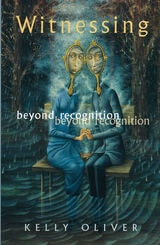
Witnessing
Beyond RecognitionKelly Oliver
University of Minnesota Press, 2001
A new, ethically based theory of identity by a major scholar.
Challenging the fundamental tenet of the multicultural movement-that social struggles turning upon race, gender, and sexuality are struggles for recognition-this work offers a powerful critique of current conceptions of identity and subjectivity based on Hegelian notions of recognition. The author’s critical engagement with major texts of contemporary philosophy prepares the way for a highly original conception of ethics based on witnessing.
Central to this project is Oliver’s contention that the demand for recognition is a symptom of the pathology of oppression that perpetuates subject-object and same-different hierarchies. While theorists across the disciplines of the humanities and social sciences focus their research on multiculturalism around the struggle for recognition, Oliver argues that the actual texts and survivors’ accounts from the aftermath of the Holocaust and slavery are testimonials to a pathos that is “beyond recognition.” Oliver traces many of the problems with the recognition model of subjective identity to a particular notion of vision presupposed in theories of recognition and misrecognition. Contesting the idea of an objectifying gaze, she reformulates vision as a loving look that facilitates connection rather than necessitates alienation. As an alternative, Oliver develops a theory of witnessing subjectivity. She suggests that the notion of witnessing, with its double meaning as either eyewitness or bearing witness to the unseen, is more promising than recognition for describing the onset and sustenance of subjectivity. Subjectivity is born out of and sustained by the process of witnessing-the possibility of address and response-which puts ethical obligations at its heart.