Results by title
2 books match the query 'Recommendations'
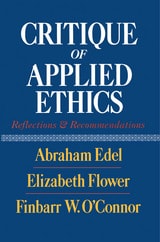
Critique Of Applied Ethics
Reflections and RecommendationsAbraham Edel
Temple University Press, 1994
"Part One is historically rich and analytically sophisticated. It is unquestionably the best treatment of the applied ethics landscape. In Part Two, the authors have an uncanny sense of the issues and a remarkable ability to demythologize the jargon temple of doom, such that controversial philosophical positions are rendered clear.... I look forward to teaching from this book."
--John J. McDermott, Distinguished Professor of Philosophy and Humanities, Professor and Head of Humanities in Medicine, Texas A&M University
Over the past two decades, applied ethics has turned increasingly toward theories that explore ethical questions faced by a variety of professions and away from classic moral concerns. Abraham Edel, Elizabeth Flower, and Finbarr O'Connor utilize examples of professional, public policy, and personal decision making to illustrate the strengths and limitations of the application of ethics in a rapidly changing world.
They first discuss the emergence of applied ethics and how it functions within a philosophical tradition. They are not concerned, however, with solving the problems they expose, but with employing them as a means to critique applied ethics. Using human rights and health and welfare issues, the authors examine the subsequent ethical stumbling blocks that surround the "moral order" of these social concerns. Through a historical discussion of the abundant ethical theories posited since the Enlightenment, they suggest ways to decide which can serve as intellectual tools for applied ethics and consider how knowledge and experience enter into any moral decision.
Turning to the factors pertinent in the analysis and solution of moral problems, they dissect the underlying influences on the practice of ethics, the way in which a moral problem is diagnosed and its relevant contexts established, the ensuing conflicts between the concerns of the individual and of society, and the degree of inventiveness in issues of morality. The authors suggest that, instead of viewing theory as a set consequence derived from prior applications, relating theory to practice will engage a process of mutual aid, from which each element will learn, refining and improving the other.
[more]
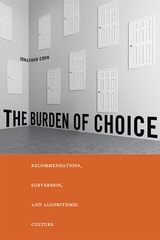
The Burden of Choice
Recommendations, Subversion, and Algorithmic CultureJonathan Cohn
Rutgers University Press, 2019
The Burden of Choice examines how recommendations for products, media, news, romantic partners, and even cosmetic surgery operations are produced and experienced online. Fundamentally concerned with how the recommendation has come to serve as a form of control that frames a contemporary American as heteronormative, white, and well off, this book asserts that the industries that use these automated recommendations tend to ignore and obscure all other identities in the service of making the type of affluence they are selling appear commonplace. Focusing on the period from the mid-1990s to approximately 2010 (while this technology was still novel), Jonathan Cohn argues that automated recommendations and algorithms are far from natural, neutral, or benevolent. Instead, they shape and are shaped by changing conceptions of gender, sexuality, race, and class. With its cultural studies and humanities-driven methodologies focused on close readings, historical research, and qualitative analysis, The Burden of Choice models a promising avenue for the study of algorithms and culture.
[more]