Results by title

11 books match the query 'Recovering'
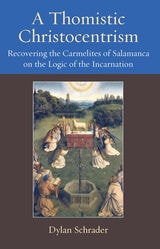
cover of A Thomistic Christocentrism: Recovering the Carmelites of Salamanca on the Logic of the Incarnation

A Thomistic Christocentrism

Recovering the Carmelites of Salamanca on the Logic of the Incarnation

Dylan Schrader

Catholic University of America Press, 2021
Saint Thomas Aquinas famously held the opinion that, in God’s actual plan for the world, the Word would not have become flesh except to redeem us from sin. Conversely, Blessed John Duns Scotus argued that God intended Christ first, such that Christ would have come even if there had been no sin. While Aquinas and Scotus were far from the first to consider this question, they became emblematic of two seemingly irreconcilable approaches. In this book, Father Dylan Schrader recovers the thought of the Salmanticenses, the Discalced Carmelites writing at the University of Salamanca in the seventeenth century. The Salmanticenses argue that Christ is primary in God’s intention precisely as redeemer, so that it is true both that God has made everything else for the sake of Christ and that Christ’s coming is essentially redemptive, connected with sin. In this way, the Salmanticenses offer a Thomistic Christocentrism. This book summarizes the historical background to the Salmanticenses, from the time of Anselm up through the early-modern period. Next, it presents and defends the Salmanticenses’ argument for the primacy of Christ the redeemer. A Thomistic Christocentrism then turns to two key post-conciliar figures, Karl Rahner and Hans Urs von Balthasar. Rahner sees Christ as the culmination of the world’s opening up to God. Balthasar sees Christ as the reconciler of divine and human freedom through his cross, descent, and resurrection. Both Christocentric approaches have good aspirations but suffer from serious flaws. In its final chapters, this book applies the Salamanca theory to Rahner and Balthasar, showing its enduring value for post-conciliar Christocentrism.
[more]
cover of Anthems, Sonnets, and Chants: Recovering the African American Poetry of the 1930s

Anthems, Sonnets, and Chants

Recovering the African American Poetry of the 1930s

Jon Woodson

The Ohio State University Press, 2011
In the 1930s African Americans faced three distinct historical crises that impacted the lives of African Americans directly—the Great Depression, the existential-identity crisis, and the Italo-Ethiopian War, with its threat of a race war. A sizeable body of black poetry was produced in this decade, which captured the new modes of autonomy through which black Americans resisted these social calamities. Much of it, however, including the most influential protest poems, was dismissed as “romantic” by major, leftist critics and anthologists.
 
Anthems, Sonnets, and Chants: Recovering the African American Poetry of the 1930s, by Jon Woodson, uses social philology to unveil social discourse, self fashioning, and debates in poems gathered from anthologies, magazines, newspapers, and individual collections. The first chapter examines three long poems, finding overarching jeremiadic discourse that inaugurated a militant, politically aware agent. Chapter two examines self-fashioning in the numerous sonnets that responded to the new media of radio, newsreels, movies, and photo-magazines. The third chapter shows how new subjectivities were generated by poetry addressed to the threat of race war in which the white race was exterminated.
 
The black intellectuals who dominated the interpretative discourses of the 1930s fostered exteriority, while black culture as a whole plunged into interiority. Anthems, Sonnets, and Chants delineates the struggle between these inner and outer worlds, a study made difficult by a contemporary intellectual culture which recoils from a belief in a consistent, integrated self.
 
[more]
cover of Flannery O'Connor and Blaise Pascal: Recovering the Incarnation for the Modern Mind

Flannery O'Connor and Blaise Pascal

Recovering the Incarnation for the Modern Mind

Ann Hartle

Catholic University of America Press, 2025
Flannery O’Connor is a guide for the Catholic who seeks to gain a deeper understanding of what it means to live the life of faith in the modern world. O’Connor describes herself as a Catholic burdened by the modern consciousness which the psychologist Carl Gustav Jung views as “unhistorical, solitary, and guilty.” Ann Hartle understands O’Connor’s fiction as her confrontation with this specifically modern form of consciousness. The seventeenth-century philosopher Blaise Pascal helps us to experience the meaning of O’Connor’s fiction because Pascal confronted that same consciousness in its origins in Montaigne’s philosophy. O’Connor recognizes in Pascal a truly Catholic modern philosopher who speaks to the experience of the searching mind of modern man. Flannery O'Connor and Blaise Pascal approaches O’Connor’s fiction from a philosophical perspective rather than the perspective of a literary critic. The goal of this volume is to deepen the experience of the meaning of her stories insofar as they are addressed to a specifically modern audience burdened with the form of consciousness that is highly skeptical of the historical reality of the Christian mystery. Hartle's argument is that modern consciousness rests on the “spiritualization” of the Incarnation. Both Montaigne and Jung abstract a purely human meaning from the historical embodied reality of the Incarnation and place that meaning in the service of modern man’s attempt at self-creation and self-redemption. O’Connor presents us with an especially vivid picture of Jung’s truly modern individual in Hazel Motes, Hulga Hopewell, George Rayber, and The Misfit. In her comic art, O’Connor brings out the possibility of grace against the background of the pervasive psychological attitude toward human conduct. She shows us how the modern distortions of the human personality can be addressed in a specifically Catholic way, that is, through the meaning of the Catholic sacramental view of life and the Catholic principle of mutual interdependence.
[more]
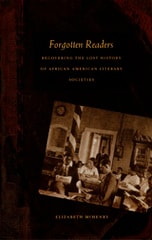
cover of Forgotten Readers: Recovering the Lost History of African American Literary Societies

Forgotten Readers

Recovering the Lost History of African American Literary Societies

Elizabeth McHenry

Duke University Press, 2002

Over the past decade the popularity of black writers including E. Lynn Harris and Terry McMillan has been hailed as an indication that an active African American reading public has come into being. Yet this is not a new trend; there is a vibrant history of African American literacy, literary associations, and book clubs. Forgotten Readers reveals that neglected past, looking at the reading practices of free blacks in the antebellum north and among African Americans following the Civil War. It places the black upper and middle classes within American literary history, illustrating how they used reading and literary conversation as a means to assert their civic identities and intervene in the political and literary cultures of the United States from which they were otherwise excluded.

Forgotten Readers expands our definition of literacy and urges us to think of literature as broadly as it was conceived of in the nineteenth century. Elizabeth McHenry delves into archival sources, including the records of past literary societies and the unpublished writings of their members. She examines particular literary associations, including the Saturday Nighters of Washington, D.C., whose members included Jean Toomer and Georgia Douglas Johnson. She shows how black literary societies developed, their relationship to the black press, and the ways that African American women’s clubs—which flourished during the 1890s—encouraged literary activity. In an epilogue, McHenry connects this rich tradition of African American interest in books, reading, and literary conversation to contemporary literary phenomena such as Oprah Winfrey’s book club.

[more]
cover of Recovering an Irish Voice from the American Frontier: The Prose Writings of Eoin Ua Cathail

Recovering an Irish Voice from the American Frontier

The Prose Writings of Eoin Ua Cathail

Patrick J. Mahoney

University of North Texas Press, 2021
[more]
cover of Recovering the Black Female Body: Self-Representation by African American Women

Recovering the Black Female Body

Self-Representation by African American Women

Edited by Michael Bennett and Vanessa D Dickerson

Rutgers University Press, 2000

Despite the recent flood of scholarly work investigating the interrelated issues of race, gender, and representation, little has been written about black women’s depictions of their own bodies. Both past and present-day American cultural discourse has attempted either to hypereroticize the black female body or make it a site of impropriety and crime.

The essays in this volume focus on how African American women, from the nineteenth century to the present, have represented their physical selves in opposition to the distorted vision of others. Contributors attempt to  “recover” the black female body in two ways: they explore how dominant historical images have mediated black female identity, and they analyze how black women have resisted often demeaning popular cultural perceptions in favor of more diverse, subtle presentations of self.   

The pieces in this book—all of them published here for the first time—address a wide range of topics, from antebellum American poetry to nineteenth-century African American actors, and twentieth-century pulp fiction.

Recovering the Black Female Body recognizes the pressing need to highlight through scholarship the vibrant energy of African American women’s attempts to wrest control of the physical and symbolic construction of their bodies away from the distortions of others.

Contributors are Margaret Bass, Dorri Rabung Beam, Michael Bennett, Jacqueline E. Brady, Daphne A. Brooks, Vanessa D. Dickerson, Meredith Goldsmith, Yvette Louis, Ajuan Maria Mance, Noliwe Rooks, Mark Winokur, and Doris Witt. This book also contains a foreword by Carla L. Peterson and an afterword by Deborah E. McDowell.

[more]
cover of Recovering the Commons: Democracy, Place, and Global Justice

Recovering the Commons

Democracy, Place, and Global Justice

Herbert Reid and Betsy Taylor

University of Illinois Press, 2010

This penetrating work culls key concepts from grassroots activism to hold critical social theory accountable to the needs, ideas, and organizational practices of the global justice movement. The resulting critique of neoliberalism hinges on place-based struggles of groups marginalized by globalization and represents a brave rethinking of politics, economy, culture, and professionalism.
Providing new practical and conceptual tools for responding to human and environmental crises in Appalachia and beyond, Recovering the Commons radically revises the framework of critical social thought regarding our stewardship of the civic and ecological commons. Herbert Reid and Betsy Taylor ally social theory, field sciences, and local knowledge in search of healthy connections among body, place, and commons that form a basis for solidarity as well as a vital infrastructure for a reliable, durable world. Drawing particularly on the work of philosophers Maurice Merleau-Ponty, John Dewey, and Hannah Arendt, the authors reconfigure social theory by ridding it of the aspects that reduce place and community to sets of interchangeable components. Instead, they reconcile complementary pairs such as mind/body and society/nature in the reclamation of public space.

With its analysis embedded in philosophical and material contexts, this penetrating work culls key concepts from grassroots activism to hold critical social theory accountable to the needs, ideas, and organizational practices of the global justice movement. The resulting critique of neoliberalism hinges on place-based struggles of groups marginalized by globalization and represents a brave rethinking of politics, economy, culture, and professionalism.

[more]
cover of Recovering the Eucharistic Ecclesiology of the Early Church: An Introduction to Nicolas Afanasiev

Recovering the Eucharistic Ecclesiology of the Early Church

An Introduction to Nicolas Afanasiev

Anastacia Wooden

Catholic University of America Press, 2025
The first theologian who spoke of eucharistic ecclesiology was the Russian Orthodox church historian and canonist Nicholas Afanasiev (1893-1966). He claimed to have re-discovered and systematized the original ecclesiology of the early church, which he called “eucharistic.” Since then, the eucharistic ecclesiology crossed confessional borders and shaped the theological discussion on the nature of the church. Many authors of different Christian confessions developed Afanasiev’s basic intuition while proposing a variety of their own understandings of the “eucharistic nature” of the church: from Orthodox theologians like John Zizioulas and John Romanides to Catholic theologians like J.-M. Tillard and Joseph Ratzinger. Ironically, the details of Afanasiev’s own ecclesiological system remain largely unknown. The aim of this book is to formulate a comprehensive view of Afanasiev’s ecclesiological vision and of its significance for contemporary ecclesial life in two parts. It is Anastacia Wooden’s conviction that the prevailing “stereotypical” view of Afanasiev’s ecclesiology is suffering from misapprehension of his thought. Therefore, Part one addresses the issues that historically complicated understanding of Afanasiev’s ecclesiology. It will provide historical, theological, and biographical context of Afanasiev’s scholarship by presenting keys to understanding of his eucharistic ecclesiology. In the second part the book provides a synthesis of Afanasiev’s total ecclesiological vision as well as systematic presentation of six specific ecclesiological issues. It demonstrates how Afanasiev’s methodological assumption that ecclesiology can serve as a tool to make sense of the historical data on the life of the church led to his realization that the early church had an operative ecclesiology which placed the exercise of royal priesthood in the Eucharist as the starting point of the ecclesial structure. In each chapter of the second part, this book provides reflections on the contemporary relevance of Afanasiev’s work. In the current crises of leadership in the Catholic Church (as well as other Christian churches) it may prevent the adoption of arbitrary forms of lay participation in the church governance by reminding church leaders that a theologically meaningful increase of lay participation should always be framed in terms of the increased participation of local churches.
[more]
cover of Recovering the Margins of American Religious History: The Legacy of David Edwin Harrell Jr.

Recovering the Margins of American Religious History

The Legacy of David Edwin Harrell Jr.

B. Dwain Waldrep

University of Alabama Press, 2012
Normal0falsefalsefalseMicrosoftInternetExplorer4
Recovering the Margins of American Religious History, a celebration of the life and work of David Edwin Harrell Jr., brings together essays from Harrell’s colleagues, peers, and students that explore his impact and legacy in the field of American religious studies. Raised in an upper-class family in mid-twentieth-century Jacksonville, Florida, Harrell’s membership in the Church of Christ helped establish his sense of self as a spiritual outsider. This early exclusion from the Christian mainstream laid a foundation for Harrell’s pioneering studies of marginalized faiths, including the first stirrings of neo-fundamentalism and the diminishingly influential social gospel movement.
 
Harrell’s connections with these religious movements point to his deeper ongoing concerns with class, gender, and race as core factors behind religious institutions, and he has unblinkingly investigated a wide range of social dynamics. Combining an extensive knowledge of and long-standing passion for American religious history with a comprehensive understanding of the developing world, Harrell’s research and writings over his lifetime have produced compelling portraits of the American religious underclass, an increased integration of religion into the narrative of world history, and innovative new comparative studies in the healing and charismatic movements of the developing world.
 
Normal0falsefalsefalseMicrosoftInternetExplorer4
Contributors
Scott C. Billingsley / Wayne Flynt / James R. Goff Jr. / John C. Hardin / Samuel S. Hill / Richard T. Hughes / Beth Barton Schweiger / Grant Wacker / B. Dwain Waldrep / Charles Reagan Wilson
[more]
cover of Recovering the Nation's Body: Cultural Memory, Medicine, and the Politics of Redemption

Recovering the Nation's Body

Cultural Memory, Medicine, and the Politics of Redemption

Linda F Hogle

Rutgers University Press, 1999

The body is both a site for medical practice and a source of therapeutic and scientific tools. As such, there are a variety of meanings ascribed to the body which both affect and are affected by cultural, economic, political and legal complexities. In order to access and use body parts, Linda F. Hogle states, transformative scientific and  cultural processes are brought into play. Nowhere is this more evident than present-day Germany, where the spectre of Nazi medical experimentation still plays a large role  in national policies governing the use of body parts and the way these policies are put into practice.  In their efforts to be perceived as not repeating atrocities of the past, German medical practitioners and policy-makers reformulate ideas of bodily violation.  To further confuse the issue, the reunification of East and West Germany has engendered new questions about the relationship between individuals’ bodies, science, and the state.

Hogle shows how “universal” medicine is reinterpreted through the lens of national and transnational politics and history, using comparative examples from her research in the United. States.  Recovering the Nation’s Body is the first book to analyze the actual practices involved in procuring human tissue, and the first to examine how the German past and the unique present-day situation within the European Union are key in understanding the form that medical practices take within various contexts.

[more]
cover of Rights or Self-Government?: Recovering the Meaning of Citizenship in an Age of Rights

Rights or Self-Government?

Recovering the Meaning of Citizenship in an Age of Rights

Thomas E. Schneider

St. Augustine's Press, 2026

[more]