Results by title
5 books match the query 'Red Planet'
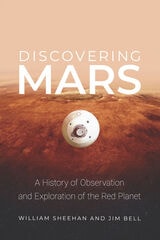
Discovering Mars
A History of Observation and Exploration of the Red PlanetWilliam Sheehan and Jim Bell
University of Arizona Press, 2021
Historian William Sheehan and astronomer and planetary scientist Jim Bell combine their talents to tell a unique story of what we’ve learned by studying Mars through evolving technologies. What the eye sees as a mysterious red dot wandering through the sky becomes a blurry mirage of apparent seas, continents, and canals as viewed through Earth-based telescopes. Beginning with the Mariner and Viking missions of the 1960s and 1970s, space-based instruments and monitoring systems have flooded scientists with data on Mars’s meteorology and geology, and have even sought evidence of possible existence of life-forms on or beneath the surface. This knowledge has transformed our perception of the Red Planet and has provided clues for better understanding our own blue world.
Discovering Mars vividly conveys the way our understanding of this other planet has grown from earliest times to the present. The story is epic in scope—an Iliad or Odyssey for our time, at least so far largely without the folly, greed, lust, and tragedy of those ancient stories. Instead, the narrative of our quest for the Red Planet has showcased some of our species’ most hopeful attributes: curiosity, cooperation, exploration, and the restless drive to understand our place in the larger universe. Sheehan and Bell have written an ambitious first draft of that narrative even as the latest chapters continue to be added both by researchers on Earth and our robotic emissaries on and around Mars, including the latest: the Perseverance rover and its Ingenuity helicopter drone, which set down in Mars’s Jezero Crater in February 2021.
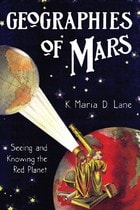
Geographies of Mars
Seeing and Knowing the Red PlanetK. Maria D. Lane
University of Chicago Press, 2011
A highly original exploration of geography’s spatial dimensions at the beginning of the twentieth century, offering a new view of the mapping of far-off worlds.
One of the first maps of Mars, published by an Italian astronomer in 1877, with its pattern of canals, fueled belief in intelligent life forms on the distant red planet—a hope that continued into the 1960s. Although the Martian canals have long since been dismissed as a famous error in the history of science, K. Maria D. Lane argues that there was nothing accidental about these early interpretations. Indeed, she argues, the construction of Mars as an incomprehensibly complex and engineered world both reflected and challenged dominant geopolitical themes during a time of major cultural, intellectual, political, and economic transition in the Western world.
Geographies of Mars telescopes in on a critical period in the development of the geographical imagination, when European imperialism was at its zenith and American expansionism had begun in earnest. Astronomers working in the new observatories of the American Southwest or in the remote heights of the South American Andes were inspired, Lane finds, by their own physical surroundings and used representations of the Earth’s arid landscapes to establish credibility for their observations of Mars. With this simple shift to the geographer’s point of view, Lane deftly explains some of the most perplexing stances on Mars taken by familiar protagonists such as Percival Lowell, Alfred Russel Wallace, and Lester Frank Ward.

How to Find a Martian
A Fossil Hunter’s Guide to the Red PlanetSean McMahon
University of Chicago Press, 2027
Join today’s search for signs of alien life in fossil remains from prehistoric Mars, an Earth-like world that glittered with rivers, lakes, and deep blue seas.
Billions of years ago, there was another Earth in our solar system: the temperate and blue-streaked world of ancient Mars. Today, the rocky ruins of that lost world offer our best hope of finding signs of alien life. In How to Find a Martian, astrobiologist and paleontologist Sean McMahon argues that we may soon find fossils on Mars—perhaps even in our lifetime.
There are now thousands of astrobiologists around the world, using the tools of modern science to answer some of the most profound, intellectually exciting questions that have ever been asked: What is life? How does it evolve and proliferate across vast spans of space and time, and what forms might it take on alien worlds? The search for life on Mars is a mainstay of this research program, and it has never been more advanced, more sophisticated, or better funded than it is today. Although scientists have not yet found fossils on Mars, astrobiologist Sean McMahon says, we have at least learned how to find them. We now know which regions and landscapes on Mars could once have supported life and preserved its remains in rocks and minerals. We know how the remains of living organisms can end up woven into the texture of ancient rocks, transmuted into minerals or transcribed into the subtle language of fossil carbon molecules. But we have also learned to be cautious—and not to be fooled when non-living nature imitates the patterns of life.
Accessibly explaining trailblazing ideas and findings in astronomy, geology, microbiology, and paleontology, McMahon makes a persuasive and alluring case that we have the tools, ideas, methods, and missions to find past life on Mars.
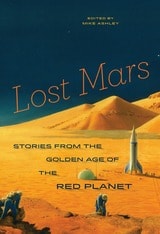
Lost Mars
Stories from the Golden Age of the Red PlanetEdited by Mike Ashley
University of Chicago Press, 2018
An antique-shop owner gets a glimpse of the Red Planet through an intriguing artifact. A Martian’s wife contemplates the possibility of life on Earth. A resident of Venus describes his travels across the two alien planets. From an arid desert to an advanced society far superior to that of Earth, portrayals of Mars have differed radically in their attempts to uncover the truth about our neighboring planet.
Since the 1880s, after an astronomer first described “channels” on the surface of Mars, writers have been fascinated with the planet, endlessly speculating on what life on Mars might look like and what might happen should we make contact with the planet's inhabitants. This wonderful collection offers ten wildly imaginative short stories from the golden age of science fiction by such classic sci-fi writers as H.G. Wells, Ray Bradbury, and J. G. Ballard, as well as hard-to-find stories by unjustly forgotten writers from the genre.
Assembled and introduced by acclaimed anthologist Mike Ashley, these stories vividly evoke a time when notions of life on other planets—from vegetation and water to space invaders and utopian societies—were new and startling. As we continue to imagine landing people on Mars, these stories are well worth revisiting as gripping and vivid dispatches from futurists past.
Mars
The Pristine Beauty of the Red PlanetAlfred S. McEwen, Candice Hansen-Koharcheck, and Ari Espinoza
University of Arizona Press, 2017
Mars enthusiasts will appreciate these perfect snapshots of our current understanding of Mars, with soon-to-be classic pictures that have come to define our vision of the Red Planet. These images and their interpretations will be held as a yardstick for future exploration as we learn more about the surface and geologic processes of the fourth planet from the Sun.
With tantalizing and artistic glimpses at actively eroding slopes, impact craters, strange polar landscapes, avalanches, and even spectacular descent pictures of probes like the Phoenix Lander and the Mars Science Laboratory, we see what researchers are seeing.
Through vivid and beautiful images, this book underscores the need for such a camera on future orbiters, especially as more landing missions are planned. Mars: The Pristine Beauty of the Red Planet provides a stunning keepsake of one of humanity’s greatest accomplishments in space travel.