Results by title
4 books match the query 'Redon, Odilon'
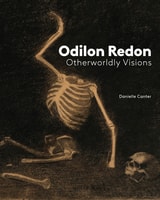
Odilon Redon
Otherworldly VisionsDanielle Canter
J. Paul Getty Trust, The, 2026
This visually striking book provides an introduction to the mysterious and dreamlike work of the artist Odilon Redon.
Enigmatic and haunting, the work of the French Symbolist Odilon Redon (1840–1916) intrigues and entrances all who encounter it. During the first half of his career, Redon created dramatically monochromatic charcoal drawings and lithographs, dreamily dark images that plumbed the depths of his wild imagination. Eventually, however, he also turned to pastels, adopting a bold colorful palette in fantastical explorations of the natural world.
Featuring more than seventy illustrations, this publication offers an overview of Redon's career. The informative, accessible essays examine his disparate influences from the worlds of religion, mythology, literature, and music, and demonstrate why Redon’s mysterious work is an important precursor to Surrealism.
This volume is published to accompany an exhibition on view at the J. Paul Getty Museum at the Getty Center from July 14 to October 18, 2026.
[more]
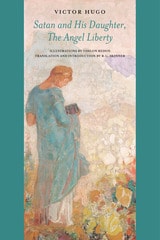
Satan and His Daughter, the Angel Liberty
Selected VersesVictor Hugo
Swan Isle Press, 2018
Victor Hugo spent years in political exile off the coast of Normandy. While there, he produced his masterpiece, Les Misérables—but that wasn’t all: he also wrote a book-length poem, La Fin de Satan, left unfinished and not published until after his death.
Satan and his Daughter, the Angel Liberty, drawn from this larger poem, tells the story of Satan and his daughter, the angel created by God from a feather left behind following his banishment. Hugo details Satan’s fall, and through a despairing soliloquy, reveals him intent on revenge, yet desiring God’s forgiveness. The angel Liberty, meanwhile, is presented by Hugo as the embodiment of good, working to convince her father to return to Heaven.
This new translation by Richard Skinner presents Hugo’s verse in a unique prose approach to the poet’s poignant work, and is accompanied by the Symbolist artist Odilon Redon’s haunting illustrations. No adventurous reader will want to miss this beautiful mingling of the epic and familial, religious and political.
[more]
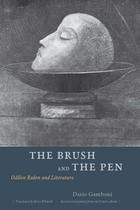
The Brush and the Pen
Odilon Redon and LiteratureDario Gamboni
University of Chicago Press, 2011
French symbolist artist Odilon Redon (1840–1916) seemed to thrive at the intersection of literature and art. Known as “the painter-writer,” he drew on the works of Poe, Baudelaire, Flaubert, and Mallarmé for his subject matter. And yet he concluded that visual art has nothing to do with literature. Examining this apparent contradiction, The Brush and the Pen transforms the way we understand Redon’s career and brings to life the interaction between writers and artists in fin-de-siècle Paris.
Dario Gamboni tracks Redon’s evolution from collaboration with the writers of symbolism and decadence to a defense of the autonomy of the visual arts. He argues that Redon’s conversion was the symptom of a mounting crisis in the relationship between artists and writers, provoked at the turn of the century by the growing power of art criticism that foreshadowed the modernist separation of the arts into intractable fields. In addition to being a distinguished study of this provocative artist, The Brush and the Pen offers a critical reappraisal of the interaction of art, writing, criticism, and government institutions in late nineteenth-century France.
[more]
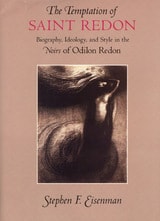
The Temptation of Saint Redon
Biography, Ideology, and Style in the Noirs of Odilon RedonStephen F. Eisenman
University of Chicago Press, 1992
Bristling with demons, grotesques, and bizarre apparitions, the graphic work of Odilon Redon has often seemed to be the product of a mind unhinged. In The Temptation of Saint Redon, Stephen F. Eisenman argues instead that these works are Redon's conscious and considered response to changing social realities—an attempt to find refuge from the forces of modernization in an imaginative world of the macabre and the fantastic. Eisenman's careful attention to the circumstances of Redon's life (1840-1916) allows him to bring into focus the interconnections between Redon's complex style and the culture and society of his time. Born and raised on a sixteenth-century estate near Bordeaux, Redon was immersed as a child in traditional rural culture. "I spent my entire childhood in the Médoc completely free, among peasant children," he recalled in his memoirs. "I heard them tell supernatural tales—witches still exist there."
Indeed, local tales and legends of witches, ghosts, one-eyed monsters, evil eyes, and wood fairies figure prominently in Redon's graphic works, which he called his noirs, or "blacks." After formal training at Bordeaux and Paris in the 1850s and 1860s, Redon began to chart his independent artistic course. Eisenman shows how, rejecting both naturalism and classicism, Redon, a prototypical Symbolist, found in grotesque and epic genres the expression of organic communities and precapitalist societies. He places Redon's desire for this imagined world of superstitious simplicity a desire manifest in his entire mature artistic practice in the context of contemporary avant-garde movements.
Redon's great noirs of the 1870s and 1880s, dreamlike configurations of seemingly irreconcilable elements from portraits, still lifes, and landscapes, show an increasingly subtle control of connotation and a complex indebtedness to caricature, allegory, and puns. Many of the noirs also visually interpret works by like-minded authors, including Baudelaire, Flaubert, Poe, and Mallarmé, one of Redon's close friends. Eisenman's analysis of the noirs underscores Redon's interest in creating an imaginative, even fantastic art, that could act directly on the human spirit. In addition to deepening our understanding of Redon and his art, The Temptation of Saint Redon exposes a link between place, politics, personal history, and the artistic imagination.
[more]