Results by title
5 books match the query 'Refugees in literature'
Displacement and the Somatics of Postcolonial Culture
Douglas Robinson
The Ohio State University Press, 2013
Fighting Over There
U.S. War Making and Contemporary Refugee LiteratureAlaina Kaus
University of Massachusetts Press, 2023
U.S. foreign policy has long been built on a dichotomy of an irreplaceable “here” and an expendable “there.” In his 2003 announcement of the military campaign in Iraq, George W. Bush declared that we would fight in the Middle East so we wouldn’t have to fight “on the streets of our cities.” But what do the millions of people who live over “there” have to say about U.S. interventions and the displacement they provoke?
In this pathbreaking study, Alaina Kaus analyzes literature by and about refugees who fled Southeast Asia, Central America, the Caribbean, North Africa, and the Middle East, in the wake of U.S. military occupation and economic intervention. Narratives by authors such as Lan Cao, Viet Thanh Nguyen, Demetria Martínez, Héctor Tobar, Dave Eggers, Mohsin Hamid, and Riverbend reveal contradictions in the human rights pledges that undergird U.S. foreign policy, which promote freedom while authorizing intervention and displacement, and favor market-based solutions over social justice and racial equality.
Migrating Fictions
Gender, Race, and Citizenship in U.S. Internal DisplacementsAbigail G. H. Manzella
The Ohio State University Press, 2018
Winner, 2021 CCCC Outstanding Book Award
Migrating Fictions analyzes the role of race, gender, and citizenship in the major internal displacements of the 20th century in history and in narrative. Surveying the particular tactics employed by the United States during the Great Migration, the Dust Bowl, the Japanese American incarceration, and the migrant labor of the Southwest, Abigail G. H. Manzella reveals how the country’s past is imbued with governmentally (en)forced movements that diminished access to full citizenship rights for the laboring class, people of color, and women.
This work is the first book-length study to examine all of these movements together along with their literature, including Zora Neale Hurston’s Their Eyes Were Watching God, Sanora Babb’s Whose Names Are Unknown, Julie Otsuka’s When the Emperor Was Divine, Helena María Viramontes’s Under the Feet of Jesus, and Jesmyn Ward’s Salvage the Bones. Manzella shows how the United States’ history of spatial colonization within its own borders extends beyond isolated incidents into a pattern based on ideology about nation-building, citizenship, and labor. This book seeks to theorize a Thirdspace, an alternate location for social justice that acknowledges the precarity of the internally displaced person.
Race and Displacement
Nation, Migration, and Identity in the Twenty-First CenturyEdited by Maha Marouan and Merinda Simmons
University of Alabama Press, 2013
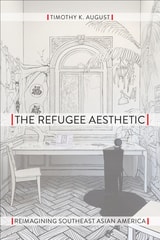
The Refugee Aesthetic
Reimagining Southeast Asian AmericaTimothy August
Temple University Press, 2021
The refugee is conventionally considered a powerless figure, eagerly cast aside by both migrant and host communities. In his book, The Refugee Aesthetic, Timothy August investigates how and why a number of Southeast Asian American artists and writers have recently embraced the figure of the refugee as a particularly transformative position. He explains how these artists, theorists, critics, and culture-makers reconstruct their place in the American imagination by identifying and critiquing the underlying structures of power that create refugees in the contemporary world.
August looks at the outside forces that shape refugee representation and how these expressions are received. He considers the visual legacy of the Southeast Asian refugee experience by analyzing music videos, graphic novels, and refugee artwork. August also examines the power of refugee literature, showing how and why Southeast Asian American writers look to the refugee position to disentangle their complicated aesthetic legacy.
Arguing that “aesthetics” should be central to the conceptualization of critical refugee studies, August shows how representational structures can galvanize or marginalize refugees, depending on how refugee aesthetics are used and circulated.