Results by title

4 books match the query 'Reggaetón'
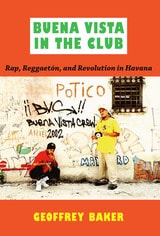
cover of Buena Vista in the Club: Rap, Reggaetón, and Revolution in Havana

Buena Vista in the Club

Rap, Reggaetón, and Revolution in Havana

Geoffrey Baker

Duke University Press, 2011
In Buena Vista in the Club, Geoffrey Baker traces the trajectory of the Havana hip hop scene from the late 1980s to the present and analyzes its partial eclipse by reggaetón. While Cuban officials initially rejected rap as “the music of the enemy,” leading figures in the hip hop scene soon convinced certain cultural institutions to accept and then promote rap as part of Cuba’s national culture. Culminating in the creation of the state-run Cuban Rap Agency, this process of “nationalization” drew on the shared ideological roots of hip hop and the Cuban nation and the historical connections between Cubans and African Americans. At the same time, young Havana rappers used hip hop, the music of urban inequality par excellence, to critique the rapid changes occurring in Havana since the early 1990s, when the Soviet Union fell, its subsidy of Cuba ceased, and a tourism-based economy emerged. Baker considers the explosion of reggaetón in the early 2000s as a reflection of the “new materialism” that accompanied the influx of foreign consumer goods and cultural priorities into “sociocapitalist” Havana. Exploring the transnational dimensions of Cuba’s urban music, he examines how foreigners supported and documented Havana’s growing hip hop scene starting in the late 1990s and represented it in print and on film and CD. He argues that the discursive framing of Cuban rap played a crucial part in its success.
[more]
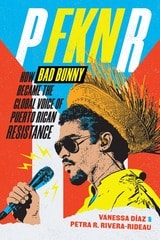
cover of P FKN R: How Bad Bunny Became the Global Voice of Puerto Rican Resistance

P FKN R

How Bad Bunny Became the Global Voice of Puerto Rican Resistance

Vanessa Díaz and Petra R. Rivera-Rideau

Duke University Press, 2026

“Aquí mataron gente por sacar la bandera / Por eso es que ahora yo la llevo donde quiera." (Here they killed people for taking out the flag / that’s why I bring it anywhere I want now.)—LA MuDANZA

Global superstar Bad Bunny, born Benito Antonio Martínez Ocasio, like many other Puerto Ricans, has lived a life marked by public crises—blackouts, hurricanes, political corruption and oppression, among others—that have exposed the ongoing impacts of colonialism in Puerto Rico. Offering a portrait of the past and future of Puerto Rican resistance through one of its loudest and proudest voices, P FKN R draws on interviews with musicians, politicians, and journalists as well as ethnographic research to set Bad Bunny and Puerto Rican resistance in a historical, political, and cultural context. Authors Vanessa Díaz and Petra Rivera-Rideau—creators of the “Bad Bunny Syllabus”—demonstrate Bad Bunny’s place in a long tradition of infusing both joy and protest into music and honor the many evolving forms of daily resistance to oppression and colonialism that are part of Puerto Rican life.
[more]
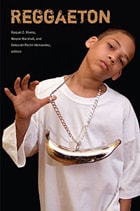
cover of Reggaeton

Reggaeton

Raquel Z. Rivera, Wayne Marshall, and Deborah Pacini Hernandez, eds.

Duke University Press, 2009

A hybrid of reggae and rap, reggaeton is a music with Spanish-language lyrics and Caribbean aesthetics that has taken Latin America, the United States, and the world by storm. Superstars—including Daddy Yankee, Don Omar, and Ivy Queen—garner international attention, while aspiring performers use digital technologies to create and circulate their own tracks. Reggaeton brings together critical assessments of this wildly popular genre. Journalists, scholars, and artists delve into reggaeton’s local roots and its transnational dissemination; they parse the genre’s aesthetics, particularly in relation to those of hip-hop; and they explore the debates about race, nation, gender, and sexuality generated by the music and its associated cultural practices, from dance to fashion.

The collection opens with an in-depth exploration of the social and sonic currents that coalesced into reggaeton in Puerto Rico during the 1990s. Contributors consider reggaeton in relation to that island, Panama, Jamaica, and New York; Cuban society, Miami’s hip-hop scene, and Dominican identity; and other genres including reggae en español, underground, and dancehall reggae. The reggaeton artist Tego Calderón provides a powerful indictment of racism in Latin America, while the hip-hop artist Welmo Romero Joseph discusses the development of reggaeton in Puerto Rico and his refusal to embrace the upstart genre. The collection features interviews with the DJ/rapper El General and the reggae performer Renato, as well as a translation of “Chamaco’s Corner,” the poem that served as the introduction to Daddy Yankee’s debut album. Among the volume’s striking images are photographs from Miguel Luciano’s series Pure Plantainum, a meditation on identity politics in the bling-bling era, and photos taken by the reggaeton videographer Kacho López during the making of the documentary Bling’d: Blood, Diamonds, and Hip-Hop.

Contributors. Geoff Baker, Tego Calderón, Carolina Caycedo, Jose Davila, Jan Fairley, Juan Flores, Gallego (José Raúl González), Félix Jiménez, Kacho López, Miguel Luciano, Wayne Marshall, Frances Negrón-Muntaner, Alfredo Nieves Moreno, Ifeoma C. K. Nwankwo, Deborah Pacini Hernandez, Raquel Z. Rivera, Welmo Romero Joseph, Christoph Twickel, Alexandra T. Vazquez
[more]
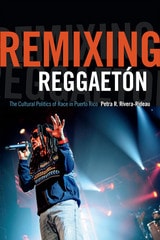
cover of Remixing Reggaetón: The Cultural Politics of Race in Puerto Rico

Remixing Reggaetón

The Cultural Politics of Race in Puerto Rico

Petra R. Rivera-Rideau

Duke University Press, 2015

Puerto Rico is often depicted as a "racial democracy" in which a history of race mixture has produced a racially harmonious society. In Remixing Reggaetón, Petra R. Rivera-Rideau shows how reggaetón musicians critique racial democracy's privileging of whiteness and concealment of racism by expressing identities that center blackness and African diasporic belonging. Stars such as Tego Calderón criticize the Puerto Rican mainstream's tendency to praise black culture but neglecting and marginalizing the island's black population, while Ivy Queen, the genre's most visible woman, disrupts the associations between whiteness and respectability that support official discourses of racial democracy. From censorship campaigns on the island that sought to devalue reggaetón, to its subsequent mass marketing to U.S. Latino listeners, Rivera-Rideau traces reggaetón's origins and its transformation from the music of San Juan's slums into a global pop phenomenon. Reggaetón, she demonstrates, provides a language to speak about the black presence in Puerto Rico and a way to build links between the island and the African diaspora.
 
[more]