Results by title
11 books match the query 'Regional & National'
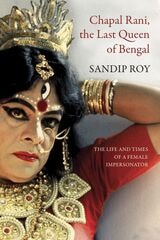
Chapal Rani, the Last Queen of Bengal
The Life and Times of a Female ImpersonatorSandip Roy
Seagull Books, 2025
As the last great female impersonator of Bengali theater, Chapal Bhaduri—known as Chapal Rani—once held audiences spellbound in the jatra tradition, where men became goddesses and heroines. But when women finally took their place on stage, Chapal found himself exiled from the world he had ruled. In this groundbreaking biography, Sandip Roy captures the rise and fall of a performer whose art was inseparable from his identity.
Told in Chapal’s own voice and interwoven with evocative fictional vignettes, Chapal Rani, the Last Queen of Bengal brings to life Kolkata’s golden age of theater and the resilience of a man who refused to disappear. Through decades of research and deeply personal interviews, Roy crafts a moving portrait of gender and belonging.
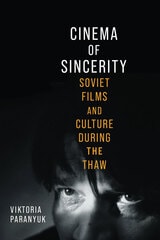
Cinema of Sincerity
Soviet Films and Culture During the ThawViktoria Paranyuk
University of Wisconsin Press, 2025
Using both theory and close readings of specific films produced in the Soviet Union during the Thaw, a period known for its relative political and cultural liberalization, Cinema of Sincerity treats sincerity as both a concept and an aesthetic strategy. Viktoria Paranyuk argues that Soviet cinema’s use of sincerity was a reworking of a trend in global cinema that sought to bridge the gap between reality and the filmed image. This period saw increased accessibility to world cinematic traditions, new voices in criticism, and, above all, the multigenerational effort in filmmaking that developed and thrived in centers outside Moscow. Paranyuk demonstrates how these changes allowed Soviet cinema to renew its visual language and use film as a space for collective self-examination.
Constructed Latinx(s) Identities
Racialized Bodies in Visual and Textual CultureEdited by José I. Lara
Amherst College Press, 2025
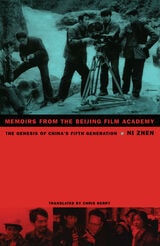
Memoirs from the Beijing Film Academy
The Genesis of China's Fifth GenerationZhen Ni
Duke University Press, 2002
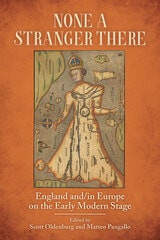
None a Stranger There
England and/in Europe on the Early Modern StageEdited by Scott Oldenburg and Matteo Pangallo
University of Alabama Press, 2025

Scream! Bleed! Take Off Your Clothes!
Stuart Gordon and Chicago’s Organic Theater CompanyMary Griswold, Cordis Heard, Jim Rinnert and Mike Saad
University of Chicago Press, 2026
A captivating firsthand account of Chicago’s groundbreaking, tumultuous Organic Theater Company.
When the founder of the Organic Theater Company died in 2020, the Chicago Tribune asked, “Did one person invent Chicago theater? If so, it was Stuart Gordon.” And yet, this iconic theater group is arguably the most influential Chicago company whose story has never been fully told.
In its heyday, from 1969 through 1985, the Organic’s high-spirited, gutsy, and close-knit company created more than thirty idiosyncratic works. A springboard for playwright David Mamet and for the television series ER, it also was formative in the careers of many well-known actors, including Joe Mantegna, André De Shields, Meshach Taylor, and Dennis Franz. Scream! Bleed! Take Off Your Clothes! is the story of a young theater company that always pushed boundaries with an anarchic exuberance. Drawing on extensive interviews and archival research, this insiders’ account, assembled by three Organic members and an artistic associate, details those exciting productions and the company’s complicated internal dynamics, while also positioning the group within Chicago’s vibrant theater scene and the larger culture of the time.
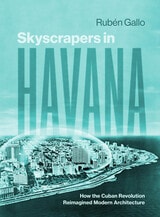
Skyscrapers in Havana
How the Cuban Revolution Reimagined Modern ArchitectureRubén Gallo
University of Chicago Press, 2027
Why Havana attracted the most important architects in the 1950s, and how the Cuban Revolution transformed the uses of these impressive skyscrapers.
During the 1950s, Havana’s Vedado district became an epicenter of modern architecture. Architects from around the world—including Mies van der Rohe, Richard Neutra, and Josep Lluis Sert—worked in Cuba and helped make Havana one of the most modern capitals in Latin America. After the Cuban Revolution, the buildings designed during Cuba’s American-influenced hyper-capitalist past had to be reimagined, about what use what use could luxury hotels, private condominiums, and golf clubs could have in a socialist society. Writers and artists from around the world including Simone de Beauvoir, Agnès Varda, Allen Ginsberg, Graham Greene, and Gabriel García Márquez flocked to Havana to witness the first socialist experiment in the Americas and marveled at the modern towers. French philosopher Jean-Paul Sartre wrote about “Skyscrapers in Havana” for his first journalistic piece about his trip. In contrast, modern architects abandoned Cuba after the Revolution: not even those designers who had built projects there set foot in the island again.
Considering Havana’s architecture as part of a larger Cuban modernity, Gallo places built projects in dialogue with film, literature, and other cultural texts, revealing how poets, novelists, filmmakers, and designers theorized the city’s urban fabric. Skyscrapers in Havana features six chapters, each devoted to an iconic modernist structure, as well as five shorter meditations on the architects, including Le Corbusier, who had the opportunity to go to Cuba after the Revolution but decided to stay away.
Southern Stages
Space and Memory in US PerformanceHopkins, Chandra
University of Iowa Press, 2025
Through the eyes of actors and everyday people, Southern Stages offers an engaging new model for interrogating the performance of southernness, as well as how memory and imagination intersect in spaces that have shaped hundreds of years of American history. Chandra Owenby Hopkins employs cultural memory and lived realities of Black and white communities to examine the earliest and most enduring southern stages: the playhouse and the public square.
Soviet Rock on Screen
The Life, Death, and Resurrection of a Film GenreRita Safariants
University of Wisconsin Press, 2026
In Soviet Rock on Screen, Rita Safariants chronicles the birth, life, death, and resurrection of a genre that rapidly became one of the most readily recognized cultural signifiers of the perestroika era and which continues to reflect and codify Russian culture. During their initial heyday in the 1980s, rock films were influenced by and encouraged the cultural shifts of perestroika and the incipient political storm. Today, Safariants argues, the reemergence and reconfiguration of the genre indicates the extent to which Soviet-era cultural emblems inform Russian national identity and obliquely support the current political repression under Putin.
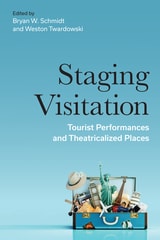
Staging Visitation
Tourist Performances and Theatricalized PlacesBryan Schmidt and Weston Twardowski
University of Michigan Press, 2026
Staging Visitation frames tourism and travel as complex social performances that shape identities, communities, and global imaginaries. This volume proposes “visitation” as a framework that emphasizes the participatory and relational dimensions of travel. While tourism is often pejoratively framed as a commodified or exploitative leisure activity for those with means, its reality is far more nuanced. Tourism stages heritage, provokes encounters across cultural divides, and prompts both visitors and hosts to negotiate values and identities—all while sustaining economies (and the power relations they produce) at global and local scales.
From museums and theme parks to festivals and influencer culture, the essays in this volume trace how transitory encounters—embodied, affective, and historically layered—build travel destinations into theatricalized places. These essays bring theater and performance studies into conversation with cultural geography, sociology, anthropology, and media studies to demonstrate how tourism functions as both a stage and a repertoire for modern life.
Staging Visitation argues that travel is not only about movement across space, but also about the performance of culture itself—its preservation, reinvention, and transformation.
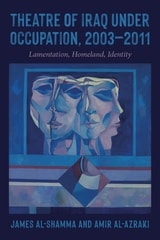
Theatre of Iraq Under Occupation, 2003-2011
Lamentation, Homeland, IdentityJames Al-Shamma
University of Iowa Press, 2025
However, in 2003, the United States invasion of Iraq propelled Iraqi theatre in an altogether different direction. Global media published photographs documenting the torture of Iraqi detainees by American soldiers and sectarian violence broke out, as Shiʿa and Sunni militias struggled for power. Theatre of Iraq Under Occupation examines the occupation’s impact on Iraqi theatre as eliciting lamentation over loss of homeland and identity, and as an assault on the Iraqi character itself. The first volume in English dedicated solely to theatre in Iraq, James Al-Shamma and Amir Al-Azraki’s insights don’t just offer a significant contribution to cultural studies, they bridge foreign policy and art in real time.