Results by title
3 books match the query 'Rehding, Alexander'

Adorno and Music
Critical VariationsPeter E. Gordon and Alexander Rehding, special issue editors
Duke University Press, 0
Contributors
Daniel K. L. Chua, Lydia Goehr, Peter E. Gordon, Martin Jay, Brian Kane, Max Paddison, Alexander Rehding, Fred Rush, Martin Scherzinger
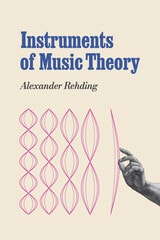
Instruments of Music Theory
Alexander Rehding
University of Chicago Press, 2027
Shows how musical instruments and the sounds they produce are not incidental, but an integral part of music theory.
Many musicians dread music theory: Its rules and diagrams can feel stern and lifeless, far removed from the sounds that make music so thrilling. In this book, Alexander Rehding looks at music theory from a different angle. He argues that the sounds of the instruments on which music theory is demonstrated—starting with the piano in the music classroom—play a much more active role than we usually notice. They are “instruments” in a double sense: musical noisemakers, but also tools in a kind of scientific experiment. Rehding strips these devices down to their sound-generating mechanisms to show us how to read musical instruments for their theoretical content.
Instruments of Music Theory turns our attention to instruments such as multiphonic sirens, tuning forks, Chladni plates, Aeolian harps, and Wheatstone concertinas—these devices generate sounds that call for new ways of listening, measuring, and thinking about music. Bringing together music theory, critical organology, and media theory, this book can be read as a user’s manual for how to put sound back into music theory. Rehding shows us how instruments do not only produce sound—they produce knowledge about music. Through the lens of these new instruments, Instruments of Music Theory recasts fundamental musical ideas such as pitch, harmony, form, and scale from the ground up to give new meaning to the stuff we call music.
Music's Monisms
Disarticulating ModernismDaniel Albright
University of Chicago Press, 2021
Daniel Albright was one of the preeminent scholars of musical and literary modernism, leaving behind a rich body of work before his untimely passing. In Music’s Monisms, he shows how musical and literary phenomena alike can be fruitfully investigated through the lens of monism, a philosophical conviction that does away with the binary structures we use to make sense of reality. Albright shows that despite music’s many binaries—diatonic vs. chromatic, major vs. minor, tonal vs. atonal—there is always a larger system at work that aims to reconcile tension and resolve conflict.
Albright identifies a “radical monism” in the work of modernist poets such as T. S. Eliot and musical works by Wagner, Debussy, Britten, Schoenberg, and Stravinsky. Radical monism insists on the interchangeability, even the sameness, of the basic dichotomies that govern our thinking and modes of organizing the universe. Through a series of close readings of musical and literary works, Albright advances powerful philosophical arguments that not only shed light on these specific figures but also on aesthetic experience in general. Music’s Monisms is a revelatory work by one of modernist studies’ most distinguished figures.