Results by title
2 books match the query 'Reisinger, William M.'

Bribes, People, and Politics
How Everyday Corruption Shapes Governance in EurasiaWilliam M. Reisinger & Marina Zaloznaya
University of Michigan Press, 2027
Everyday bureaucratic corruption is not the domain of oligarchs or powerful elites, but of informal exchanges between bureaucrats and ordinary citizens seeking to move paperwork, secure benefits, or avoid penalties. Despite extensive research on the economic, legal, and social consequences of corruption, this mundane form has rarely been treated as a political phenomenon.
Drawing on original, nationally representative surveys conducted in Russia, Ukraine, Georgia, and China, Bribes, People, and Politics analyzes how citizens’ encounters with corrupt bureaucratic practices influence popular political trust, perceptions of elite corruption, legal attitudes, voting behavior, and political activism. After each interaction with public bureaucracy, citizens subtly revise their views about what role people like themselves play within the political system. As a result, corrupt bureaucratic encounters can significantly shape popular attitudes and behavior toward the political order. By linking the microdynamics of bureaucratic encounters to macro-level questions of political legitimacy and regime durability, this book bridges the literature on corruption, political sociology, and comparative politics, offering a new framework for understanding the persistent phenomenon of public sector corruption in Eurasia.
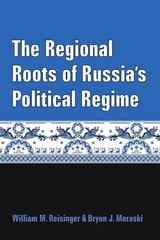
The Regional Roots of Russia's Political Regime
William M. Reisinger and Bryon J. Moraski
University of Michigan Press, 2017
By analyzing successive federal elections, Reisinger and Moraski show that regions that led the way in delivering votes in Putin’s favor were those that had been both more independent and more authoritarian during the Yeltsin era. These authoritarian enclaves under Yeltsin became models of behavior in the Putin regime, which prized deferential election results. Other regions were quick to follow this lead, functioning during Putin’s ascendancy as “swing states.” Still, Russia’s regimes continued to exhibit regime diversity, with democratic enclaves resisting the push to become cogs in the Kremlin’s electoral authoritarian wheel.
While motivated by scholarly questions about authoritarianism, democracy, and the influence of subnational forces on national regime trajectories, Reisinger and Moraski also consider policy-relevant questions.