Results by title

11 books match the query 'Relation to the Old Testament'
cover of Abiding Words: The Use of Scripture in the Gospel of John

Abiding Words

The Use of Scripture in the Gospel of John

Alicia D. Myers

SBL Press, 2015

A collection of essays by experts from around the world

Like the other New Testament Gospels, the Gospel of John repeatedly appeals to Scripture (Old Testament). Preferring allusions and “echoes” alongside more explicit quotations, however, the Gospel of John weaves Scripture as an authoritative source concerning its story of Jesus. Yet, this is the same Gospel that is often regarded as antagonistic toward “the Jews,” especially the Jewish religious leaders, depicted within it.

Features:

  • Introduces and updates readers on the question of John’s employment of Scripture
  • Showcases useful approaches to more general studies on the New Testament’s use of Scripture, sociological and rhetorical analyses, and memory theory
  • Explores the possible implications surrounding Scripture usage for the Gospel audiences both ancient and contemporary
[more]
cover of Beyond Babel: A Handbook for Biblical Hebrew and Related Languages

Beyond Babel

A Handbook for Biblical Hebrew and Related Languages

John Kaltner

SBL Press, 2002

Beyond Babel provides a general introduction to and overview of the languages that are significant for the study of the Hebrew Bible and ancient Israel. Included are essays on biblical and inscriptional Hebrew, Akkadian, Northwest Semitic dialects (Ammonite, Edomite, and Moabite), Arabic, Aramaic, Egyptian, Hittite, Phoenician, postbiblical Hebrew, and Ugaritic.

Each chapter in the volume shares a common format, including an overview of the language, a discussion of its significance for the Hebrew Bible, and a list of ancient sources and modern resources for further study of the language. A general introduction by John Huehnergard discusses the importance of the study of Near Eastern languages for biblical scholarship, helping to make the volume an ideal resource for persons beginning an in-depth study of the Hebrew Bible.
[more]
cover of In the School of the Word: Biblical Interpretation from the New to the Old Testament

In the School of the Word

Biblical Interpretation from the New to the Old Testament

Carlos Granados

Saint Paul Seminary Press, 2021
Carlos Granados and Luis Sánchez-Navarro propose reading the Bible with Christian faith, not as one approach among many, but as a disposition demanded by the New Testament for proper interpretation of both the Old and the New. Even so, the authors’ faith never leads them to dismiss history or to discard the tools of the historical-critical method. On the contrary, these sciences allow the faithful reader to take a holistic approach to biblical truth. When the reader also takes full account of the ecclesial reality in which the Bible was formed and transmitted, and in which it must be read still today, he or she encounters the word proclaimed by the text. Indeed, the words of Holy Writ ultimately proclaim the Word (Logos), Jesus Christ, in whose Spirit they were written. This book’s thirteen essays are grouped into three parts. Part I, “The Church, Living Subject of Sacred Scripture,” takes up a foundational theme of the whole book: sacred Scripture calls for a reading within the community of the People of God under the guidance of the Holy Spirit, and the same People constitute the living subject of Scripture. In Part II, “Christ, Exegete of the Fulfillment,” the authors focus on the relationship between the two biblical testaments. They argue that the Christian can both respect and venerate the Old Testament on its own terms, even as they find in Jesus, as presented in the New Testament and encountered in faith, the key for unlocking the Old Testament’s deepest meaning. The third and final part of this book, “The Teaching in Benedict XVI’s Verbum Domini,” examines Pope Benedict XVI’s 2010 post-synodal apostolic exhortation on the word of God in the life and mission of the Church. The authors’ years of shared prayer, study, conversation, and ministry have led to this coauthored book bearing witness to that ongoing unity that they live as confreres. Not surprisingly, they frequently reference the same theologians, especially Brevard Childs, Paul Beauchamp, SJ, and Pope Benedict XVI.
[more]
cover of Israel and the Assyrians: Deuteronomy, the Succession Treaty of Esarhaddon, and the Nature of Subvers

Israel and the Assyrians

Deuteronomy, the Succession Treaty of Esarhaddon, and the Nature of Subvers

C. L. Crouch

SBL Press, 2014

Was Deuteronomy created to be a subversive text based on Assyian treaties?

In this new book Crouch focuses on Deuteronomy’s subversive intent, asking what would be required in order for Deuteronomy to successfully subvert either a specific Assyrian source or Assyrian ideology more generally. The book reconsiders the nature of the relationship between Deuteronomy and Assyria, Deuteronomy’s relationship to ancient Near Eastern and biblical treaty and loyalty oath traditions, and the relevance of Deuteronomy’s treaty affinities to discussions of its date.

Features:

  • A thorough investigation of the nature and requirements of subversion
  • A focused examination of the context in which Deuteronomy would have functioned
  • An appendix focused on redactional questions related to Deuteronoy 13 and 28
[more]
cover of Predicting the Past in the Ancient Near East: Mantic Historiography in Ancient Mesopotamia, Judah, and the Mediterranean World

Predicting the Past in the Ancient Near East

Mantic Historiography in Ancient Mesopotamia, Judah, and the Mediterranean World

Matthew Neujahr

SBL Press, 2012

This work provides an in-depth investigation of after-the-fact predictions in ancient Near Eastern texts from roughly 1200 B.C.E.–70 C.E. It argues that the Akkadian, Aramaic, Hebrew, and Greek works discussed are all part of a developing scribal discourse of “mantic historiography” by which scribes blend their local traditions of history writing and predictive texts to produce a new mode of historiographic expression. This in turn calls into question the use and usefulness of traditional literary categories such as “apocalypse” to analyze such works.
[more]
cover of Receiving the Bible in faith: historical and theological exegesis

Receiving the Bible in faith

historical and theological exegesis

David M. Williams

Catholic University of America Press, 2004

The book should prove helpful to students as an overview of some of the issues involved, while more advanced readers will appreciate its analysis of recent scholars as well the attempt to integrate and adapt their insights.
[more]
cover of Textual History and the Reception of Scripture in Early Christianity

Textual History and the Reception of Scripture in Early Christianity

Johannes de Vries

SBL Press, 2013
The essays in this volume summarize an international research project on early Christian citations from Israel’s scriptures. These quotations are not only theologically significant but are also part of the textual history of the Septuagint and adjacent textual traditions of the Greek and Hebrew Old Testament. The essays discuss relevant manuscripts (Bible codices, papyri, etc.) up to the fifth century, signs and marginal notes (e.g., the diplé) that were used in the ancient scriptoria, and the specifics of the reception history in early Christianity from Matthew to 1 Peter and from the apostolic fathers to Theophilos of Antioch. The contributors are Felix Albrecht, Ronald H. van der Bergh, Heinz-Josef Fabry, Kerstin Heider, Martin Karrer, Christin Klein, Arie van der Kooij, Siegfried Kreuzer, Horacio E. Lona, Martin Meiser, Maarten J. J. Menken, Matthias Millard, Darius Müller, Ferdinand R. Prostmeier, Alexander Stokowski, Martin Vahrenhorst, Christiane Veldboer, and Johannes de Vries.
[more]
cover of The Invention of Hebrew

The Invention of Hebrew

Seth L. Sanders

University of Illinois Press, 2011

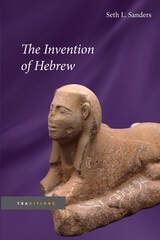
The Invention of Hebrew is the first book to approach the Bible in light of recent epigraphic discoveries on the extreme antiquity of the alphabet and its use as a deliberate and meaningful choice. Hebrew was more than just a way of transmitting information; it was a vehicle of political symbolism and self-representation.

Seth L. Sanders connects the Bible's distinctive linguistic form--writing down a local spoken language--to a cultural desire to speak directly to people, summoning them to join a new community that the text itself helped call into being. Addressing the people of Israel through a vernacular literature, Hebrew texts reimagined their audience as a public. By comparing Biblical documents with related ancient texts in Hebrew, Ugaritic, and Babylonian, this book shows Hebrew's distinctiveness as a self-conscious political language. Illuminating the enduring stakes of Biblical writing, Sanders demonstrates how Hebrew assumed and promoted a source of power previously unknown in written literature: "the people" as the protagonist of religion and politics.
[more]
cover of The Song of Songs and the Ancient Egyptian Love Songs

The Song of Songs and the Ancient Egyptian Love Songs

Michael V. Fox

University of Wisconsin Press, 1985

Available once more, this is a comprehensive, comparative literary philological examination of two enduring bodies of love poetry from the ancient Near East.
[more]
cover of The Use of the Old Testament in the New and other essays: studies in honor of William Franklin Stinespring

The Use of the Old Testament in the New and other essays

studies in honor of William Franklin Stinespring

James M. Efird

Duke University Press, 1972
[more]
cover of Writing and Literacy in the World of Ancient Israel:Epigraphic Evidence from the Iron Age

Writing and Literacy in the World of Ancient Israel

Epigraphic Evidence from the Iron Age

Christopher A. Rollston

SBL Press, 2010

Winner of the 2011 Frank Moore Cross Prize as the most substantial volume in the field of Northwest Semitic Epigraphy Ancient Northwest Semitic inscriptions from Israel, Phoenicia, Syria, Moab, Ammon, Edom, and Philistia enlighten and sharpen our vision of the Old Testament world in various ways. Writing and Literacy in the World of Ancient Israel focuses on this epigraphic evidence in order to broaden our understanding of the techniques and roles of writing, education, and literacy during this biblical period. To that end, the volume systematically covers scribal education; scribal implements; writing media such as stones, potsherds, and plaster; and the religious, administrative, and personal uses of writing. Its “handbook” format makes it easily accessible, including for use as a textbook in courses addressing the cultural context of ancient Israel.
[more]