Results by title
2 books match the query 'Relations with Korean Americans'

Mu, 49 Marks of Abolition
Sora Y. Han
Duke University Press, 2024
In March 2020, Sora Y. Han learned her father was dying of cancer just as the COVID-19 pandemic arrived on California's shores. These two events led Han to introspection: “Who have I been writing to?” and “Who have I been writing for?” In her observance of the 49 days of mourning in Buddhist tradition, answers come in the form of mu – no thing, nothingness. Han’s poetic meditations on freedom struggle come alive in the empty spaces between words, letters, and pictograms spanning her many languages—English, Korean, Chinese, jazz, law, and poetry. Transliterating and dystranslating the writings of Fred Moten, Theresa Hak Kyung Cha, Jacques Lacan, Frantz Fanon, and others through the Korean alphabet, Han weaves the DMZ, Betty’s Case, the Thirteenth Amendment, Afro-pessimism, and psychoanalytic desire together into the open field of Bay Area radicalism. Mu is both a loving homage to and a playful subversion of political inheritances and the unsayable beyond law.
[more]
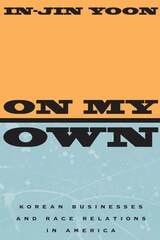
On My Own
Korean Businesses and Race Relations in AmericaIn-Jin Yoon
University of Chicago Press, 1997
The Los Angeles riots shattered Korean immigrants’ naive belief in the American dream. As many as 2,300 Korean shopkeepers lost their lifetime investments in one day. Korean immigrants had struggled for years to become economically independent through small businesses of their own. However, the riots made them realize how fragile their economic base is because their businesses are dependent on the impoverished, oppressed, and rebellious classes.
In On My Own, In-Jin Yoon combines an intimate fieldwork account of Korean-black relations in Chicago and Los Angeles with extensive quantitative analysis at the national level. Yoon argues that a complete understanding of the contemporary Korean-American community requires systematic analyses of patterns of Korean immigration, entrepreneurship, and race relations with other minority groups. He explains how small business has become the major economic activity of Korean immigrants and how Korean businesses in minority neighborhoods have intensified racial tensions between Koreans and minorities like blacks and Latinos.
“A groundbreaking study of Korean-black relations. Yoon’s insights on immigration, entrepreneurship, and race relations significantly enhance our understanding of urban racial tensions.”—William Julius Wilson, Harvard University
[more]