Results by title

6 books match the query 'Relativity (Physics)'

cover of An Equation That Changed the World: Newton, Einstein, and the Theory of Relativity

An Equation That Changed the World

Newton, Einstein, and the Theory of Relativity

Harald Fritzsch

University of Chicago Press, 1994

Fritzsch offers readers the opportunity to listen in on a meeting of Isaac Newton, Albert Einstein, and a present-day physicist. While he introduces the theory of relativity, Fritzsch teaches its sources, its workings, and the ways it has revolutionized our view of the physical world. An Equation That Changed the World dramatizes the importance of relativity, for the human race, and the survival of our planet.

"Fritzsch could not give the modern reader a more memorable introduction to the personalities and science of Isaac Newton and Albert Einstein unless somehow he could find the keys to H. G. Wells' time machine. . . . Many readers will applaud Fritzsch for this lively but profoundly insightful book." —Booklist, starred review

"[Fritzsch] has dreamed up a dialogue between the two great physicists, helped along by a fictional modern physicist. . . . The conversation builds up to an explanation of E=mc2, and on the way illuminates the important points where Newtonian and Einsteinian theory diverge." —David Lindley, New York Times Book Review
[more]
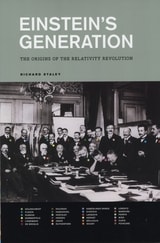
cover of Einstein's Generation: The Origins of the Relativity Revolution

Einstein's Generation

The Origins of the Relativity Revolution

Richard Staley

University of Chicago Press, 2009

Why do we celebrate Einstein’s era above all other epochs in the history of physics? Much of the history of physics at the beginning of the twentieth century has been written with a sharp focus on a few key figures and a handful of notable events. Einstein’s Generation offers a distinctive new approach to the origins of modern physics by exploring both the material culture that stimulated relativity and the reaction of Einstein’s colleagues to his pioneering work.

Richard Staley weaves together the diverse strands of experimental and theoretical physics, commercial instrument making, and the sociology of physics around 1900 to present the collective efforts of a group whose work helped set the stage for Einstein’s revolutionary theories and the transition from classical to modern physics that followed. Collecting papers, talks, catalogues, conferences, and correspondence, Staley juxtaposes scientists’ views of relativity at the time to modern accounts of its history. Einstein’s Generation tells the story of a group of individuals which produced some of the most significant advances of the twentieth century; and challenges our celebration of Einstein’s era above all others.
[more]
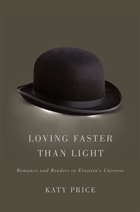
cover of Loving Faster than Light: Romance and Readers in Einstein's Universe

Loving Faster than Light

Romance and Readers in Einstein's Universe

Katy Price

University of Chicago Press, 2012
In November 1919, newspapers around the world alerted readers to a sensational new theory of the universe: Albert Einstein’s theory of relativity. Coming at a time of social, political, and economic upheaval, Einstein’s theory quickly became a rich cultural resource with many uses beyond physical theory. Media coverage of relativity in Britain took on qualities of pastiche and parody, as serious attempts to evaluate Einstein’s theory jostled with jokes and satires linking relativity to everything from railway budgets to religion. The image of a befuddled newspaper reader attempting to explain Einstein’s theory to his companions became a set piece in the popular press.
           
Loving Faster than Light focuses on the popular reception of relativity in Britain, demonstrating how abstract science came to be entangled with class politics, new media technology, changing sex relations, crime, cricket, and cinematography in the British imagination during the 1920s. Blending literary analysis with insights from the history of science, Katy Price reveals how cultural meanings for Einstein’s relativity were negotiated in newspapers with differing political agendas, popular science magazines, pulp fiction adventure and romance stories, detective plots, and esoteric love poetry. Loving Faster than Light is an essential read for anyone interested in popular science, the intersection of science and literature, and the social and cultural history of physics.
[more]
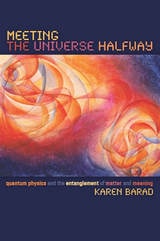
cover of Meeting the Universe Halfway: Quantum Physics and the Entanglement of Matter and Meaning

Meeting the Universe Halfway

Quantum Physics and the Entanglement of Matter and Meaning

Karen Barad

Duke University Press, 2006

Meeting the Universe Halfway is an ambitious book with far-reaching implications for numerous fields in the natural sciences, social sciences, and humanities. In this volume, Karen Barad, theoretical physicist and feminist theorist, elaborates her theory of agential realism. Offering an account of the world as a whole rather than as composed of separate natural and social realms, agential realism is at once a new epistemology, ontology, and ethics. The starting point for Barad’s analysis is the philosophical framework of quantum physicist Niels Bohr. Barad extends and partially revises Bohr’s philosophical views in light of current scholarship in physics, science studies, and the philosophy of science as well as feminist, poststructuralist, and other critical social theories. In the process, she significantly reworks understandings of space, time, matter, causality, agency, subjectivity, and objectivity.

In an agential realist account, the world is made of entanglements of “social” and “natural” agencies, where the distinction between the two emerges out of specific intra-actions. Intra-activity is an inexhaustible dynamism that configures and reconfigures relations of space-time-matter. In explaining intra-activity, Barad reveals questions about how nature and culture interact and change over time to be fundamentally misguided. And she reframes understanding of the nature of scientific and political practices and their “interrelationship.” Thus she pays particular attention to the responsible practice of science, and she emphasizes changes in the understanding of political practices, critically reworking Judith Butler’s influential theory of performativity. Finally, Barad uses agential realism to produce a new interpretation of quantum physics, demonstrating that agential realism is more than a means of reflecting on science; it can be used to actually do science.

[more]
cover of Theoretical Principles in Astrophysics and Relativity

Theoretical Principles in Astrophysics and Relativity

Norman R. Lebovitz, William H. Reid, and Peter O. Vandervoort

University of Chicago Press, 1981

"This is a remarkable book: a symposium proceedings volume that will also function as a graduate-level text. Dedicated to the great theorist S. Chandrasekhar, the book consists of ten well-written chapters that cover the essential tools of theoretical astrophysics. The first half of the volume is concerned with the theory of how stars work (structure, stability, rotation, magnetism, dynamics) and the latter half is mainly a survey of relativistic astrophysics. . . . Read it for a broad-brush view of what theorists are up to now and how they solve problems."—Journal of the British Astronomical Association

"The book as a whole should be a gift from every research supervisor to every new graduate student in theoretical astronomy."—D. W. Sciama, Science
[more]
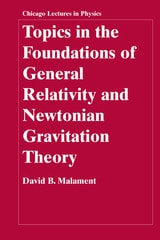
cover of Topics in the Foundations of General Relativity and Newtonian Gravitation Theory

Topics in the Foundations of General Relativity and Newtonian Gravitation Theory

David B. Malament

University of Chicago Press, 2012

In Topics in the Foundations of General Relativity and Newtonian Gravitation Theory, David B. Malament presents the basic logical-mathematical structure of general relativity and considers a number of special topics concerning the foundations of general relativity and its relation to Newtonian gravitation theory. These special topics include the geometrized formulation of Newtonian theory (also known as Newton-Cartan theory), the concept of rotation in general relativity, and Gödel spacetime. One of the highlights of the book is a no-go theorem that can be understood to show that there is no criterion of orbital rotation in general relativity that fully answers to our classical intuitions. Topics is intended for both students and researchers in mathematical physics and philosophy of science.
[more]