Results by title
16 books match the query 'Reliability'
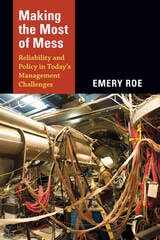
Making the Most of Mess
Reliability and Policy in Today's Management ChallengesEmery Roe
Duke University Press, 2013
Throughout, Roe focuses on the global financial mess of 2008 and its ongoing aftermath, showing how mismanagement has allowed it to morph into other national and international messes. More effective management is still possible for this and many other policy messes but that requires better recognition of patterns and formulation of scenarios, as well as the ability to translate pattern and scenario into reliability. Developing networks of professionals who respond to messes is particularly important. Roe describes how these networks enable the avoidance of bad or worse messes, take advantage of opportunities resulting from messes, and address societal and professional challenges. In addition to finance, he draws from a wide range of case material in other policy arenas. Roe demonstrates that knowing how to manage policy messes is the best approach to preventing crises.
Modern Power Electronic Devices
Physics, applications, and reliabilityFrancesco Iannuzzo
The Institution of Engineering and Technology, 2020

Offshore Wind Power
Reliability, availability and maintenancePeter Tavner
The Institution of Engineering and Technology, 2021
Offshore Wind Turbines
Reliability, availability and maintenancePeter Tavner
The Institution of Engineering and Technology, 2012

Performance, Modelling and Reliability of Photovoltaic Systems
George E. Georghiou
The Institution of Engineering and Technology, 2020
Principles of Performance Engineering for Telecommunication and Information Systems
M. Ghanbari
The Institution of Engineering and Technology, 1997
Reliability of Photovoltaic Power Systems
Saeed Peyghami
The Institution of Engineering and Technology, 2026

Reliability of Power Electronic Converter Systems
Henry Shu-hung Chung
The Institution of Engineering and Technology, 2016
Reliability of Power Electronic Converter Systems
Henry Shu-Hung Chung
The Institution of Engineering and Technology, 2025
Reliability of Power Electronics Converters for Solar Photovoltaic Applications
Ahteshamul Haque
The Institution of Engineering and Technology, 2021
Reputation
Studies in the Voluntary Elicitation of Good ConductDaniel B. Klein, Editor
University of Michigan Press, 1997
SiC Power Module Design
Performance, robustness and reliabilityAlberto Castellazzi
The Institution of Engineering and Technology, 2022
The City Electric
Infrastructure and Ingenuity in Postsocialist TanzaniaMichael Degani
Duke University Press, 2022

The Imperative of Reliability
Russian Prose on the Eve of the Novel, 1820s-1850sVictoria Somoff
Northwestern University Press, 2015
The Imperative of Reliability examines the development of nineteenth-century Russian prose and the remarkably swift emergence of the Russian novel. Victoria Somoff identifies an unprecedented situation in the production and perception of the utterance that came to define nascent novelistic fictionality both in European and Russian prose, where the utterance itself—whether an oral story or a “found” manuscript—became the object of representation within the compositional format of the frame narrative. This circumstance generated a narrative perspective from which both the events and their representation appeared as concomitant in time and space: the events did not precede their narration but rather occurred and developed along with and within the narration itself. Somoff establishes this story-discourse convergence as a major factor in enabling the transition from shorter forms of Russian prose to the full-fledged realist novel.

Trust and Trustworthiness
Russell Hardin
Russell Sage Foundation, 2002

Whom Can We Trust?
How Groups, Networks, and Institutions Make Trust PossibleKaren S. Cook
Russell Sage Foundation, 2009