Results by title
5 books match the query 'Relics'
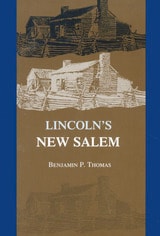
Lincoln's New Salem
Benjamin P. Thomas
Southern Illinois University Press, 1988
Thomas tells the story of the village where Abraham Lincoln lived from 1831 to 1837. His three-part examination of the village often referred to as Lincoln’s "Alma Mater" features the founding and early history of New Salem, Lincoln’s impact on the village and its effect on him, and the story of the Lincoln legend and the reconstruction of the town.
Thomas argues convincingly that New Salem was the town where Lincoln acquired faith in himself, faith in people. At 22 the future president drifted into town seeking to become a blacksmith. Thomas introduces us to the people who created New Salem and who knew, influenced, and befriended Lincoln.
Thomas highlights Lincoln’s arrival, his relationships with his neighbors, his important wrestling match with Jack Armstrong, his self-education, his quiet career as an Indian fighter, his experience as a postmaster largely indifferent to postal regulations, his financial woes as a businessman, his loyal friends who often came to his aid, and his election to the legislature.
This colorful history closes with a discussion of the Lincoln legend. The truth of the stories is unimportant. What matters is that the growing Lincoln legend prompted the gradual realization that New Salem was not a dismal mire from which President Lincoln had had to extricate himself but was, in fact, an energizing force. This realization led to research and finally to the restoration of New Salem, which began in 1932.
Relics
Travels in Nature's Time MachinePiotr Naskrecki
University of Chicago Press, 2011
On any night in early June, if you stand on the right beaches of America’s East Coast, you can travel back in time all the way to the Jurassic. For as you watch, thousands of horseshoe crabs will emerge from the foam and scuttle up the beach to their spawning grounds, as they’ve done, nearly unchanged, for more than 440 million years.
Horseshoe crabs are far from the only contemporary manifestation of Earth’s distant past, and in Relics, world-renowned zoologist and photographer Piotr Naskrecki leads readers on an unbelievable journey through those lingering traces of a lost world. With camera in hand, he travels the globe to create a words-and-pictures portrait of our planet like no other, a time-lapse tour that renders Earth’s colossal age comprehensible, visible in creatures and habitats that have persisted, nearly untouched, for hundreds of millions of years.
Naskrecki begins by defining the concept of a relic—a creature or habitat that, while acted upon by evolution, remains remarkably similar to its earliest manifestations in the fossil record. Then he pulls back the Cambrian curtain to reveal relic after eye-popping relic: katydids, ancient reptiles, horsetail ferns, majestic magnolias, and more, all depicted through stunning photographs and first-person accounts of Naskrecki’s time studying them and watching their interactions in their natural habitats. Then he turns to the habitats themselves, traveling to such remote locations as the Atewa Plateau of Africa, the highlands of Papua New Guinea, and the lush forests of the Guyana Shield of South America—a group of relatively untrammeled ecosystems that are the current end point of staggeringly long, uninterrupted histories that have made them our best entryway to understanding what the prehuman world looked, felt, sounded, and even smelled like.
The stories and images of Earth’s past assembled in Relics are beautiful, breathtaking, and unmooring, plunging the reader into the hitherto incomprehensible reaches of deep time. We emerge changed, astonished by the unbroken skein of life on Earth and attentive to the hidden heritage of our planet’s past that surrounds us.
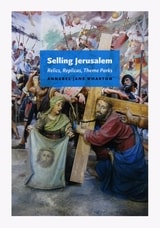
Selling Jerusalem
Relics, Replicas, Theme ParksAnnabel Jane Wharton
University of Chicago Press, 2006
From relics of the True Cross and Templar replicas of the Holy Sepulchre to Franciscan recreations of the Passion to nineteenth-century mass-produced prints and contemporary theme parks, Wharton describes the evolving forms by which the city has been possessed in the West. She also maps those changing embodiments of the Holy City against shifts in the western market. From the gift-and-barter economy of the early Middle Ages to contemporary globalization, both money and the representations of Jerusalem have become progressively incorporeal, abstract, illusionistic, and virtual.
Selling Jerusalem offers a penetrating introduction to the explosive combination of piety and capital at work in religious objects and global politics. It is sure to interest students and scholars of art history, economic history, popular culture, religion, and architecture, as well as those who want to better understand Jerusalem’s problematic place in history.
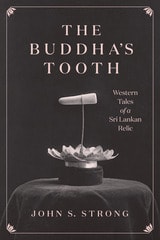
The Buddha's Tooth
Western Tales of a Sri Lankan RelicJohn S. Strong
University of Chicago Press, 2021
Bodily relics such as hairs, teeth, fingernails, pieces of bone—supposedly from the Buddha himself—have long served as objects of veneration for many Buddhists. Unsurprisingly, when Western colonial powers subjugated populations in South Asia, they used, manipulated, redefined, and even destroyed these objects to exert control.
In The Buddha’s Tooth, John S. Strong examines Western stories, from the sixteenth to the twentieth century, surrounding two significant Sri Lankan sacred objects to illuminate and concretize colonial attitudes toward Asian religions. First, he analyzes a tale about the Portuguese capture and public destruction, in the mid-sixteenth century, of a tooth later identified as a relic of the Buddha. Second, he switches gears to look at the nineteenth-century saga of British dealings with another tooth relic of the Buddha—the famous Daḷadā enshrined in a temple in Kandy—from 1815, when it was taken over by English forces, to 1954, when it was visited by Queen Elizabeth II. As Strong reveals, the stories of both the Portuguese tooth and the Kandyan tooth reflect nascent and developing Western understandings of Buddhism, realizations of the cosmopolitan nature of the tooth, and tensions between secular and religious interests.
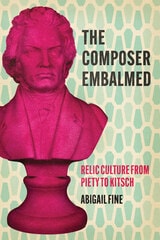
The Composer Embalmed
Relic Culture from Piety to KitschAbigail Fine
University of Chicago Press, 2025
During the nineteenth century, music institutions promoted artworks they deemed timeless and made composers into figureheads of a lasting Western canon. Alongside this institutional face of the canon was a more intimate impulse to preserve, touch, and embrace the residues of the dead. In Germany and Austria between 1870 and 1930, music lovers venerated the bodies, houses, and belongings of composers as relics, shrines, and talismans. In The Composer Embalmed, Abigail Fine documents the vernacular and eccentric ways that composers have been remembered.
Fine navigates a wealth of unknown archival material to recover the stories of devotees: from pilgrims who felt time stop in historic houses to music-loving doctors who made skulls into sacred specimens, dilettantes who displayed Beethoven’s mask as a relic of the “beautiful death,” and interwar critics of those dilettantes who disparaged piety as a false religion, a kitsch replica. In isolation, these practices may look like simple acts of affection. But in the aggregate, Fine asserts, acts of devotion constituted what we might broadly understand as relic culture—a culture that sought to possess the body of the departed genius, and that superimposed habits of anthropological collecting onto artifacts of Austro-German heritage. By excavating objects, ephemera, amateur lyric, visitors’ books, letters, and travelogues, The Composer Embalmed reveals the underbelly of the canon, where guilty pleasures blur the boundary between sanctity and desecration.