Results by title
237 books match the query 'Religion, Politics & State' and 12 start with a
A Ministry of Presence
Chaplaincy, Spiritual Care, and the LawWinnifred Fallers Sullivan
University of Chicago Press, 2014
In A Ministry of Presence, Winnifred Fallers Sullivan explores how chaplaincy works in the United States—and in particular how it sits uneasily at the intersection of law and religion, spiritual care, and government regulation. Responsible for ministering to the wandering souls of the globalized economy, the chaplain works with a clientele often unmarked by a specific religious identity, and does so on behalf of a secular institution, like a hospital. Sullivan's examination of the sometimes heroic but often deeply ambiguous work yields fascinating insights into contemporary spiritual life, the politics of religious freedom, and the never-ending negotiation of religion's place in American institutional life.
A Peaceful Conquest
Woodrow Wilson, Religion, and the New World OrderCara Lea Burnidge
University of Chicago Press, 2016
With A Peaceful Conquest, Cara Lea Burnidge presents the most detailed analysis yet of how Wilson’s religious beliefs affected his vision of American foreign policy, with repercussions that lasted into the Cold War and beyond. Framing Wilson’s intellectual development in relationship to the national religious landscape, and paying greater attention to the role of religion than in previous scholarship, Burnidge shows how Wilson’s blend of Southern evangelicalism and social Christianity became a central part of how America saw itself in the world, influencing seemingly secular policy decisions in subtle, lasting ways. Ultimately, Burnidge makes a case for Wilson’s religiosity as one of the key drivers of the emergence of the public conception of America’s unique, indispensable role in international relations.
As the presidential election cycle once again raises questions of America’s place in the world, A Peaceful Conquest offers a fascinating excavation of its little-known roots.
A Shared Future
Faith-Based Organizing for Racial Equity and Ethical DemocracyRichard L. Wood and Brad R. Fulton
University of Chicago Press, 2015
In A Shared Future, Richard L. Wood and Brad R. Fulton draw on a new national study of community organizing coalitions and in-depth interviews of key leaders in this field to show how faith-based organizing is creatively navigating the competing aspirations of America’s universalist and multiculturalist democratic ideals, even as it confronts three demons bedeviling American politics: economic inequality, federal policy paralysis, and racial inequity. With a broad view of the entire field and a distinct empirical focus on the PICO National Network, Wood and Fulton’s analysis illuminates the tensions, struggles, and deep rewards that come with pursuing racial equity within a social change organization and in society. Ultimately, A Shared Future offers a vision for how we might build a future that embodies the ethical democracy of the best American dreams.
An interview of the authors on the subject of faith leaders organizing for justice (Peace Talks Radio, copyright Good Radio Shows, Inc.) can be heard at this link: https://beta.prx.org/stories/190030
Abusing Religion
Literary Persecution, Sex Scandals, and American Minority ReligionsMegan Goodwin
Rutgers University Press, 2020
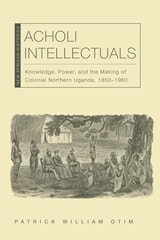
Acholi Intellectuals
Knowledge, Power, and the Making of Colonial Northern Uganda, 1850–1960Patrick William Otim
Ohio University Press, 2024
All Politics Are God’s Politics
Moroccan Islamism and the Sacralization of DemocracyAhmed Khanani
Rutgers University Press, 2021
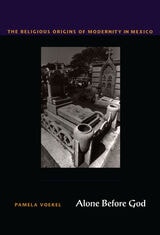
Alone Before God
The Religious Origins of Modernity in MexicoPamela Voekel
Duke University Press, 2002
Drawing on the archival research of wills, public documents, and other texts from late-colonial and early-republican Mexico, Voekel describes the marked scaling-down of the pomp and display that had characterized baroque Catholic burials and the various devices through which citizens sought to safeguard their souls in the afterlife. In lieu of these baroque practices, the new enlightened Catholics, claims Voekel, expressed a spiritually and hygienically motivated preference for extremely simple burial ceremonies, for burial outside the confines of the church building, and for leaving their earthly goods to charity. Claiming that these changes mirrored a larger shift from an external, corporate Catholicism to a more interior piety, she demonstrates how this new form of Catholicism helped to initiate a cultural and epistemic shift that placed the individual at the center of knowledge.
Breaking with the traditional historiography to argue that Mexican liberalism had deeply religious roots, Alone Before God will be of interest to specialists in Latin American history, modernity, and religion.
America's Blessings
How Religion Benefits Everyone, Including AtheistsRodney Stark
Templeton Press, 2013
A few years ago, a debate between atheists and religious believers spilled out from the halls of academia and the pews of America’s churches and into the public spotlight. A crop of atheist manifestos led the charge, surmounting and holding the tops of the nonfiction bestseller lists. This debate brought on an outpouring of religious rebuttals as both sides exchanged spirited volleys, accusations were leveled; myths, stereotypes, and strawmen arguments were perpetuated; and bitter hostility filled the air. Today many of these misconceptions and myths linger on, along with the generally acrimonious spirit of the debate.
In America’s Blessings, distinguished researcher Rodney Stark seeks to clear the air of this hostility and debunk many of the debate’s most widely perpetuated misconceptions by drawing from an expansive pool of sociological findings. Stark rises above the fray and focuses exclusively on facts by examining the measurable effects of religious faith and practice on American society. His results may surprise many atheists and believers alike.
Starting with a historical overview, Stark traces America’s religious roots from the country’s founding to the present day, showing that religiosity in America has never been consistent, static, or monolithic. Interestingly, he finds that religious practice is now more prevalent than ever in America, despite any claims to the contrary. From here, Stark devotes whole chapters to unpacking the latest research on how religion affects the different facets of modern American life, including crime, family life, sexuality, mental and physical health, sophistication, charity, and overall prosperity. The cumulative effect is that when translated into comparisons with western European nations, the United States comes out on top again and again. Thanks in no small part to America’s rich religious culture, the nation has far lower crime rates, much higher levels of charitable giving, better health, stronger marriages, and less suicide, to note only a few of the benefits.
In the final chapter, Stark assesses the financial impact of these religious realities. It turns out that belief benefits the American economy—and all 300 million citizens, believers, and nonbelievers alike—by a conservative estimate of $2.6 trillion a year. Despite the atheist outcry against religion, the remarkable conclusion is clear: all Americans, from the most religious among us to our secular neighbors, really ought to count our blessings.
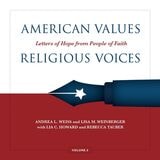
American Values, Religious Voices, Volume 2
Letters of Hope from People of FaithEdited by Andrea Weiss and Lisa Weinberger
University of Minnesota Press, 2022
In the aftermath of the 2016 presidential election, biblical scholar Andrea L. Weiss and graphic designer Lisa M. Weinberger teamed up to create Values & Voices, a national nonpartisan campaign that used letters and social media to highlight core American values connected to our diverse religious traditions. The result was American Values, Religious Voices: 100 Days, 100 Letters, a collection of one hundred letters written by some of America's most accomplished and thoughtful scholars of religion interspersed with original artwork during the first one hundred days of the Trump presidency.
In 2021, Weiss and Weinberger invited religious scholars and leaders to address President Biden, Vice President Harris, and members of the 117th Congress in their national letter writing and social media campaign. During the first 100 days of the Biden administration, religious leaders from across the country and from a range of religious denominations once again sent one letter a day to elected leaders in Washington. These letters bring an array of religious texts and teachings to bear on our most pressing contemporary issues. Arranged chronologically, the 2021 edition features 59 returning letter writers and 42 new scholars, new artwork, original essays, and and a new section focused on putting the letters into practice by using them for teaching, preaching, meditative practice, civic activism, and more. An alternate table of contents arranged by core values that emerged in the letters over the 100 days allows for thematic reading.
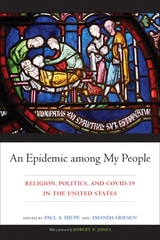
An Epidemic among My People
Religion, Politics, and COVID-19 in the United StatesEdited by Paul A. Djupe and Amanda Friesen
Temple University Press, 2023
The pandemic presented religion as a paradox: faith is often crucial for helping people weather life’s troubles and make difficult decisions, but how can religion continue to deliver these benefits and provide societal structure without social contact? The topical volume, An Epidemic among My People explains how the COVID-19 pandemic stress tested American religious communities and created a new politics of religion centered on public health.
The editors and contributorsconsider how the virus and government policy affected religion in America. Chapters examine the link between the prosperity gospel and conspiracy theories, the increased purchase of firearms by evangelicals, the politics of challenging public health orders as religious freedom claims, and the reactions of Christian nationalists, racial groups, and female clergy to the pandemic (and pandemic politics). As sharp lines were drawn between people and their governments during this uncertain time, An Epidemic among My People provides a comprehensive portrait of religion in American public life.
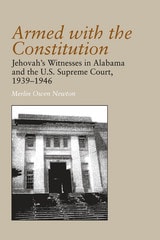
Armed with the Constitution
Jehovah's Witnesses in Alabama and the U.S Supreme Court, 1939-1946Merlin Owen Newton
University of Alabama Press, 1995
Armed with the Constitution stresses the courage of a black man, Rosco Jones, and a white woman, Grace Marsh, who dared to challenge the status quo in Alabama in the early 1940s. These two Jehovah’s Witnesses helped to lay a foundation for testing the constitutionality of state and local laws, establishing precedents that the Civil Rights movement, the feminist movement, and similar forces could follow. Newton has prepared a finely woven tale of oral, legal, and social history that opens a window on the world of the Jehovah’s Witnesses in Alabama.
More than a legal study, this book is also a dramatic history of two powerful personalities whose total commitment to their faith enabled them to carry the Jehovah’s Witnesses’ battle from rural Alabama to the halls of the U.S. Supreme Court.
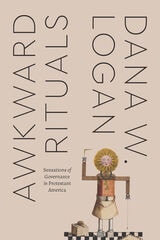
Awkward Rituals
Sensations of Governance in Protestant AmericaDana W. Logan
University of Chicago Press, 2022
In the years between the American Revolution and the Civil War, there was an awkward persistence of sovereign rituals, vestiges of a monarchical past that were not easy to shed. In Awkward Rituals, Dana Logan focuses our attention on these performances, revealing the ways in which governance in the early republic was characterized by white Protestants reenacting the hierarchical authority of a seemingly rejected king. With her unique focus on embodied action, rather than the more common focus on discourse or law, Logan makes an original contribution to debates about the relative completeness of America’s Revolution.
Awkward Rituals theorizes an under-examined form of action: rituals that do not feel natural even if they sometimes feel good. This account challenges common notions of ritual as a force that binds society and synthesizes the self. Ranging from Freemason initiations to evangelical societies to missionaries posing as sailors, Logan shows how white Protestants promoted a class-based society while simultaneously trumpeting egalitarianism. She thus redescribes ritual as a box to check, a chore to complete, an embarrassing display of theatrical verve. In Awkward Rituals, Logan emphasizes how ritual distinctively captures what does not change through revolution.