Results by title
3 books match the query 'Religion in motion pictures'
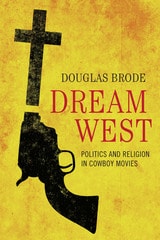
Dream West
Politics and Religion in Cowboy MoviesBy Douglas Brode
University of Texas Press, 2013
While political liberals celebrated the end of “cowboy politics” with the election of Barack Obama to the presidency, political conservatives in the Tea Party and other like-minded groups still vociferously support “cowboy” values such as small government, low taxes, free-market capitalism, and the right to bear arms. Yet, as Douglas Brode argues in this paradigm-shifting book, these supposedly cowboy or “Old West” values hail not so much from the actual American frontier of the nineteenth century as from Hollywood’s portrayal of it in the twentieth century. And a close reading of Western films and TV shows reveals a much more complex picture than the romanticized, simplistic vision espoused by the conservative right.
Examining dozens of Westerns, including Gunfight at the O.K. Corral, Red River, 3:10 to Yuma (old and new), The Wild Ones, High Noon, My Darling Clementine, The Alamo, and No Country for Old Men, Brode demonstrates that the genre (with notable exceptions that he fully covers) was the product of Hollywood liberals who used it to project a progressive agenda on issues such as gun control, environmental protection, respect for non-Christian belief systems, and community cohesion versus rugged individualism. Challenging us to rethink everything we thought we knew about the genre, Brode argues that the Western stands for precisely the opposite of what most people today—whether they love it or hate it—believe to be the essential premise of “the only truly, authentically, and uniquely American narrative form.”
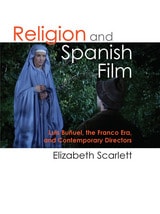
Religion and Spanish Film
Luis Buñuel, the Franco Era, and Contemporary DirectorsElizabeth Scarlett
University of Michigan Press, 2014
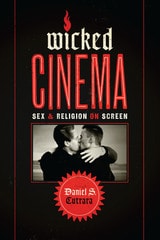
Wicked Cinema
Sex and Religion on ScreenBy Daniel Cutrara
University of Texas Press, 2014
From struggles over identity politics in the 1990s to current concerns about a clash of civilizations between Islam and Christianity, culture wars play a prominent role in the twenty-first century. Movies help to define and drive these conflicts by both reflecting and shaping cultural norms, as well as showing what violates those norms. In this pathfinding book, Daniel S. Cutrara employs queer theory, cultural studies, theological studies, and film studies to investigate how cinema represents and often denigrates religion and religious believers—an issue that has received little attention in film studies, despite the fact that faith in its varied manifestations is at the heart of so many cultural conflicts today.
Wicked Cinema examines films from the United States, Europe, and the Middle East, including Crimes and Misdemeanors, The Circle, Breaking the Waves, Closed Doors, Agnes of God, Priest, The Last Temptation of Christ, and Dogma. Central to all of the films is their protagonists’ struggles with sexual transgression and traditional belief systems within Christianity, Judaism, or Islam—a struggle, Cutrara argues, that positions believers as the Other and magnifies the abuses of religion while ignoring its positive aspects. Uncovering a hazardous web of ideological assumptions informed by patriarchy, the spirit/flesh dichotomy, and heteronormativity, Cutrara demonstrates that ultimately these films emphasize the “Otherness” of the faithful through a variety of strategies commonly used to denigrate the queer, from erasing their existence, to using feminization to make them appear weak, to presenting them as dangerous fanatics.