Results by title
2 books match the query 'Religious Origins'
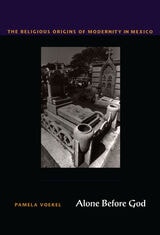
Alone Before God
The Religious Origins of Modernity in MexicoPamela Voekel
Duke University Press, 2002
Focusing on cemetery burials in late-eighteenth-century Mexico, Alone Before God provides a window onto the contested origins of modernity in Mexico. By investigating the religious and political debates surrounding the initiative to transfer the burials of prominent citizens from urban to suburban cemeteries, Pamela Voekel challenges the characterization of Catholicism in Mexico as an intractable and monolithic institution that had to be forcibly dragged into the modern world.
Drawing on the archival research of wills, public documents, and other texts from late-colonial and early-republican Mexico, Voekel describes the marked scaling-down of the pomp and display that had characterized baroque Catholic burials and the various devices through which citizens sought to safeguard their souls in the afterlife. In lieu of these baroque practices, the new enlightened Catholics, claims Voekel, expressed a spiritually and hygienically motivated preference for extremely simple burial ceremonies, for burial outside the confines of the church building, and for leaving their earthly goods to charity. Claiming that these changes mirrored a larger shift from an external, corporate Catholicism to a more interior piety, she demonstrates how this new form of Catholicism helped to initiate a cultural and epistemic shift that placed the individual at the center of knowledge.
Breaking with the traditional historiography to argue that Mexican liberalism had deeply religious roots, Alone Before God will be of interest to specialists in Latin American history, modernity, and religion.
[more]
Islamists in a Zionist Coalition
The Political and Religious OriginsUriya Shavit
Rutgers University Press, 2025
Islamists in a Zionist Coalition: The Political and Religious Origins explores the decision made in 2021 by the United Arab List, the political arm of the Southern Branch of the Islamic Movement in Israel (SIM), to join the Israeli Zionist coalition for the first time, and specifically how and why it was possible for an Islamist movement to become the enabler of a Zionist government without losing the support of its religious scholars or political base. Through analyses of hundreds of books, columns, fatwas, media interviews, and posts on social media, as well as interviews conducted by the author with all the living leaders of the SIM and the United Arab List, Uriya Shavit demonstrates that the Islamic premises on which the SIM operates, rather than limit the party's flexibility, made it possible for the United Arab List to advance a pragmatic political agenda. This book argues that while the decision of the United Arab List to join a Zionist coalition led to dramatic consequences, it was grounded in decades of religious writings that prepared the ground for its legitimization, and aligned with a political orientation with which significant segments of the Arab population identified since the founding of the modern state of Israel.
[more]