Results by title
2 books match the query 'Religious awakening'
Seeing the Light
The Social Logic of Personal DiscoveryThomas DeGloma
University of Chicago Press, 2014
In Seeing the Light, Thomas DeGloma explores such accounts of personal awakening, in stories that range from the discovery of a religious truth to remembering a childhood trauma to embracing a new sexual orientation. He reveals a common social pattern: When people discover a life-changing truth, they typically ally with a new community. Individuals then use these autobiographical stories to shape their stances on highly controversial issues such as childhood abuse, war and patriotism, political ideology, human sexuality, and religion. Thus, while such stories are seemingly very personal, they also have a distinctly social nature. Tracing a wide variety of narratives through nearly three thousand years of history, Seeing the Light uncovers the common threads of such stories and reveals the crucial, little-recognized social logic of personal discovery.
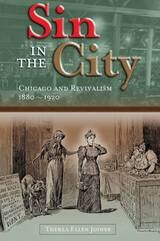
Sin in the City
Chicago and Revivalism, 1880-1920Thekla Ellen Joiner
University of Missouri Press, 2013
Long before today’s culture wars, the “Third Great Awakening” rocked America. During the late nineteenth and early twentieth centuries, evangelists such as Dwight L. Moody and Billy Sunday roused citizens to renounce sin as it manifested in popular culture, moral ambiguity, and the changing role of women.
Sin in the City examines three urban revivals in turn-of-the-century Chicago to show how revivalists negotiated that era’s perceived racial, sexual, and class threats. While most studies of this movement have focused on its male leaders and their interactions with society, Thekla Ellen Joiner raises new questions about gender and race by exploring Third Awakening revivalism as the ritualized performance of an evangelical social system defined by middle-class Protestant moral aspirations for urban America. Rather than approaching these events merely as the achievements of persuasive men, she views them as choreographed collective rituals reinforcing a moral order defined by ideals of femininity, masculinity, and racial purity.
Joiner reveals how revivalist rhetoric and ritual shifted from sentimentalist identification of sin with males to a more hard-nosed focus on females, castigating “loose women” whose economic and sexual independence defied revivalist ideals and its civic culture. She focuses on Dwight L. Moody’s 1893 World’s Fair revival, the 1910 Chapman-Alexander campaign, and the 1918 Billy Sunday revival, comparing the locations, organization, messages, and leaders of these three events to depict the shift from masculinized to feminized sin. She identifies the central role women played in the Third Awakening as the revivalists promoted feminine virtue as the corrective to America’s urban decline. She also shows that even as its definition of sin became more feminized, Billy Sunday’s revivalism began to conform to Chicago’s emerging color line.
Enraged by rapid social change in cities like Chicago, these preachers spurred Protestant evangelicals to formulate a gendered and racialized moral regime for urban America. Yet, as Joiner shows, even as revivalists demonized new forms of entertainment, they used many of the modern cultural practices popularized in theaters and nickelodeons to boost the success of their mass conversions.
Sin in the City shows that the legacy of the Third Awakening lives on today in the religious right’s sociopolitical activism; crusade for family values; disparagement of feminism; and promotion of spirituality in middle-class, racial, and cultural terms. Providing cultural and gender analysis too often lacking in the study of American religious history, it offers a new model for understanding the development of a gendered theology and set of religious practices that influenced Protestantism in a period of enormous social change.