Results by title
4 books match the query 'Religious communities'
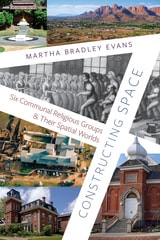
Constructing Space
Six Communal Religious Groups and Their Spatial WorldsMartha Bradley Evans
University of Utah Press, 2025
Worldviews and experiences of place among noted religious communities
Religion transforms and inspires specific ways of living in the world. Through architecture and the built environment, members of religious communities communicate intangible beliefs about God, gender and family, the sacred and profane, and more. This captivating volume explores the spatial worlds of six different religious communities— the Latter-day Saints, the Oneida Colony, the Shakers, the Branch Davidians, the FLDS, and Adidam—through the architecture and cultural landscapes they built.
What does the strict order and regularity of a Shaker village tell us about the community’s hierarchies and relationships? How might a temple building site affect an LDS Church member’s daily life? Constructing Space reveals the hidden language of meaning, association, and identity that religious persons speak as they mold their faith into concrete forms, and how they interpret the meanings of those spaces within their practices.
[more]
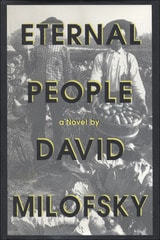
Eternal People
A NovelDavid Milofsky
University Press of Colorado, 1998
<i>Eternal People,/i> tells the story of Joseph Abrams, a Ukrainian Jew who finds his way to America at the end of the nineteenth-century. During a break from his studies in Russia, he returns to his shtetl in the Ukraine to find it is the target of a Cos
[more]
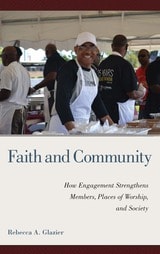
Faith and Community
How Engagement Strengthens Members, Places of Worship, and SocietyRebecca A. Glazier
Temple University Press, 2024
Places of worship are important anchor institutions in communities, helping to create social capital through discussion groups, soup kitchens, and neighborhood clean-ups. While congregations face increasing pressures, from declining attendance to political polarization, community engagement is an overall positive for their members and for democracy.
Faith and Community shows the benefits of religious people taking action in their communities. Through more than a decade of multi-method data collection, Rebecca Glazier surveyed over 4,000 congregants and nearly 500 clergy in Little Rock, Arkansas to gather opinions from members and leaders on community issues and engagement. Together with interviews and case studies, her findings indicate that active congregants are happier and more civically involved.
Faith and Community provides valuable insights into the relationship between religion and community engagement. The data illustrates how community engagement benefits individuals, congregations, and democracy and offers one solution to what ails religion in America today.
[more]
Gatherings In Diaspora
Religious Communities and the New Immigrationedited by Stephen R. Warner and Judith G. Wittner
Temple University Press, 1998
Gatherings in Diaspora brings together the latest chapters in the long-running chronicle of religion and immigration in the American experience. Today, as in the past, people migrating to the United States bring their religions with them, and their religious identities often mean more to them away from home, in their diaspora, than they did before.
This book explores and analyzes the diverse religious communities of post-1965 diasporas: Christians, Hews, Muslims, Hindus, Rastafarians, and practitioners of Vodou, from countries such as China, Guatemala, Haiti, India, Iran, Jamaica, Korea, and Mexico. The contributors explore how, to a greater or lesser extent, immigrants and their offspring adapt their religious institutions to American conditions, often interacting with religious communities already established. The religious institutions they build, adapt, remodel, and adopt become worlds unto themselves, congregations, where new relations are forged within the community -- between men and women, parents and children, recent arrival and those longer settled.
This book explores and analyzes the diverse religious communities of post-1965 diasporas: Christians, Hews, Muslims, Hindus, Rastafarians, and practitioners of Vodou, from countries such as China, Guatemala, Haiti, India, Iran, Jamaica, Korea, and Mexico. The contributors explore how, to a greater or lesser extent, immigrants and their offspring adapt their religious institutions to American conditions, often interacting with religious communities already established. The religious institutions they build, adapt, remodel, and adopt become worlds unto themselves, congregations, where new relations are forged within the community -- between men and women, parents and children, recent arrival and those longer settled.
[more]