Results by title
6 books match the query 'Religious identity'
Beyond Betrayal
The Priest Sex Abuse Crisis, the Voice of the Faithful, and the Process of Collective IdentityPatricia Ewick and Marc W. Steinberg
University of Chicago Press, 2019
In 2002, the national spotlight fell on Boston’s archdiocese, where decades of rampant sexual misconduct from priests—and the church’s systematic cover-ups—were exposed by reporters from the Boston Globe. The sordid and tragic stories of abuse and secrecy led many to leave the church outright and others to rekindle their faith and deny any suggestions of institutional wrongdoing. But a number of Catholics vowed to find a middle ground between these two extremes: keeping their faith while simultaneously working to change the church for the better.
Beyond Betrayal charts a nationwide identity shift through the story of one chapter of Voice of the Faithful (VOTF), an organization founded in the scandal’s aftermath. VOTF had three goals: helping survivors of abuse; supporting priests who were either innocent or took risky public stands against the wrongdoers; and pursuing a broad set of structural changes in the church. Patricia Ewick and Marc W. Steinberg follow two years in the life of one of the longest-lived and most active chapters of VOTF, whose thwarted early efforts at ecclesiastical reform led them to realize that before they could change the Catholic Church, they had to change themselves. The shaping of their collective identity is at the heart of Beyond Betrayal, an ethnographic portrait of how one group reimagined their place within an institutional order and forged new ideas of faith in the wake of widespread distrust.
Beyond Betrayal charts a nationwide identity shift through the story of one chapter of Voice of the Faithful (VOTF), an organization founded in the scandal’s aftermath. VOTF had three goals: helping survivors of abuse; supporting priests who were either innocent or took risky public stands against the wrongdoers; and pursuing a broad set of structural changes in the church. Patricia Ewick and Marc W. Steinberg follow two years in the life of one of the longest-lived and most active chapters of VOTF, whose thwarted early efforts at ecclesiastical reform led them to realize that before they could change the Catholic Church, they had to change themselves. The shaping of their collective identity is at the heart of Beyond Betrayal, an ethnographic portrait of how one group reimagined their place within an institutional order and forged new ideas of faith in the wake of widespread distrust.
[more]
Guarded by Two Jaguars
A Catholic Parish Divided by Language and FaithEric Hoenes del Pinal
University of Arizona Press, 2022
In communities in and around Cobán, Guatemala, a small but steadily growing number of members of the Q’eqchi’ Maya Roman Catholic parish of San Felipe began self-identifying as members of the Catholic Charismatic Renewal. Their communities dramatically split as mainstream and charismatic Catholic parishioners who had been co-congregants came to view each other as religiously distinct and problematic “others.”
In Guarded by Two Jaguars, Eric Hoenes del Pinal tells the story of this dramatic split and in so doing addresses the role that language and gesture have played in the construction of religious identity. Drawing on a range of methods from linguistic and cultural anthropology, the author examines how the introduction of the Catholic Charismatic Renewal movement in the parish produced a series of debates between parishioners that illustrate the fundamentally polyvocal nature of Catholic Christianity. This work examines how intergroup differences are produced through dialogue, contestation, and critique. It shows how people’s religious affiliations are articulated not in isolation but through interaction with each other.
Although members of these two congregations are otherwise socially similar, their distinct interpretations of how to be a “good Catholic” led them to adopt significantly different norms of verbal and nonverbal communication. These differences became the idiom through which the two groups contested the meaning of being Catholic and Indigenous in contemporary Guatemala, addressing larger questions about social and religious change.
[more]
Intimate Geopolitics
Love, Territory, and the Future on India’s Northern ThresholdSara Smith
Rutgers University Press, 2020
Winner of the 2021 Julian Minghi Distinguished Book Award from the American Association of Geographers
2021 Foreword Indies Finalist - Politics and Social Sciences
Intimate Geopolitics begins with a love story set in the Himalayan region of Ladakh, in India’s Jammu and Kashmir State, but this is also a story about territory, and the ways that love, marriage, and young people are caught up in contemporary global processes. In Ladakh, children grow up to adopt a religious identity in part to be counted in the census, and to vote in elections. Religion, population, and voting blocs are implicitly tied to territorial sovereignty and marriage across religious boundaries becomes a geopolitical problem in an area that seeks to define insiders and outsiders in relation to borders and national identity. This book populates territory, a conventionally abstract rendering of space, with the stories of those who live through territorial struggle at marriage and birth ceremonies, in the kitchen and in the bazaar, in heartbreak and in joy. Intimate Geopolitics argues for the incorporation of the role of time–temporality–into our understanding of territory.
[more]
Obeah, Orisa, and Religious Identity in Trinidad, Volume I, Obeah
Africans in the White Colonial Imagination, Volume 1Tracey E. Hucks
Duke University Press, 2022
Obeah, Orisa, and Religious Identity in Trinidad is an expansive two-volume examination of social imaginaries concerning Obeah and Yoruba-Orisa from colonialism to the present. Analyzing their entangled histories and systems of devotion, Tracey E. Hucks and Dianne M. Stewart articulate how these religions were criminalized during slavery and colonialism yet still demonstrated autonomous modes of expression and self-defense. In Volume I, Obeah, Hucks traces the history of African religious repression in colonial Trinidad through the late nineteenth century. Drawing on sources ranging from colonial records, laws, and legal transcripts to travel diaries, literary fiction, and written correspondence, she documents the persecution and violent penalization of African religious practices encoded under the legal classification of “obeah.” A cult of antiblack fixation emerged as white settlers defined themselves in opposition to Obeah, which they imagined as terrifying African witchcraft. These preoccupations revealed the fears that bound whites to one another. At the same time, persons accused of obeah sought legal vindication and marshaled their own spiritual and medicinal technologies to fortify the cultural heritages, religious identities, and life systems of African-diasporic communities in Trinidad.
[more]
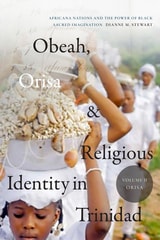
Obeah, Orisa, and Religious Identity in Trinidad, Volume II, Orisa
Africana Nations and the Power of Black Sacred Imagination, Volume 2Dianne M. Stewart
Duke University Press, 2022
Obeah, Orisa, and Religious Identity in Trinidad is an expansive two-volume examination of social imaginaries concerning Obeah and Yoruba-Orisa from colonialism to the present. Analyzing their entangled histories and systems of devotion, Tracey E. Hucks and Dianne M. Stewart articulate how these religions were criminalized during slavery and colonialism yet still demonstrated autonomous modes of expression and self-defense. In Volume II, Orisa, Stewart scrutinizes the West African heritage and religious imagination of Yoruba-Orisa devotees in Trinidad from the mid-nineteenth century to the present and explores their meaning-making traditions in the wake of slavery and colonialism. She investigates the pivotal periods of nineteenth-century liberated African resettlement, the twentieth-century Black Power movement, and subsequent campaigns for the civil right to religious freedom in Trinidad. Disrupting syncretism frameworks, Stewart probes the salience of Africa as a religious symbol and the prominence of Africana nations and religious nationalisms in projects of black belonging and identity formation, including those of Orisa mothers. Contributing to global womanist thought and activism, Yoruba-Orisa spiritual mothers disclose the fullness of the black religious imagination’s affective, hermeneutic, and political capacities.
[more]

What Happened to Notre Dame?
Charles E. Rice
St. Augustine's Press, 2009
[more]