Results by title
119 books match the query 'Religious life and customs' and 6 start with a
A Monastery in Time
The Making of Mongolian BuddhismCaroline Humphrey and Hurelbaatar Ujeed
University of Chicago Press, 2013
A Particular Place
Urban Restructuring and Religious Ecology in a Southern ExurbEiesland, Nancy L
Rutgers University Press, 2000
A Particular Place tells the story of the dramatic changes that take place in the religious lives of a community faced with urban restructuring—in this case, Dacula, Georgia, a once-quiet small town on the outskirts of Atlanta. The demographics of Dacula were changed dramatically by the population inflow, service sector development, and housing expansion brought on by the growing metropolis.
Nancy L. Eiesland provides a qualitative study of how the local religious congregations altered themselves, their relations with one another, and—over time—their community in light of this disruption to their social order. Eiesland accounts for these changes by examining the lives of area newcomers and long-time residents, discussing the responses of locals to the emergence of a megachurch in their community, investigating the wrenching processes of congregational birth and deaths, and studying responses to community conflicts.Applying population ecology approaches to the study of religious organizations within their local contexts, A Particular Place addresses together two types of restructuring that are often mutually implicated—urban and religious restructuring. This book demonstrates all that can be learned from studious attention to a particular place.
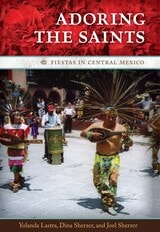
Adoring the Saints
Fiestas in Central MexicoBy Yolanda Lastra, Dina Sherzer, and Joel Sherzer
University of Texas Press, 2009
Mexico is famous for spectacular fiestas that embody its heart and soul. An expression of the cult of the saint, patron saint fiestas are the centerpiece of Mexican popular religion and of great importance to the lives and cultures of people and communities. These fiestas have their own language, objects, belief systems, and practices. They link Mexico's past and present, its indigenous and European populations, and its local and global relations.
This work provides a comprehensive study of two intimately linked patron saint fiestas in the state of Guanajuato, near San Miguel de Allende—the fiesta of the village of Cruz del Palmar and that of the town of San Luis de la Paz. These two fiestas are related to one another in very special ways involving both religious practices and their respective pre-Hispanic origins.
A mixture of secular and sacred, patron saint fiestas are multi-day affairs that include many events, ritual specialists, and performers, with the participation of the entire community. Fiestas take place in order to honor the saints, and they are the occasion for religious ceremonies, processions, musical performances, dances, and dance dramas. They feature spectacular costumes, enormous puppets, masked and cross-dressed individuals, dazzling fireworks, rodeos, food stands, competitions, and public dances. By encompassing all of these events and performances, this work displays the essence of Mexico, a lens through which this country's complex history, religion, ethnic mix, traditions, and magic can be viewed.
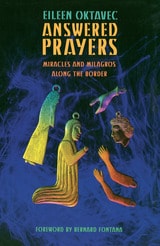
Answered Prayers
Miracles and Milagros along the BorderEileen Oktavec
University of Arizona Press, 1995
In Answered Prayers, the Mexicans, Mexican Americans, Tohono O'odham, and Yaquis who practice this tradition share their stories of unwavering faith and divine intervention. Anthropologist and photographer Eileen Oktavec has spent more than two decades documenting this fascinating tradition in the Arizona-Mexico borderlands. Quoting extensive interviews, she explains the beliefs of the people who perform this ancient folk ritual and the many rules guiding this practice. She also describes the many places where milagros are offered—from the elaborate Mexican baroque Mission San Xavier near Tucson, Arizona, to tiny household shrines and hospitals on both sides of the border. Oktavec also explains how milagros are made, where they are bought, and how they are used in jewelry, sculpture, and art.

Appalachian Mountain Religion
A HISTORYDeborah Vansau McCauley
University of Illinois Press, 1995
Appalachian Mountain Religion is much more than a narrowly focused look at the religion of a region. Within this largest regional and widely diverse religious tradition can be found the strings that tie it to all of American religious history. The fierce drama between American Protestantism and Appalachian mountain religion has been played out for nearly two hundred years; the struggle between piety and reason, between the heart and the head, has echoes reaching back even further--from Continental Pietism and the Scots-Irish of western Scotland and Ulster to Colonial Baptist revival culture and plain-folk camp-meeting religion. Deborah Vansau McCauley places Appalachian mountain religion squarely at the center of American religious history, depicting the interaction and dramatic conflicts between it and the denominations that comprise the Protestant "mainstream." She clarifies the tradition histories and symbol systems of the area's principally oral religious culture, its worship practices and beliefs, further illuminating the clash between mountain religion and the "dominant religious culture" of the United States. This clash has helped to shape the course of American religious history.
The explorations in Appalachian Mountain Religion range from Puritan theology to liberation theology, from Calvinism to the Holiness-Pentecostal movements. Within that wide realm and in the ongoing contention over religious values, the many strains of American religious history can be heard.
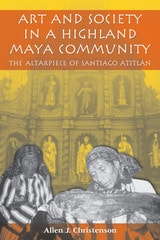
Art and Society in a Highland Maya Community
The Altarpiece of Santiago AtitlánBy Allen J. Christenson
University of Texas Press, 2001